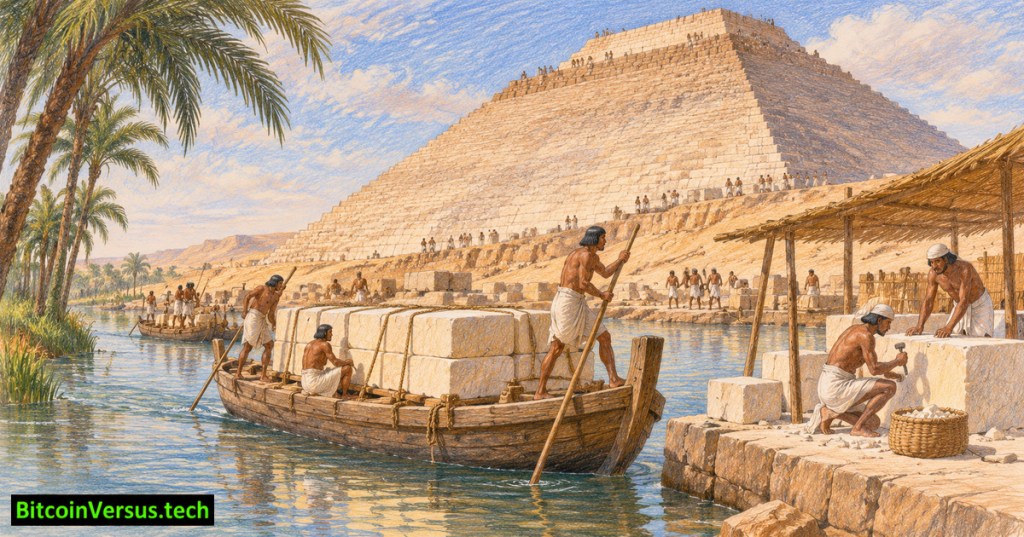
OSHE.007 follows ancient Egypt’s transition from experimental large pyramids to Khufu’s Great Pyramid at Giza. The engineering challenge went well beyond stacking masonry: royal officials had to procure limestone, coordinate boat journeys, supply workers and manage a vast construction site. Archaeological settlements and a surviving Egyptian work log provide evidence of those operations. Yet the precise method used to raise every block remains debated, and documentary evidence should not be confused with a complete building manual.
From Sneferu’s pyramids to Khufu’s project
Khufu ruled after Sneferu, whose monuments document major changes in Egyptian stone construction. OSHE.006 covers the Red Pyramid, while OSHE.005 examines the Bent Pyramid’s changing angle. OSHE.004 explains the Meidum Pyramid. Those monuments establish a meaningful technical sequence, although no single surviving text explains every design decision. Earlier OSHMS.003 on copper metallurgy supplies materials context for ancient stoneworking tools.
Khufu’s pyramid used a local limestone core and fine limestone from the Tura quarries for much of its outer casing. The remarkable surviving evidence concerns transport. An Egyptian team’s account records repeated trips associated with moving quarried stone toward Akhet-Khufu, the name of the pyramid complex.
Merer’s diary is a logistics document
Excavators discovered the Wadi el-Jarf papyri at a Red Sea harbor. Among them were daily records associated with an inspector named Merer. The Institut français d’archéologie orientale’s published English translation describes workers loading stone at Tura, sailing toward Akhet-Khufu and stopping at waterways identified by names connected to Khufu. Entries also mention work on a dyke and provisioning. The precise dates of some fragments are reconstructed, so the log should be read with its editorial brackets and uncertainties.
Crucially, the editors explain that the papyri do not specify the techniques for lifting masonry up the pyramid. The documents establish important aspects of organization and river transport; they cannot independently prove a straight ramp, spiral ramp, lever-based system or any other complete lifting scheme. Archaeological interpretations must remain separate from what the Egyptian scribe actually recorded.
A construction site needed a working town
The Ancient Egypt Research Associates’ excavations at Heit el-Ghurab identify the remains of a major settlement associated with pyramid-building administration, labor and provisioning. Excavated buildings and food-related evidence help researchers investigate how workers were housed, supplied and organized. The settlement includes occupational phases connected to more than one Giza royal project; archaeologists must not automatically assign every structure to Khufu’s reign.
The work log and excavated settlement illuminate different parts of an engineering system. One documents transport schedules; the other supplies physical traces of storage, accommodation and food production. Harvard’s Digital Giza project preserves additional site records useful for comparing claims with the archaeological record.
A simple exercise in barge displacement
Suppose, purely as a teaching example, a boat carried ten limestone blocks of 2,000 kilograms each. The payload would be 20,000 kilograms. By Archimedes’ principle, supporting that added payload in fresh water requires roughly 20 cubic meters of additional displaced water, using a water density of approximately 1,000 kilograms per cubic meter. The vessel’s own mass, freeboard, hull shape and safety limits must also be considered. No capacity for Merer’s actual boats can be deduced from the calculation.
What remains unsettled
Researchers continue to investigate quarry work, surveying, haulage paths, waterfront geography and lifting techniques. AERA’s fieldwork summaries describe ongoing study of the plateau and builders’ marks. An appealing illustration of a completed construction sequence is not the same as a measured archaeological reconstruction; the cover accompanying the lesson is an artistic interpretation, not a map of the ancient harbor.
Learning takeaway: the Great Pyramid was an engineering and administrative undertaking involving quarrying, transport, labor and supplies. Merer’s papyri establish a direct connection between Tura limestone shipments and Khufu’s project, while archaeology reveals parts of the supporting workforce system. When examining a proposed construction method, ask whether the cited evidence describes the operation itself, supports only part of it, or remains hypothetical.


Leave a Reply