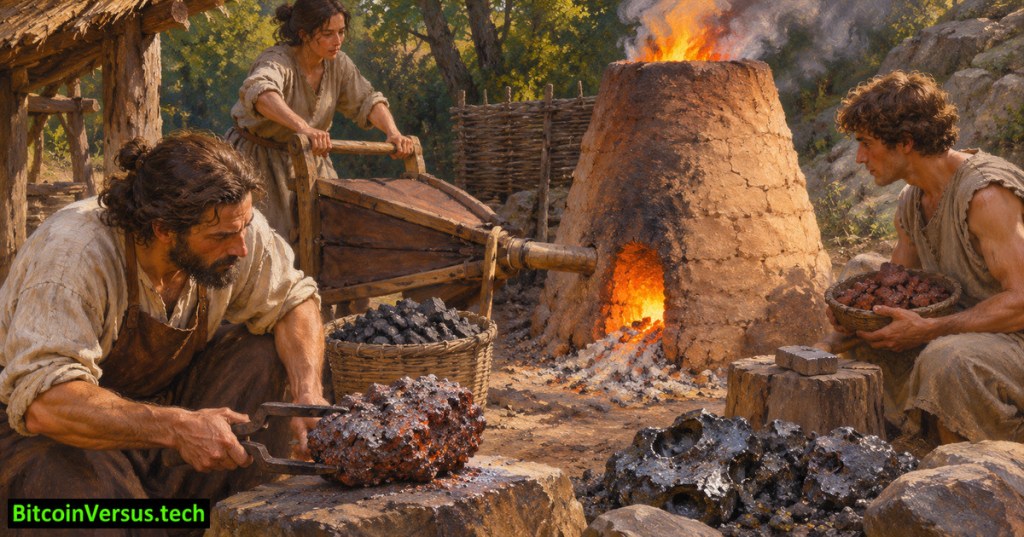
OSHMS.005 follows OSHMS.004 on early bronze and iron. Ironworking presented a demanding engineering problem: extracting metallic iron from ore without simply melting a charge into liquid metal. Ancient bloomery furnaces used charcoal, air, and carefully managed heat to form a porous mass called an iron bloom. Archaeology and modern reconstruction reveal how the process worked, while leaving room for regional differences.
Objectives and prerequisites
- Define bloomery, reduction, tuyere, slag, and bloom.
- Explain the roles of charcoal, controlled airflow, and iron oxide.
- Distinguish bloomery iron from liquid cast iron.
- Interpret experimental evidence without treating a reconstruction as a universal ancient recipe.
Prerequisites: elementary oxidation-reduction chemistry and OSHMS.003 on copper-ore reduction. No furnace, tools, or live-fire equipment are required.
Why the iron stayed solid
Iron oxide contains iron chemically bound to oxygen. At furnace temperatures, carbon monoxide generated from charcoal can remove oxygen. For hematite, a simplified overall reaction is Fe₂O₃ + 3CO → 2Fe + 3CO₂. Real ore may contain several minerals, and reduction occurs through successive reactions. Combustion produces the heat, while the furnace atmosphere governs whether oxides can be reduced.
Many reconstructed bloomeries operated around 1,200°C, below pure iron’s approximately 1,535°C melting point. Metallic iron therefore accumulated as a hot, porous bloom rather than a pool of liquid iron. Some gangue minerals and unreduced iron compounds formed a fluid slag, which could collect or be tapped. See the peer-reviewed archaeometallurgy analysis in Archaeometry.
How a bloomery worked
- Prepare ore: identify an iron-bearing source; selected historical techniques roasted and crushed ore before charging.
- Build a furnace: clay walls enclosed the fuel and ore. A tuyere delivered bellows-driven air into the hot zone.
- Charge and reduce: charcoal supplied heat and reducing gases while ore descended through changing temperatures and atmospheres.
- Manage slag: molten waste separated from the developing bloom, sometimes drained through a tapping opening.
- Extract and consolidate: the solid iron-and-slag mass was removed, reheated, and hammered to compact metal and expel some inclusions.
A documented EXARC experimental-archaeology reconstruction in Hungary describes a particular furnace run using about 20 kg of roasted bog ore and 30 kg of charcoal over 10–12 hours. Those quantities document one experimental method, not a standard yield, efficiency, or ancient operating specification.
What historians can measure
Furnace remains, tuyere fragments, ore residues, slag, and microscopic metal structures help identify past techniques. Slag composition can reveal information about ore sources and furnace conditions, but an isolated slag sample cannot establish the precise fuel consumption or skill of its operators. Researchers compare excavated materials with controlled smelting experiments. Unlike OSHMS.001 on early pottery, metallurgy requires chemical reduction as well as heat management.
Comparison: bloomery and blast-furnace iron
| Feature | Bloomery | Blast furnace |
|---|---|---|
| Primary iron product | Porous, largely solid bloom | Liquid, carbon-rich iron |
| Next processing step | Consolidation and forging | Refining, casting, or further processing |
| Typical evidence | Blooms, slag, hearths, tuyeres | Furnace structures, slag, cast iron |
Historical practices varied across regions and centuries. The emergence of cast-iron technology also followed different timelines across Eurasia; avoid treating European developments as a global chronology.
Practice exercise and answer key
Exercise: In a paper model, label iron ore, charcoal, incoming air, carbon monoxide, bloom, and slag. Then explain why a liquid slag stream does not demonstrate molten iron.
Answer: Ore provides iron oxides; charcoal supplies heat and carbon-bearing gases; injected air sustains combustion; carbon monoxide reduces iron oxides; the bloom gathers solid metal; and slag carries some unwanted material away. Slag and iron have different phase behavior and composition.
Question: Why hammer the bloom? Answer: Reheating and working consolidate loosely bonded iron and expel some entrained slag. A visually metallic lump is not necessarily a serviceable finished bar.
Safety, sources, and course progression
A bloomery emits extreme heat and potentially lethal carbon monoxide. Ancient-smelting experiments belong to trained specialists using appropriate ventilation, fire controls, and site authorization. Learners should use photographs, source materials, and calculations rather than attempting a furnace build. Continue with OSHMS.002 on early pyrotechnology and the University of Sheffield experiment report.
We volunteer daily to ensure the credibility of the information on this platform is Verifiably True. If you would like to support to help further secure the integrity of our research initiative, please scan the QR code below.



Leave a Reply