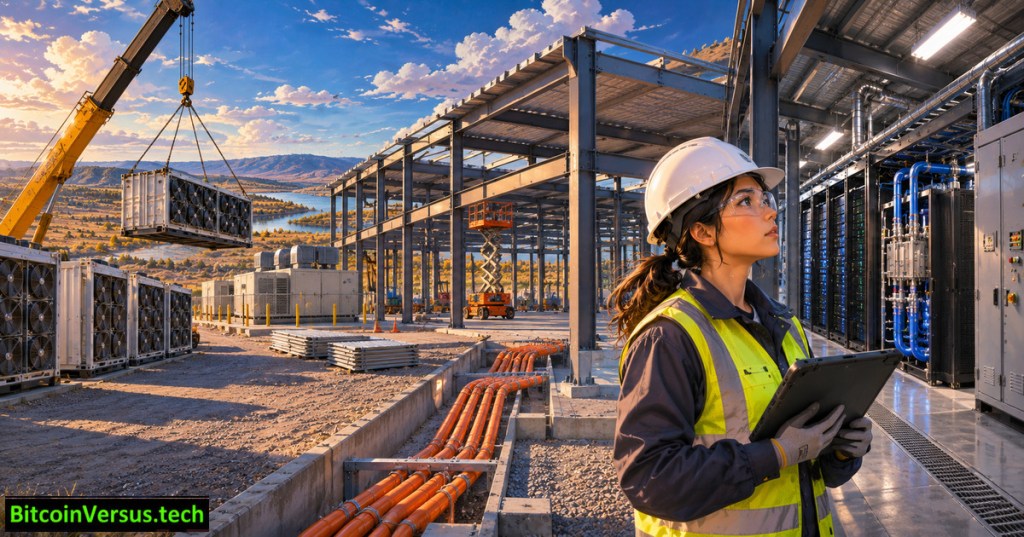
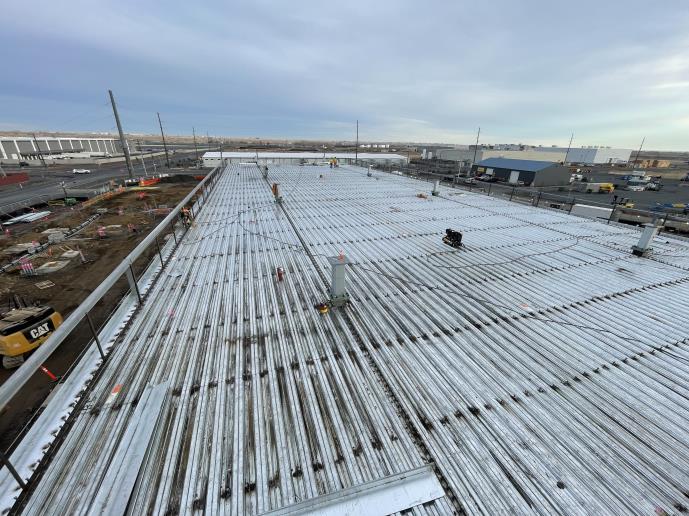
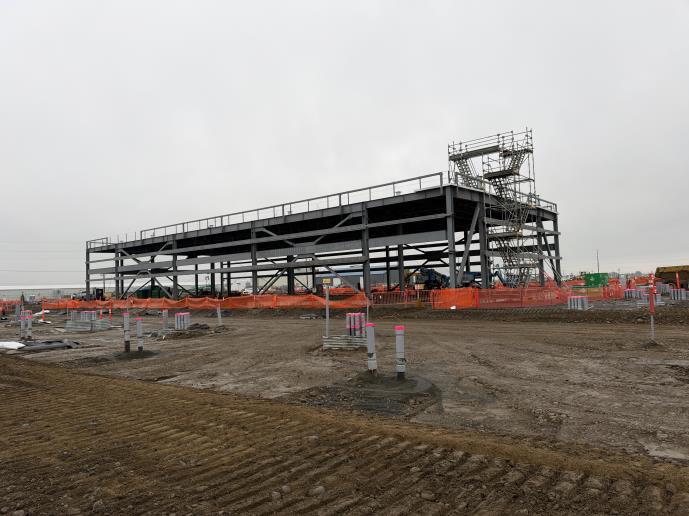
The old Bitcoin mining buildings at Moses Lake, Washington, are being replaced by a new kind of computing infrastructure. Keel Infrastructure, formerly Bitfarms, has published construction photographs dated November 10 and 13, 2026 showing an emerging steel-framed data hall, electrical-yard conduit stub-ups and roof decking. The company is converting its former 18 MW Bitcoin operation into an AI and high-performance computing facility. Actual construction is underway; an energized AI data hall is not yet operating.
Keel Infrastructure’s official September 2026 overview of its digital-power strategy; background presentation, not live November construction footage. Watch on YouTube.
What 18 MW really means
Keel lists 18 MW of energized electrical capacity across a six-acre campus, supplied through established regional infrastructure. The site stopped Bitcoin mining on April 28, 2026, and Keel says construction of its replacement data center began in September. Its November 5 results expect the property to become Keel’s first energized HPC site and begin generating HPC revenue in 2027. The schedule remains a management forecast, not confirmed commissioning.
Gross electrical capacity is not the same as usable computing power. Transformers, cooling equipment, pumps, network devices and electrical losses consume some of the incoming watts. For illustration, at a power usage effectiveness (PUE) of 1.2, an 18 MW gross-power facility could deliver about 15 MW of IT load. A PUE of 1.3 would leave approximately 13.8 MW. The examples are calculations, not Keel’s published critical-IT capacity or an achieved efficiency measurement.
From air-cooled ASICs to liquid-cooled AI racks
Keel’s project page describes NVIDIA GB300 as its reference architecture; the latest corporate update describes an optional engineering path to the Vera Rubin platform. Neither statement establishes ordered, delivered or operating GPU racks. An earlier design presentation targeted liquid cooling and rack power densities as high as 190 kW per rack, making the building’s mechanical, electrical and plumbing systems far more complicated than a typical ventilated mining shed. Related high-density rack designs illustrate the same challenges.
Power redundancy and fiber are part of the rebuild
Keel has identified Vertiv for integrated data-center systems, Turner Construction for design-build work, Syska Hennessy for MEP engineering and World Wide Technology for technology integration. PowerSecure, a Southern Company subsidiary, announced a September agreement to provide an integrated backup-power resiliency solution at Moses Lake. An agreement does not certify a completed backup plant, generator performance test or signed customer service-level agreement.
Fiber routing, switching, liquid-coolant distribution, leak detection, emergency power and monitoring determine whether a data center can meet AI customers’ reliability requirements. Nearby mining utility access can shorten development, but the actual mining machines are not interchangeable with GPU servers. The difference is visible in QIT’s proposed six-rack pod and our earlier coverage of Keel’s PowerSecure microgrid plans.
In an August 2026 interview, Keel CEO Ben Gagnon explains the company’s transition away from mining; management perspective rather than independent verification of construction. Watch on YouTube.
Bitcoin financed the transition, but leasing remains decisive
Keel reported selling 2,520 BTC for approximately $192 million in the third quarter, including its remaining treasury position at the start of the quarter and newly mined coins. The shift is documented in our Bitcoin treasury coverage. Keel’s November update describes advanced lease negotiations, rather than an announced customer contract for the Moses Lake AI facility.
The next evidence milestones are a completed building shell, installed and tested mechanical-electrical equipment, power and cooling commissioning, fiber service activation and a disclosed lease or customer handover. Keel’s photographs demonstrate tangible construction progress. They do not establish that 18 MW of AI servers have gone live.
Primary sources: Keel Moses Lake campus construction updates; Keel Q3 results, November 5, 2026; SEC Form 10-Q; PowerSecure agreement, September 9, 2026.
We volunteer daily to ensure the credibility of the information on this platform is Verifiably True. If you would like to support to help further secure the integrity of our research initiative, please scan the QR code below.



Leave a Reply