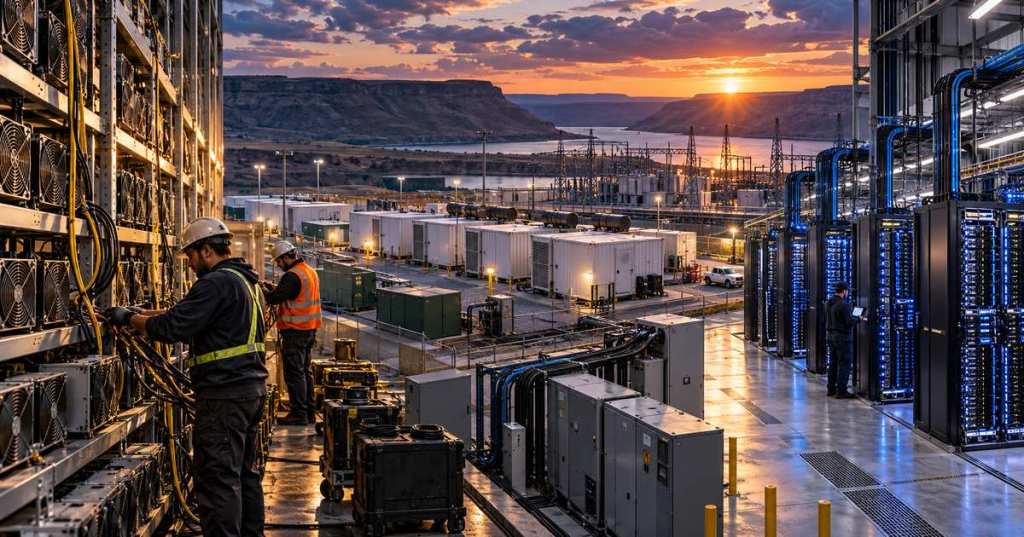
A Reuters report published October 26, 2026, highlights a growing contest to supply reliable electricity to AI data centers. One example comes from Keel Infrastructure, formerly Bitfarms, which is repurposing former U.S. Bitcoin mining facilities rather than continuing to operate miners there.
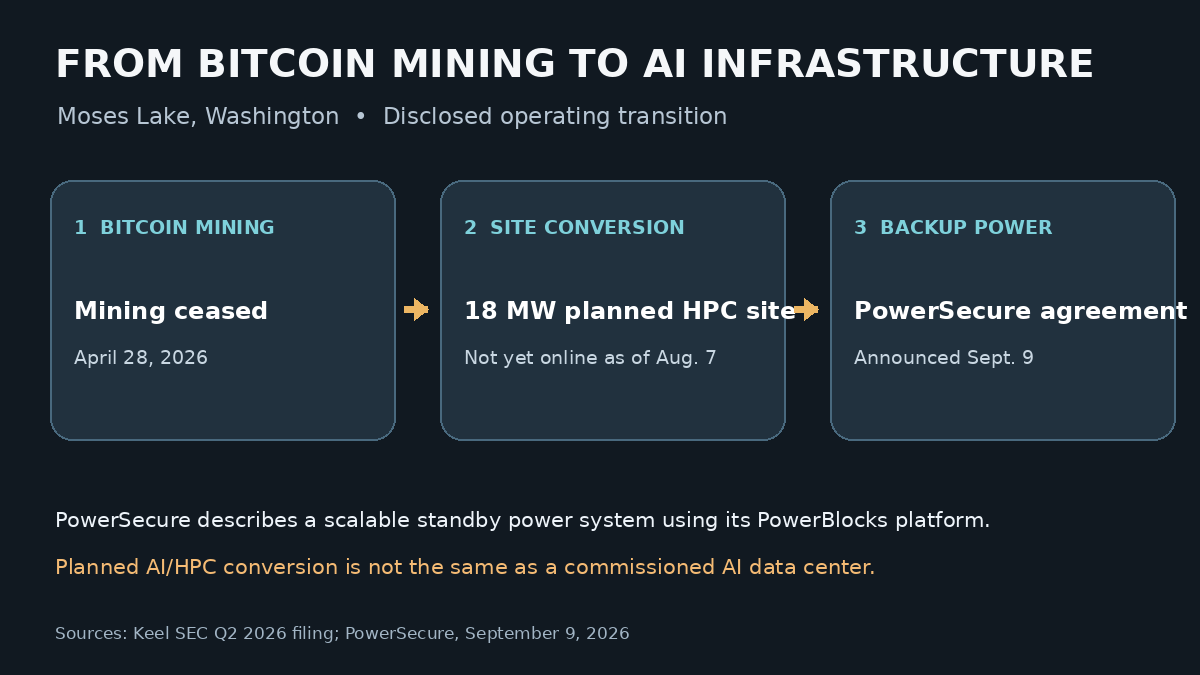
Keel’s second-quarter SEC filing says Bitcoin mining stopped at its Moses Lake, Washington, site on April 28. The company is developing that location into an 18 MW gross-capacity high-performance computing facility. As of August 7, the converted site had not begun HPC operations or recognized HPC revenue.
Backup power enters the conversion plan
Power reliability has become a central part of that transition. On September 9, Southern Company subsidiary PowerSecure announced an agreement to supply a scalable standby-power system for the Moses Lake campus. Its modular PowerBlocks approach is intended to support continuity, future expansion and peak shaving, which can reduce grid draw during periods of high demand.
The announcement describes a backup-power project, not proof that a complete islandable microgrid or AI campus has already been commissioned. Generator capacity, final deployment dates and full operating performance were not established in the cited announcement.
Why this matters for Bitcoin miners
The wider market explains why the distinction matters. Reuters cited GlobalData’s estimate that the U.S. microgrid market could expand from $8 billion in 2025 to $21.2 billion by 2030. That is a forecast, not contracted spending. Data-center developers increasingly want combinations of utility service, on-site generation, storage and controls to manage growth and outages.
Keel’s shift also illustrates a broader change in mining economics. Bitcoin ASIC facilities and AI server campuses both require substantial electrical infrastructure, but existing megawatts do not automatically translate into AI-ready capacity. Cooling, fiber, standby power and suitable server space still need engineering and investment.
BitcoinVersus.Tech previously tracked Washington’s mining-to-computing transition, Hyperscale Data’s Michigan mining shutdown, and Crusoe’s generator financing. Together, they show why the next competitive advantage may be reliable delivered power—not simply a mining site’s historical electrical allocation.
BitcoinVersus.Tech Editor’s Note: Independent reporting connects infrastructure announcements with their primary documents and clearly separates construction plans from operating results. Support ongoing research with a 5,000-satoshi Bitcoin donation using the QR code below.

For best scanning results, scan the QR code from another device or larger screen.


Leave a Reply