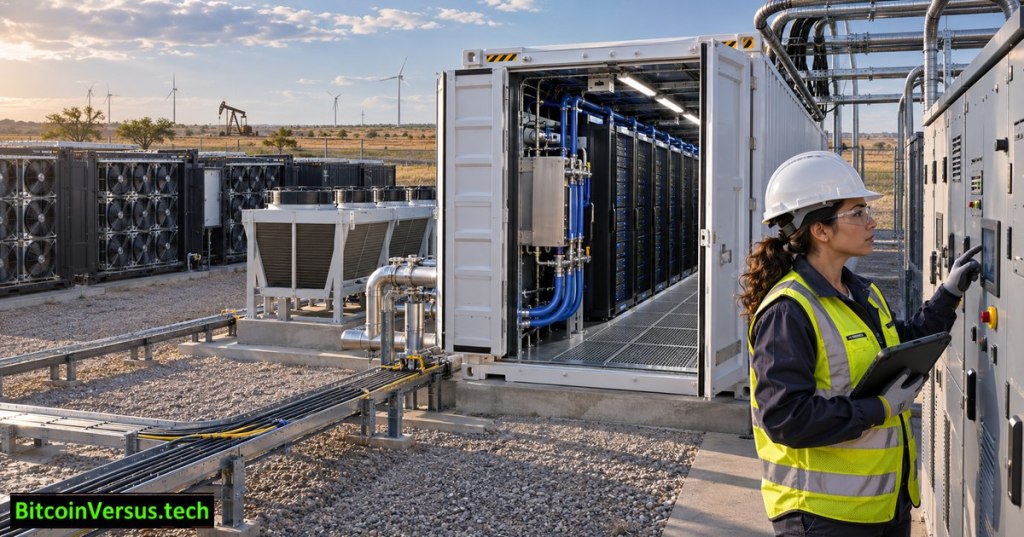
A live Bitcoin mine already has something coveted by artificial-intelligence data centers: an energized electrical connection. On November 3, 2026, infrastructure developer QIT issued preliminary drawings for Pod 001, a proposed 40-foot liquid-cooled GPU container beside mining equipment at an operating site in Texas. The idea is to reuse suitable electrical infrastructure while building a separate environment for AI servers. The drawings are for engineering study, not proof of construction, commissioning or an operating GPU fleet.
ServeTheHome covers GB300 racks, power and cooling. Equipment context, not a QIT site video. Watch on YouTube.
Six racks, 432 GPUs, and more than a megawatt at the meter
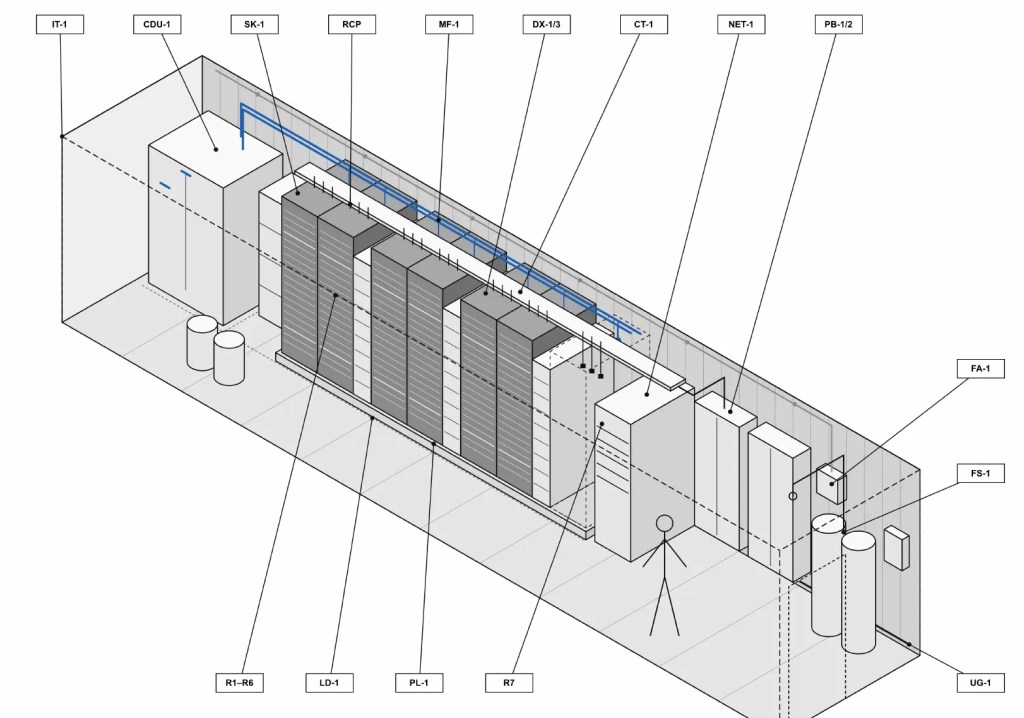
QIT’s proposed container holds six NVIDIA GB300 NVL72 racks, reserving space for a seventh. Each complete rack combines 72 Blackwell Ultra GPUs and 36 Grace CPUs according to NVIDIA. Six racks would provide 432 GPUs and 216 CPUs. QIT budgets 135 kW per rack at its stated thermal design point, or 810 kW across six racks, rising to 930 kW at the specified peak. The numbers describe a proposed configuration, not measured electricity demand.
The developer estimates 1.15–1.25 MW of total facility input, including cooling and auxiliary systems. A project marketed as a 1 MW pod should not be mistaken for exactly 1 MW of grid consumption. Final design calculations must reconcile installed rack loading, peak conditions, expansion reserves and service capacity.
Power distribution is the bottleneck
Three supply routes appear in QIT’s drawings: reuse a 2,500 kVA transformer freed from a retired mining container; install a stock 2,000 kVA unit connected to the host’s private 34.5 kV collector; or seek new utility service. The engineering study has not selected a final route. Its proposed 415Y/240 V three-phase supply feeds a 2,500 A switchboard and individual rack power shelves.
No uninterruptible power supply is planned for the GPU load, although smaller backup power supports controls, networking and fire protection. The omission reduces equipment cost and space, but compute workloads would remain exposed to interruptions longer than server power supplies can ride through. Reliability, utility coordination and service commitments therefore need resolution.
Linus Tech Tips visits an ASUS high-power test lab. Equipment context, not a QIT site video. Watch on YouTube.
Liquid loops and fiber matter as much as transformers
The design specifies a 1 MW coolant distribution unit supplying the racks at 35–40°C. Three adiabatic dry coolers of roughly 400 kW each would discharge heat outdoors; in-row air conditioning would manage residual heat. QIT also describes two physically diverse fiber routes, dual 100 Gb/s uplinks and satellite out-of-band administration. Water quality, flow balance, leak monitoring, network resilience, electrical protection and remote operations all require commissioning before customer equipment can operate reliably.
Bitcoin ASICs and GPU clusters share electrical and thermal requirements, but a mine’s mining computers and standard network switches cannot simply become a rack-scale AI cluster. Related BitcoinVersus.Tech coverage has documented IREN’s mining capacity decline, Riot’s AI campus lease, mining-derived cooling infrastructure, and alternative high-density cooling designs. Retrofitting power access is only one part of conversion.
What must happen before the GPUs arrive?
QIT says engineering work remains on the transformer choice, fault and arc-flash studies, foundations, thermal equipment, fire protection, permits and utility approval. The public project note did not establish a signed customer contract, installed GB300 racks or independently verified commissioning. Track final construction documents, permits, energized rack circuits, coolant acceptance tests and network readiness before treating Pod 001 as an operational AI data center. At present, it is a detailed infrastructure proposal.
Primary documentation: QIT Pod 001, preliminary drawings issued November 3, 2026; NVIDIA GB300 rack hardware architecture; Cisco/Supermicro rack specifications.
We volunteer daily to ensure the credibility of the information on this platform is Verifiably True. If you would like to support to help further secure the integrity of our research initiative, please scan the QR code below.



Leave a Reply