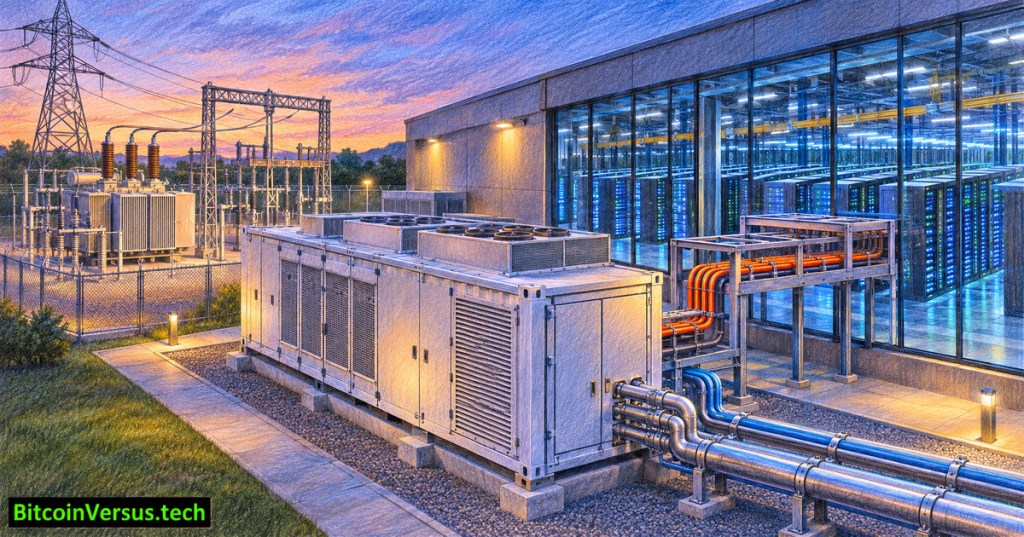
An AI data center may soon receive megawatts of electricity from a single outdoor power-conversion container rather than several separate transformers, rectifiers and UPS stages. On November 17, 2026, Vertiv presented its PowerNexus MV SST, a proposed 5 MW solid-state transformer delivering 800 V direct current for large AI compute halls. The announcement marks a new product architecture, not proof of a commissioned commercial installation.
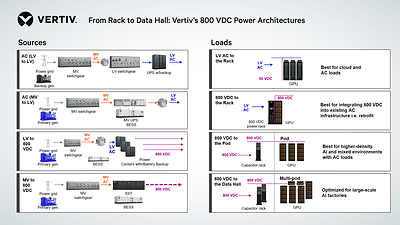
Vertiv’s SC26 announcement describes three options: conversion beside the rack, centrally at the compute pod, or outdoors ahead of an entire data hall. The newest element is the medium-voltage-to-DC design intended for a 4.8 MW super-pod reference configuration.
Vertiv CTO Scott Armul explains 800 VDC expansion from rack to data hall; official Vertiv video published August 2026. Watch directly on YouTube.
How a 5 MW solid-state transformer changes power delivery
A conventional facility can step medium-voltage alternating current down to lower-voltage AC before passing electricity through additional power-conversion equipment. Vertiv proposes high-frequency power electronics and galvanically isolated conversion from medium-voltage AC directly to an 800 VDC distribution bus. Its November product sheet identifies a 13.8 kV, three-wire-plus-ground, 5 MW reference configuration.
The manufacturer claims up to 98% AC-to-DC conversion efficiency, conditional power smoothing with external battery storage, bidirectional power capability and outdoor liquid cooling. Vertiv says the design could eliminate two or three intermediate conversion steps. Those are manufacturer specifications and proposed design benefits; no independently verified field-efficiency results accompanied the announcement.
An illustrative calculation shows why engineers care. At 5 MW of AC input, operation at 98% efficiency would deliver 4.90 MW of DC and release about 100 kW as conversion heat. Actual heat depends on load and measured efficiency. Supplying 4.8 MW at 800 V also corresponds to approximately 6,000 A of aggregate DC current, so properly rated distribution and fault isolation remain essential.
Three different places to convert electricity
The rack-level PowerDirect 5000 serves nearby AI racks, while a 90 kW PowerDirect 3000 shelf converts 800 VDC to 54 VDC inside a compute rack. The pod-level PowerDirect 9000 provides a 1.5 MW centralized conversion option from 480 V AC. An associated EnergyCore Li5 cabinet is rated for 200 kW of continuous backup output; power alone does not reveal its energy capacity or backup duration.
For newly constructed campuses, the 5 MW PowerNexus MV SST would move conversion outdoors. For retrofits, retaining existing upstream AC infrastructure may be more practical. The options represent different engineering tradeoffs, not evidence that all new data centers will adopt one voltage.
Vertiv explains its rack-level PowerDirect architecture and customer lab validation; official Vertiv video published July 2026. Watch directly on YouTube.
Why Bitcoin mines and AI operators should watch
Large Bitcoin mining campuses exploring GPU hosting already understand the cost of transformers, energized capacity, switchgear and cooling. Nevertheless, a mining transformer does not automatically supply the DC voltage, backup resilience or power quality demanded by high-density AI racks. Related coverage explores 800 VDC capacity engineering, Vertiv’s separate 3 MVA medium-voltage UPS, its power-semiconductor supply agreement and grid-scale storage supporting data centers.
The main unresolved questions concern production delivery, fault-clearing performance, installation cost, real-world efficiency over varying load, and interoperability with energy storage. Vertiv says pilot programs and technical validation are underway. A product demonstration and a manufacturer rating are not equivalent to independently documented production operation.
Primary sources: Vertiv release, November 17; PowerNexus MV SST technical sheet; Vertiv’s engineering risk overview.
We volunteer daily to ensure the credibility of the information on this platform is Verifiably True. If you would like to support to help further secure the integrity of our research initiative, please scan the QR code below.


Leave a Reply