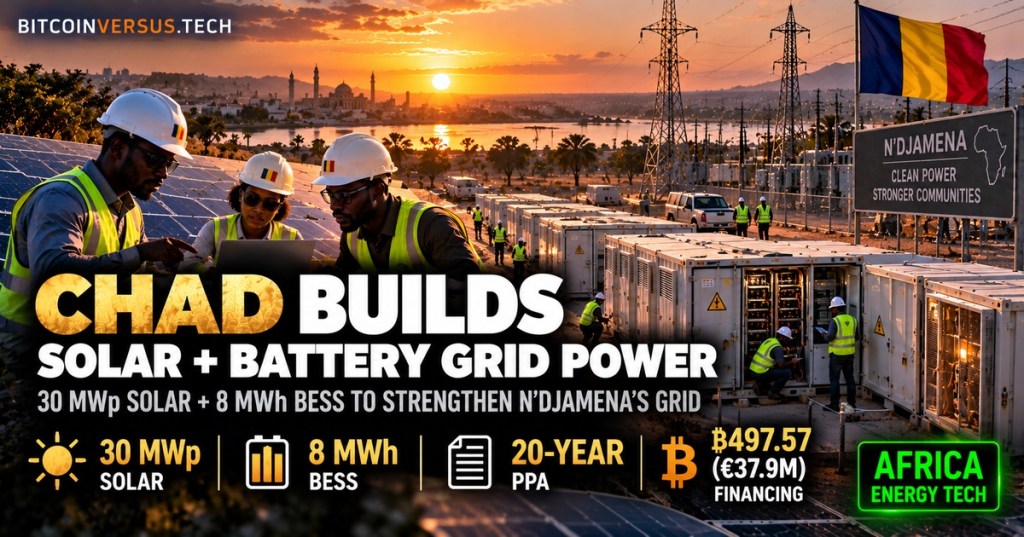
Chad is moving two hybrid solar-and-storage projects near N’Djamena into construction with a financing package worth about ₿497.57 (€37.9 million) at the October 6, 2026 BTC/EUR spot rate. The Gassi and Lamadji plants combine photovoltaic generation with battery energy storage, giving the country a more dispatchable form of renewable power than solar alone.
According to Qair, the two sites will provide a combined 30 MWp of solar and 8 MW / 8 MWh of BESS. The projects sit at Gassi and Lamadji and are tied to a 20-year power purchase agreement with Tchadelec, Chad’s national electricity utility.
30 MWp of Solar, 8 MWh of Storage
The technical pairing matters. MW and MWh describe different parts of an energy system: megawatts describe instantaneous power, while megawatt-hours describe how much energy can be delivered over time. In this case, the battery system is rated at 8 MW / 8 MWh, giving it roughly one hour of full-power discharge at its nameplate rating.
Each site is designed around about 15 MWp of solar and 4 MW / 4 MWh of batteries. That storage layer can absorb excess daytime generation and release energy when solar output falls, helping smooth ramps, support evening demand and reduce the operational stress that variable generation can place on a smaller national grid.
The Financing Uses Blended Capital
The ₿497.57 (€37.9 million) package is spread across several development-finance institutions. The African Development Bank and Proparco each supplied about ₿199.55 (€15.2 million) in loans. The Sustainable Energy Fund for Africa added roughly ₿78.77 (€6 million) in reimbursable grants, while Proparco and Agence Française de Développement contributed another ₿19.69 (€1.5 million).
A separate partial-risk guarantee of about ₿105.03 (€8 million) from the African Development Fund and Green Climate Fund supports a letter-of-credit structure covering Tchadelec’s payment obligations under the PPA. That kind of guarantee is financial infrastructure: it reduces counterparty risk enough to make a technically viable power project easier to finance.
Why the Battery Layer Matters for Chad
Solar generation is strongest in daylight, while household and commercial demand can stay high after sunset. Without storage or another flexible resource, those two curves do not naturally line up. The BESS gives grid operators a controllable buffer between production and demand.
The same distinction is why nameplate generation alone can be misleading. BitcoinVersus recently explained capacity factor: a 30 MWp solar project does not deliver 30 MW every hour of the year. Storage cannot create energy, but it can shift some of the energy produced during stronger solar periods into more useful hours.
A Grid Project, Not Just a Solar Farm
The Gassi and Lamadji plants are connected to the wider N’Djamena electricity system rather than operating as isolated generation sites. That means the engineering problem includes not only modules and batteries, but also inverters, transformers, protection, switchgear, metering, control systems and high-voltage interconnection.
The African Development Bank says the projects strengthen Chad’s national grid and advance its Desert to Power and Mission 300 initiatives. In its September 25 project update, the bank said the plants had reached financial close and received their first disbursement, allowing construction to move ahead.
Africa’s Energy Buildout Is Becoming More Technical
The important trend is not simply that another solar project is being built in Africa. The system is becoming more sophisticated: generation, storage, grid controls, credit guarantees and long-term power contracts are being engineered together as one project.
That matters across the continent because large new loads—from cities and factories to Bitcoin mining infrastructure in Ethiopia—depend on dependable electricity rather than nameplate capacity alone. Solar plus storage gives African grids another way to add generation while also adding some flexibility at the same time.
What to Watch Next
The next milestones are construction progress, commissioning, actual battery dispatch behavior and how the two sites perform once connected to Tchadelec’s grid. The hardware numbers—30 MWp and 8 MWh—are only the starting point. The real test is whether the plants improve reliability, shift useful solar energy into higher-value hours and demonstrate a repeatable model for other Sahel grids.
BitcoinVersus.Tech
Advertisement
Editor’s Note
Bitcoin conversions use the October 6, 2026 BTC/EUR spot rate. Values are rounded for readability.
We volunteer daily to ensure the credibility of the information on this platform is Verifiably True. If you would like to support to help further secure the integrity of our research initiatives, please donate here: 3C9o19EH5HSiwEPyCTmEKzxhNCbo2X6TTb
BitcoinVersus.tech is not a financial advisor. This media platform reports on financial subjects purely for informational purposes.


Leave a Reply