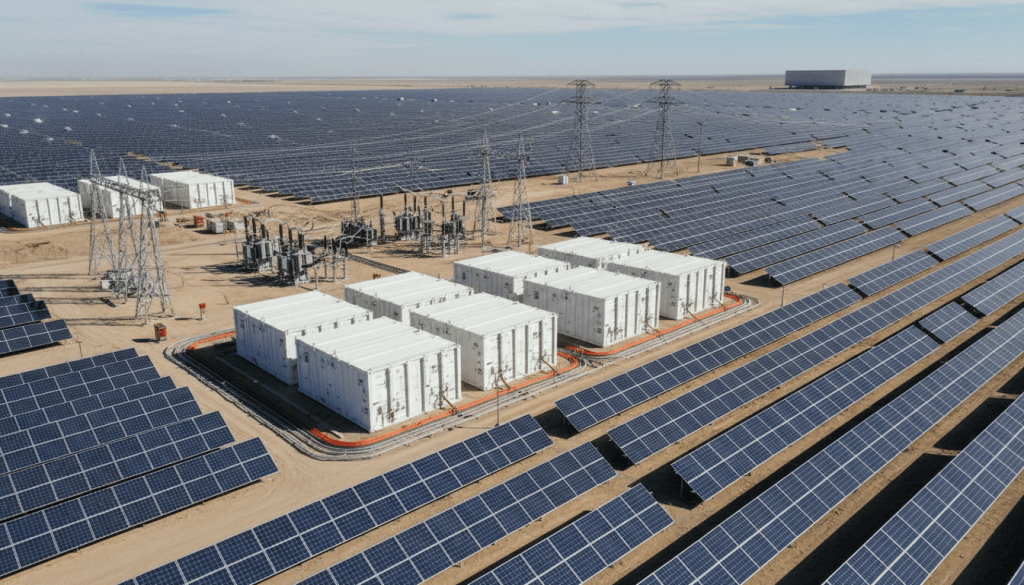
A November 3, 2026 exchange on X over artificial intelligence, robotics and employment has exposed an important electricity-infrastructure question: which technologies can add usable power fastest before 2030? An account attributed in a screenshot to David Scott Patterson forecast that AI and robots would perform every job by 2030. A commenter challenged the energy requirements, pointing to multiyear gas-turbine and nuclear-plant delivery times. Patterson replied by invoking exponential solar growth. Neither post supplied an electrical demand forecast sufficient to validate the prediction about employment.
The strongest available comparison favors solar photovoltaic installations for construction speed, but the result changes when grid connection, permitting and energy reliability enter the calculation. The International Energy Agency reported in 2026 that median construction takes approximately 220 days for utility-scale solar PV and 275 days for utility batteries, compared with more than two years for gas-fired capacity and more than six years for nuclear projects. Batteries store electrical energy rather than produce it.
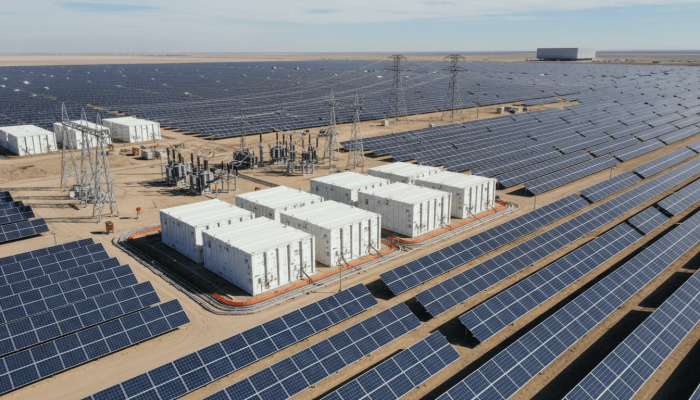
Fast Modules Do Not Guarantee Fast Connections
Construction duration is only one part of delivery. The IEA estimates that planning and building grid infrastructure can take five to fifteen years, even as new solar and wind projects generally take one to five years and data centers one to three years. A solar module may be installed quickly, but a large grid-connected plant can face lengthy queues, transformer shortages, land-use disputes, environmental reviews and network upgrades.
The U.S. Energy Information Administration previously cited a 25-month median period between solar interconnection agreement signing and commercial operation in one Lawrence Berkeley National Laboratory analysis. That interval is not interchangeable with the approximately 220-day median construction estimate. Both can be accurate because they describe different stages of project delivery.
Rapid solar manufacturing offers a genuine advantage where electricity can be consumed locally, particularly on suitable rooftops or at sites with adequate existing network capacity. Yet equipment availability, inverters, permitting and daytime output still impose limits. A factory or data center demanding continuous electricity cannot equate one gigawatt of solar nameplate capacity with one gigawatt of dependable round-the-clock supply.
Solar Expansion Is Real, but Its Output Is Variable
The International Renewable Energy Agency reported that approximately 511 gigawatts of solar power capacity entered service globally in 2025, compared with nearly 159 GW of wind. Total renewable capacity reached 5,149 GW at year-end. Solar additions therefore demonstrate extraordinary industrial scaling, but installed gigawatts do not establish gigawatt-hours generated or delivery during an evening demand peak.
Storage improves short-duration flexibility but introduces costs, battery degradation and duration limits. Gas power offers dispatchable output but faces turbine manufacturing lead times, fuel-price exposure and combustion emissions. Nuclear offers high availability once commissioned, while licensing, construction cost and financing stretch deployment schedules. Existing hydropower and pumped storage can contribute flexibility, although geography and environmental constraints restrict new construction.
Recent U.S. solar-and-battery expansion illustrates why developers pair variable generation with storage. Germany’s gas-capacity procurement demonstrates the parallel demand for dispatchable backup. Existing pumped-hydro infrastructure remains a separate energy-shifting option, while new wind construction broadens the generating mix.
The competing X claims consequently answer different questions. Solar is already expanding rapidly enough to challenge blanket statements that all new electricity supply needs five to ten years. Grid connection and firm power availability, however, challenge any assumption that exponentially more solar panels automatically provide unlimited electricity for robots or AI servers by 2030. Neither energy statistic demonstrates that all jobs will disappear, or that falling labor demand would necessarily raise birth rates.
Sources: IEA battery construction assessment; IEA Electricity 2026 grid assessment; EIA solar interconnection timeline; IRENA 2025 capacity additions.
Editor’s Note: Social-media statements are attributed to a user-provided screenshot and have not been independently authenticated to their original X URLs. Construction time, project development time, installed capacity and electricity production measure different quantities. The cover is an editorial illustration.


Leave a Reply