
Scientists have developed a way to keep high-efficiency perovskite solar cells from losing performance as temperatures repeatedly rise and fall. In research published in Science Advances on November 18, 2026, treated laboratory devices retained 94% of their initial conversion efficiency after 400 thermal cycles between −40°C and 85°C. The University of Cambridge reports 61% retention for untreated comparison devices. The work attacks a longstanding obstacle to commercial perovskite photovoltaics: durability, not simply peak efficiency.
The international study, led by researchers at Henan University with partners including Cambridge, the University of Naples Federico II and Xiamen University, produced 27.3% measured efficiency and 26.9% independently certified efficiency in optimized cells. Those values are laboratory cell measurements, not the efficiency of a commercially certified full-size rooftop panel.
Scientific Video Protocols’ earlier demonstration with University of Cambridge researchers explains perovskite-cell fabrication and contacts. It examines a different cell architecture and does not document the November 2026 experiment.
Why solar cells weaken when the weather changes
Perovskite devices are assembled from exceptionally thin semiconductor and contact layers. Materials in neighboring layers do not expand at identical rates when heated. Repeated temperature changes create shear forces at their boundaries, weakening adhesion and eventually disrupting charge transport. In the study’s untreated structures, the measured fracture energy of a buried interface declined from 1.59 to 0.50 joules per square metre after thermal ageing—approximately a 69% reduction.
The weak point was a self-assembled monolayer (SAM), a molecularly thin film connecting the perovskite to the transparent conductive oxide. In inverted solar cells, the SAM helps move positive charge toward the correct contact. Damage at that boundary can degrade performance even when the light-absorbing layer remains capable of generating carriers. Our guide to drift, diffusion and charge recombination explains why the electrical interface matters.
The chemical treatment behind the result
The researchers first treated an indium-containing transparent conductive oxide surface with indium chloride (InCl₃). The pretreatment creates additional chemical attachment sites for the SAM. Strong phosphorus–oxygen–indium coordination bonds anchor the molecular layer, while additional hydrogen-bonding interactions involving chloride contribute flexibility. The researchers call the result hierarchical multipoint anchoring: strong attachment combined with secondary interactions that better tolerate mechanical stress.
Better bonding also improved charge extraction and suppressed nonradiative energy losses, supporting the reported high conversion efficiency. The result complements our coverage of a 25.9%-certified perovskite crystal-defect treatment and a 23.9%-efficient perovskite mini-module. Each addresses a different problem: defect density, scale-up or interfacial durability.
A second test examined continuous heat and light
The team separately operated treated devices under continuous LED illumination at 65°C while monitoring maximum-power-point output. After 2,000 hours, the cells retained 95% of initial efficiency, Cambridge reports. Thermal cycling and continuous illumination probe different failure mechanisms, so their results should not be added together or interpreted as an equivalent number of outdoor years.
Cambridge researcher Sam Stranks’ earlier lecture, hosted by the Cambridge Society for the Application of Research, explains the broader physics and commercialization challenges of perovskite photovoltaics. The lecture predates and is independent of the new paper.
What remains before a rooftop deployment
The experiments do not establish a 25-year module lifetime, outdoor weather resistance or economical mass manufacturing. Commercial panels face humidity, ultraviolet radiation, mechanical loading, encapsulation defects and large-area production losses simultaneously. Cell-area measurements cannot be compared directly with certified commercial module efficiencies. Our reporting on U.S. tandem-module manufacturing describes the separate challenge of translating laboratory chemistry to production lines.
The meaningful milestone is a repeatable molecular interface that resists dramatic laboratory temperature swings while maintaining strong efficiency. Independent replication, larger modules and outdoor performance testing will determine whether the gains survive real installation conditions. As grid-development timelines demonstrate, even better solar technology has to prove reliability and economic value before it changes electricity supply.
Primary scientific records and video sources
- Wu and colleagues, Science Advances (published online November 18, 2026), DOI 10.1126/sciadv.aej6035
- U.S. National Library of Medicine, peer-reviewed article record
- University of Cambridge, research summary and methodology
- U.S. Department of Energy: perovskite technology challenges
- Earlier Cambridge researchers’ fabrication demonstration and Cambridge research lecture
- NREL public-domain laboratory photograph and attribution
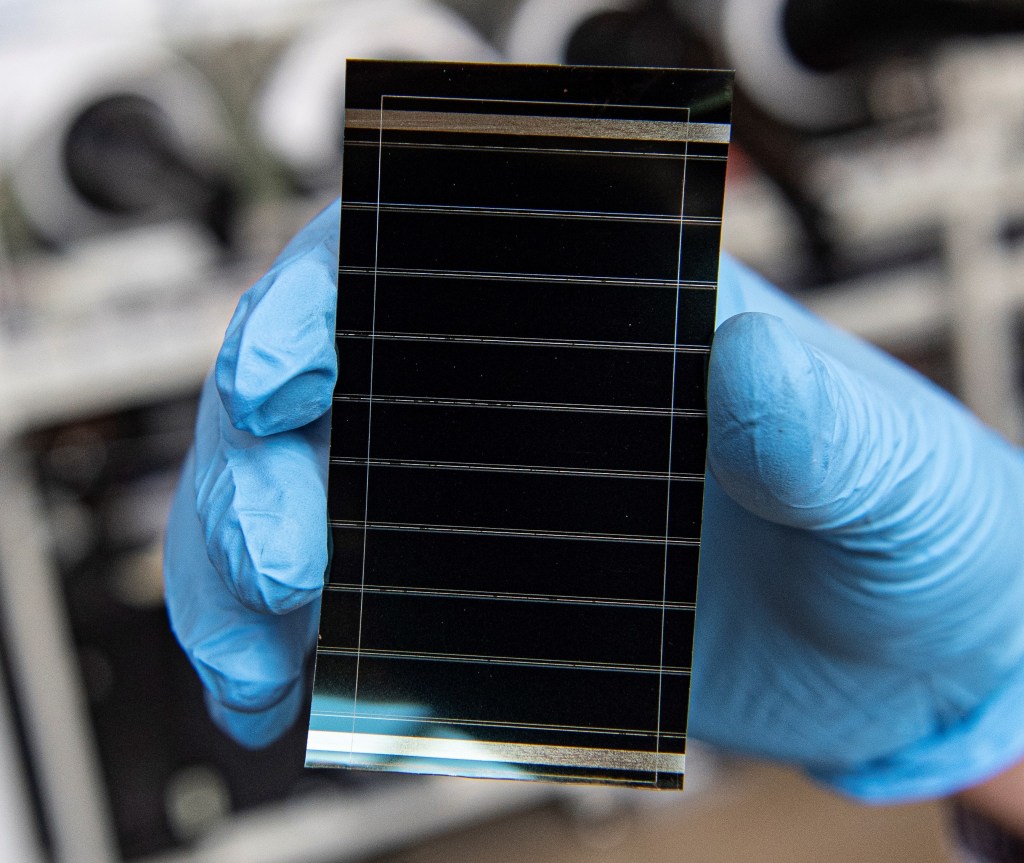
Image disclosure: The featured cover is a conceptual illustration adapted from an original BitcoinVersus.Tech lab artwork; it is not a photograph of the reported devices. The in-story NREL photograph is authentic but was taken in 2021, not during the new research.


Leave a Reply