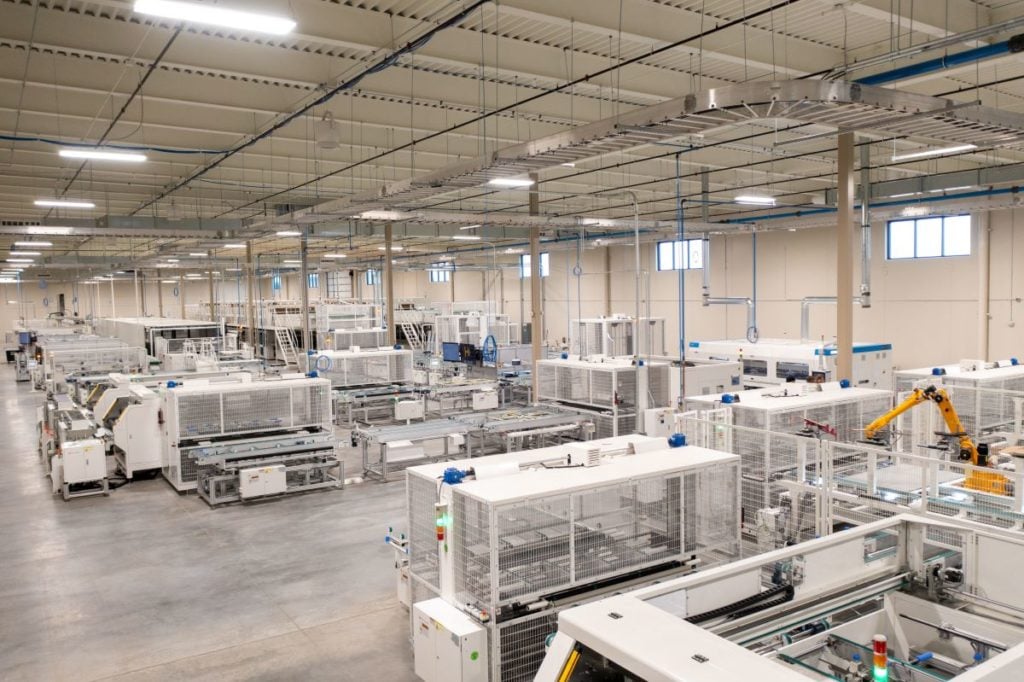
Solar manufacturer Heliene and perovskite specialist Caelux announced November 10, 2026, that commercial-scale production has begun for their hybrid-tandem photovoltaic modules in Mountain Iron, Minnesota. The product combines a power-generating perovskite glass layer with conventional n-type silicon cells. The companies report module conversion efficiency of 27% or higher and say deliveries are planned for 2027. Production has started, but independent field-performance data and large-volume customer deliveries were not documented in the announcement.
Caelux CEO Scott Graybeal discusses the company’s perovskite-on-glass manufacturing approach in a March 2026 interview with Synapse’s Hardware to Save a Planet. Historical comments are not independent confirmation of November production performance.
A second generating layer on existing solar modules
A silicon photovoltaic cell absorbs part of the incoming solar spectrum. Perovskites can be formulated to absorb other wavelengths efficiently, letting the combined module capture more usable light. Caelux deposits its energy-producing material in the front glass, while Heliene supplies the silicon-module manufacturing platform. A tandem device therefore uses two absorbers rather than requiring every additional watt to come from the silicon cell alone.
Heliene says the glass can be integrated into existing module assembly operations without constructing a wholly new production line. The exact electrical interconnection, manufacturing yields and long-term coating behavior were not supplied in the release. Readers seeking device-level background can consult BitcoinVersus.Tech’s solar-cell semiconductor characterization guide.
What 27% efficiency means
Module conversion efficiency measures the share of incident solar power converted into electrical output under defined test conditions. At an illustrative sunlight intensity of 1,000 watts per square meter, a 27%-efficient module area would correspond to 270 watts per square meter before real-world operating losses. Heliene’s September 2025 product information listed an n-type module efficiency of 22.73%. Comparing those published figures gives 4.27 percentage points more efficiency, or approximately 18.8% higher conversion on a relative basis: (27 ÷ 22.73 − 1) × 100.
The comparison is illustrative, not a controlled test of matched products. The manufacturers separately claim up to 20% greater energy generation than a conventional n-type module, but supplied no public side-by-side annual yield dataset in their announcement. Panel efficiency must not be confused with a solar farm’s capacity factor or annual electricity generation. For context, BitcoinVersus.Tech has analyzed solar’s growth in renewable generation capacity and countries with high solar electricity shares.
Earlier technical background on perovskite solar glass in a February 2025 interview with Caelux CEO Scott Graybeal, published by Sean White. The discussion predates the Heliene production announcement.
Commercial manufacture does not prove long-term reliability
Perovskite materials can lose performance under moisture, oxygen, heat, illumination and electrical stress. The U.S. Department of Energy identifies durability, efficiency at module scale, manufacturability and independent validation as central barriers for commercialization. Although laboratory tandem-cell efficiencies exceed those of many conventional silicon devices, small-area cell records are not interchangeable with certified commercial-module results.
The Heliene–Caelux announcement did not identify an independent laboratory measurement, public certification report, warranty term or long-duration field-test series supporting the new modules’ lifetime. A commercial-scale production announcement demonstrates manufacturing intent and activity; it does not establish decades of reliable operation. Grid integration also remains a separate consideration, as described in BitcoinVersus.Tech’s analysis of solar construction and transmission bottlenecks.
Delivery and scale remain future milestones
The partners announced a multi-year, multi-gigawatt commercialization agreement and said an initial industrial-scale order is underway. No contracted delivery price, confirmed annual output for the tandem product, or completed customer installation was disclosed. Heliene operates two U.S. module facilities with a stated combined capacity of 1.3 gigawatts annually, but total factory capacity is not the same as proven tandem-module output.
The firms expect deliveries in 2027 and aim to exceed 29% module conversion efficiency in 2028. Both remain forward-looking milestones rather than achieved customer performance. Greater power per unit area could improve economics where rooftops or land are limited, although any savings depend on manufacturing cost, durability, installation design and verified energy yield. The near-term technical question is whether production modules can sustain their reported advantage after independent qualification and outdoor operation.
Sources and verification: Heliene and Caelux announcement (November 10, 2026); PV Tech reporting (November 10); Heliene n-type module specification sheet (September 2025); U.S. Department of Energy research on perovskite stability and scale-up. No independent laboratory measurement or physical inspection was performed by BitcoinVersus.Tech.
BitcoinVersus.Tech Editor’s Note: We volunteer daily to ensure the credibility of the information on this platform is Verifiably True. If you would like to support to help further secure the integrity of our research initiatives, please donate using the QR code provided.

Optional contribution: 5,000 satoshis (0.00005 BTC). On mobile, open the original QR image on another screen to scan using a Bitcoin wallet, or use a wallet supporting saved-image QR scanning. Confirm the destination and amount before sending.
BitcoinVersus.Tech is maintained by volunteers. BitcoinVersus.Tech is not a financial advisor. Technology and financial coverage is for informational purposes only.


Leave a Reply