
Scientists working with MicroQuanta Semiconductor and Zhejiang University have identified a major reason promising perovskite solar cells lose performance as they become larger modules: a declining fill factor. Their Nature Communications paper, published October 29, 2026, describes a cooling-assisted fabrication method that preserved electrical performance in a mini-module with 23.9% certified steady-state power-conversion efficiency over a 19.48-square-centimeter aperture.
The efficiency result itself is not a newly measured November record: MicroQuanta’s 19.48 cm² certification was already represented in international solar efficiency tables covering 2025. The newer peer-reviewed contribution explains the manufacturing losses and shows how slowing crystal growth can limit them. PV Magazine reported the study on November 19, 2026.
MicroQuanta representative Yang Chen explains the company’s perovskite panel performance during a 2025 Perovskite Innovation Day presentation. Original industry speaker, not footage of the October 2026 paper’s tests.
Why a good solar cell can become a weaker module
A perovskite absorber converts incoming sunlight into electrical current. A laboratory cell can be only a few square centimeters, while a practical panel needs many connected subcells and substantially larger coated surfaces. As the area increases, grain nonuniformity, interconnections, inactive gaps and resistance can reduce the fraction of captured light converted into useful power.
The researchers analyzed open-circuit voltage, short-circuit current and fill factor, a measure of how closely a cell’s current-voltage curve approaches the ideal maximum-power rectangle. Using Shapley-value attribution, a method for allocating contributions among several variables, they found that declining fill factor explained the largest portion of the scale-up efficiency loss after accounting for inactive laser-scribed areas.
Fifteen seconds of cooling changes crystallization
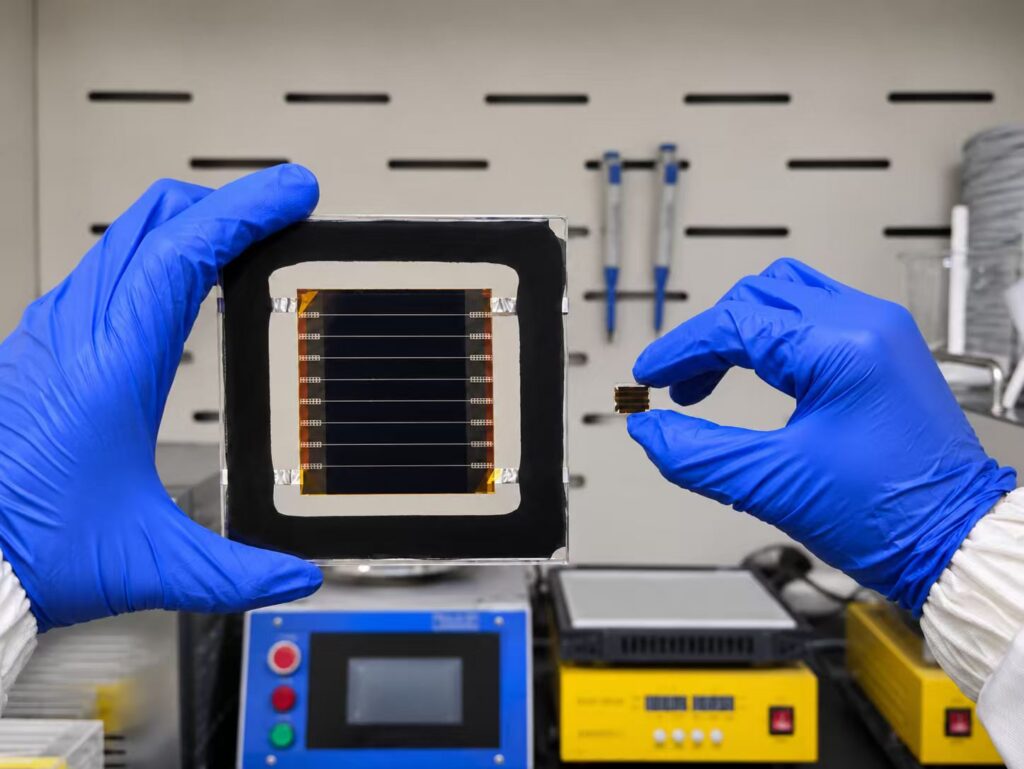
Immediately after depositing the wet precursor, the team cooled the film to 0–10°C for 15 seconds, then transferred it for vacuum treatment. Slower conversion into the finished perovskite produced larger, more uniform crystalline grains. The researchers used slot-die coating and laser scribing to build an eight-subcell series-connected mini-module.
The measured module combined 23.9% steady-state efficiency, an 83.3% fill factor and a 97% geometric fill factor, meaning nearly all of the aperture area remained active. The latter figure describes usable area, not electrical conversion efficiency. Under a separate continuous-illumination, open-circuit aging test, the fill-factor decline in cooled devices was less than one-third of the decline recorded in controls.
MicroQuanta’s January 2026 video shows a building-integrated perovskite installation in Wenzhou, China. Original company footage illustrates applications; it does not demonstrate the laboratory mini-module’s certified efficiency.
What the test does not establish
Mini-module performance cannot be substituted for the output of a full rooftop product. The tested aperture is only 19.48 cm², not 19.48 square meters. Longer outdoor lifetimes, uniform production across square-meter panels, encapsulation, moisture resistance, costs and eventual field yield require separate evidence.
Efficiency figures also require comparable test methods. A higher current-voltage scan result reported by MicroQuanta cannot simply replace the 23.9% independently certified steady-state value. The new paper does not prove a 25-year commercial lifespan or a full-scale panel operating at 23.9%.
The research complements BitcoinVersus.Tech coverage of perovskite defect-reduction techniques and U.S. tandem-module manufacturing. The site’s guides to solar-cell surface characterization and solar-cell operation explain the underlying engineering. The practical lesson is that module scaling demands control over electrical losses and manufacturing consistency, not just headline efficiency from a tiny cell.
Primary sources and verification
- Yan and colleagues, Nature Communications, October 29, 2026: peer-reviewed crystallization and fill-factor study
- PubMed abstract and author affiliations
- pv magazine, November 19, 2026: reporting and original research photo
- Solar Cell Efficiency Tables, Version 68: historical certification context
- MicroQuanta speaker video; MicroQuanta installation video
Editorial verification: The mini-module measurements are laboratory-scale and the efficiency certification predates publication of the October 2026 analysis. The featured cover is original cinematic anime artwork depicting a fictional researcher. Both historical videos provide contextual company material rather than footage of the study’s experimental procedure.
Editor’s Note: We volunteer daily to ensure the credibility of the information on this platform is Verifiably True. If you would like to support to help further secure the integrity of our research initiatives, please scan the QR code below

For mobile scanning, open the article on another display and scan the QR code with a Bitcoin wallet. The voluntary donation amount is 5,000 sats. Verify the receiving address 3C9o19EH5HSiwEPyCTmEKzxhNCbo2X6TTb before sending.
BitcoinVersus.Tech publishes technology and financial journalism for informational purposes and does not provide financial, investment, or legal advice.


Leave a Reply