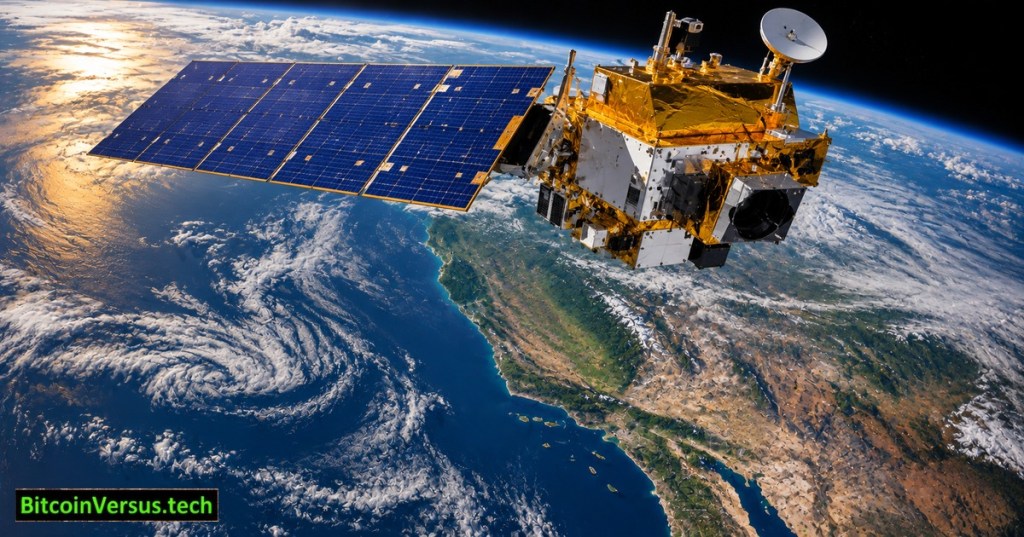
November 21, 2026 — NASA plans to stop collecting scientific observations from its Terra satellite on December 1, 2026, ending a nearly 27-year mission that helped researchers track wildfires, crop growth, air pollution and the planet’s changing ice cover. Launched on December 18, 1999, Terra was designed to operate for six years. Its longevity transformed it into one of Earth science’s longest continuous observation platforms. NASA says aging spacecraft systems and a drifting orbit have made retirement necessary, not a sudden loss of all archived data. NASA announced the end-of-science timeline November 17.
NASA Earth, *Terra Satellite 20-Year Anniversary: The Instruments* (2019); archive footage explaining the five-sensor platform, not a 2026 shutdown video. Watch the original NASA Earth upload on YouTube if the embedded player does not load.
Five sensors, one view of Earth’s systems
Terra carries five scientific instruments, each observing a different part of the Earth system. MODIS tracks vegetation, fires, clouds and snow across 36 spectral bands. ASTER observes land-surface features and temperature, while MISR gathers multi-angle measurements of clouds and airborne particles. CERES measures reflected sunlight and outgoing energy, and MOPITT tracks atmospheric carbon monoxide. Together, the instruments made it possible to relate developments on land to changes in the atmosphere and energy balance. Not every sensor remains fully operational: NASA says MOPITT and portions of CERES and ASTER were shut down earlier to conserve power. Terra’s mission overview describes the international instrument suite.
Terra’s records have helped interpret wildfire smoke and landscape changes. Our recent report on NASA’s 3D wildfire-fuel maps illustrates the newer airborne lidar measurements now complementing broad satellite records. Similarly, NASA’s field-by-field agricultural water mapping shows why consistent observations matter for managing scarce water.
What happens on December 1?
The National Snow and Ice Data Center confirms that fresh Terra observations stop on December 1. Some already-acquired products may still reach archives after the cutoff; ending data acquisition does not erase measurements collected since 1999. NASA expects mission controllers to use remaining propellant to lower the satellite’s orbit and power down spacecraft systems in January 2027. Consequently, December 1 is the science shutdown, not a scheduled atmospheric reentry date.
NASA Earth, *Terra Satellite 20-Year Anniversary: The Applications* (2019); historic examples of how Terra data have been used. Watch the original NASA Earth upload on YouTube if the embedded player does not load.
What replaces a 27-year measurement record?
Newer instruments will carry forward some of Terra’s functions. For example, VIIRS sensors aboard Suomi NPP and NOAA’s Joint Polar Satellite System provide global imagery useful for vegetation, wildfire and atmospheric monitoring. They are not identical to MODIS, however: viewing geometry, calibration, spectral response and changes in observation time complicate direct comparisons. Researchers must verify continuity before combining historical series with new measurements. NASA’s Terra transition resources identify the agency’s data-continuity efforts.
The retirement also underscores a wider infrastructure lesson. Even when scientific instruments can produce useful measurements, orbit maintenance, declining electrical power and remaining propellant constrain their service life. Comparable end-of-life decisions appear in our NICER telescope shutdown coverage. The enduring value is the public record: decades of observations that can be reanalyzed with improved algorithms and compared with future measurements. The 2026 ozone-hole analysis provides another example of why long-running Earth records matter.
Sources: NASA (November 17); Terra mission office (November 19); NSIDC advisory; NASA MODIS technical background.
We volunteer daily to ensure the credibility of the information on this platform is Verifiably True. If you would like to support to help further secure the integrity of our research initiatives, please scan the QR code below


Leave a Reply