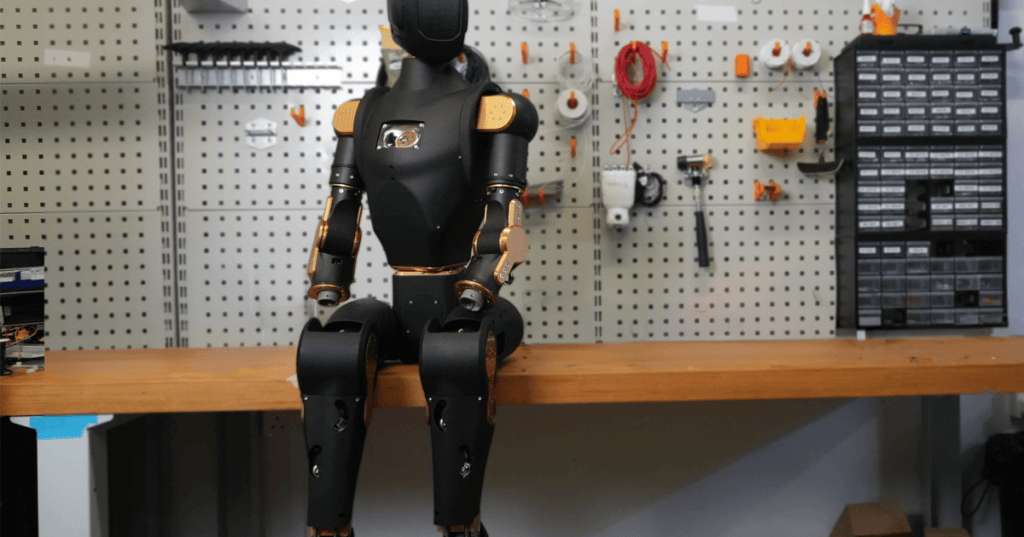
Menlo Research is selling Asimov 1, a repairable open-source humanoid robot, as an unassembled $20,000 DIY kit. Its current order page accepts a $499 reservation deposit and lists a new production batch forming, while the company’s public engineering repository describes kits already shipping. The robot was introduced earlier in 2026; the development is its continuing availability to builders, not a newly unveiled model.
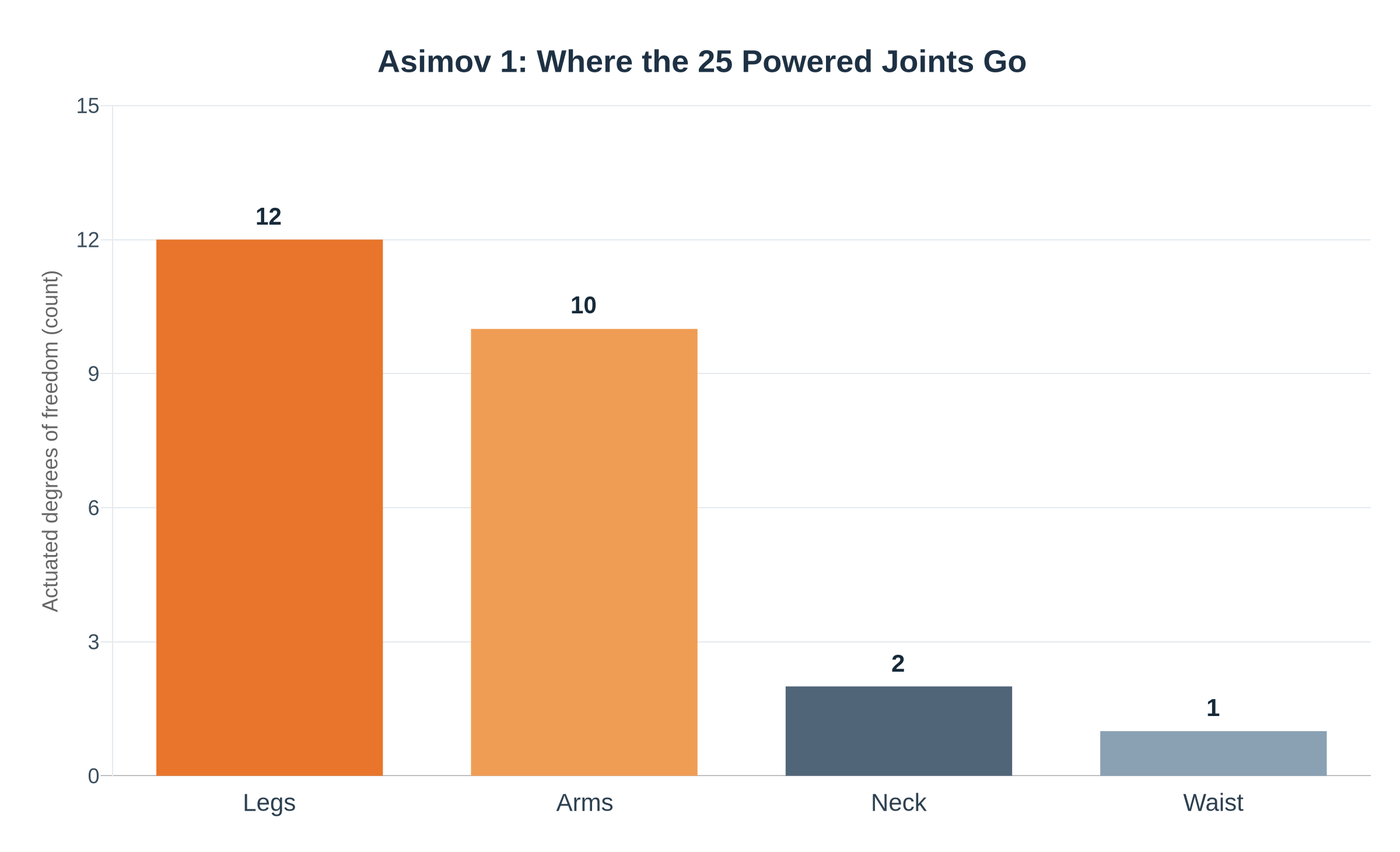
Standing approximately 1.2 meters tall and weighing 35 kilograms, Asimov 1 has 25 powered degrees of freedom, meaning 25 independently actuated joints. Menlo positions the biped for robotics research, teleoperation, data collection and software experiments rather than as a certified household worker. Its open mechanical and electronic design is meant to let developers inspect, fabricate, replace and modify components.
A 25-joint machine built from published designs
Each leg carries six powered joints, each arm five, the neck two and the waist one. That yields 12 leg actuators, 10 arm actuators and three additional joints. The frame uses 7075 aluminum and MJF PA12 nylon, while Menlo lists peak actuator torque of up to 120 newton-meters. Peak torque is not the continuous rating of every joint.
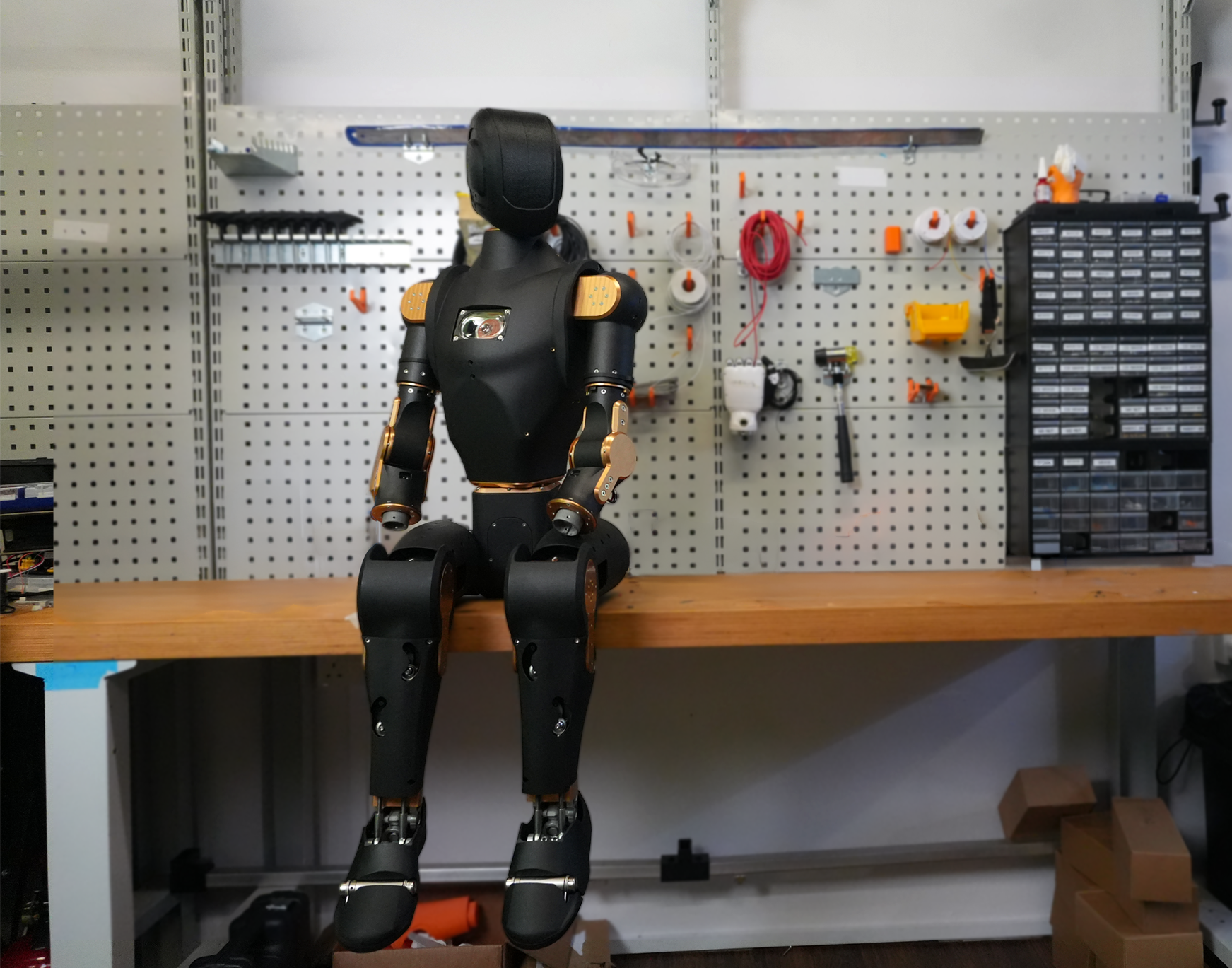
Motor commands and feedback use CAN-bus connections. A Radxa CM5 handles motion control while a Raspberry Pi 5 supports networking and media. The published specifications include a 2-megapixel monocular camera, inertial sensing, microphones, a speaker and a rechargeable battery. Menlo’s product page lists 491 watt-hours of battery energy, but does not establish a universally measured operating runtime under different workloads.
Open files, a Python SDK and real assembly work
The main robot repository includes mechanical and electrical CAD plus URDF and MuJoCo simulation models. Hardware files carry the CERN-OHL-S-2.0 license and the main software repository includes GPL-2.0 licensing. Separately, Menlo publishes the Apache-2.0-licensed Python SDK with robot-state reading, balancing and velocity-control examples, and the Cyclotron training framework for simulation-based locomotion research.
The distinction matters: Menlo’s overview still labels a broader client SDK workflow and full-body teleoperation as in development, despite the available Python SDK repository. Its bill of materials is supplied through an email-request process, rather than simply exposed as a downloadable spreadsheet. Open files enable modification, but do not prove universal interchangeability or unrestricted access to every trained model.
According to the seller, the kit contains all 25 actuators, control boards, camera, battery and charger, wiring and mechanical parts. Hands, lidar and a 360-degree camera are not standard inclusions; builders must supply workshop tools. Menlo estimates about 20 hours for assembly, not an independently measured build guarantee. Final cost can vary with location and shipping.
Repairability offers a different robotics trade-off
Earlier BitcoinVersus.Tech coverage examined Berkeley’s lower-cost open humanoid design and RoboParty’s open-source RP1. Asimov targets a more integrated, prepackaged build at a substantially higher purchase price. Access to source files may shorten repairs and support experimentation, while assembly complexity and spare-part supply remain material limitations.
Joint durability, reducers and replacement lead times are industry-wide concerns previously examined in BitcoinVersus.Tech’s actuator supply-chain reporting. Open development also depends on simulation and control tools, including the open robotics training software covered earlier. Menlo’s marketing claims about strength, assembly time and deployment still require independent field validation.
The immediate engineering questions are repeatable walking performance, battery endurance, safety interlocks, service costs and how reliably simulated policies transfer to the real robot. An accessible repository and an orderable kit mark meaningful progress, but neither proves that Asimov 1 can safely perform unsupervised general-purpose labor.
Primary sources: Menlo’s current Asimov 1 ordering page; official engineering documentation and software-status table; public robot hardware and simulation repository; Python SDK; Cyclotron training framework; and the official April 27 introduction video.
Editor’s Note: The story reports Asimov 1’s current kit listing and primary-source specifications. The April 2026 demonstration is historical, not a new product release. Manufacturer load, runtime and assembly claims are not independently tested here. The cover and workshop photograph originate from Menlo Research; the actuator chart is an original presentation of published joint counts.
Support BitcoinVersus.Tech
Support the research through the approved original donation QR below for 5,000 satoshis. On a mobile device, open the article on another screen and scan with a compatible Bitcoin wallet; inspect the recipient and amount before confirming payment.
We volunteer daily to ensure the information on this platform is Verifiably True. If you would like to support the research, please scan QR code.


Leave a Reply