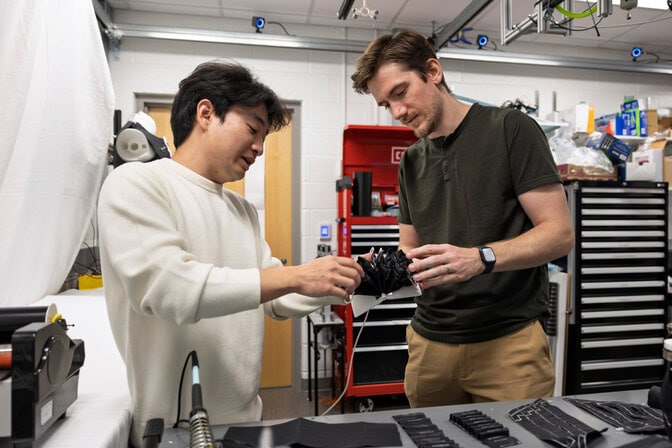
Instead of manufacturing a separate mechanical actuator for every movement a robot needs to perform, University of Michigan engineers have developed a common textile platform that can be configured into multiple kinds of pneumatic actuators. The team calls its material FaBrick. Michigan Engineering highlighted the work on November 24, 2026, following publication of the underlying Science Advances study on September 25.
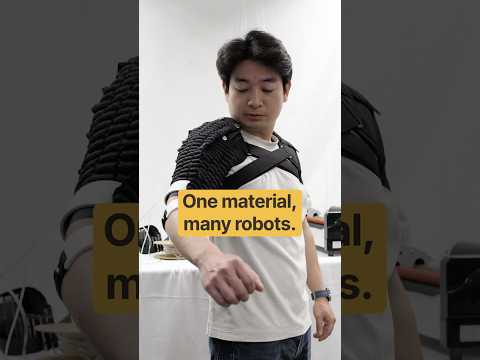
The researchers demonstrated a gripping device, an assistive sleeve, a trunk-inspired manipulator and a four-legged robot. The experiments investigate how a standardized material can reduce the amount of custom manufacturing needed to prototype different mechanical functions.
Air pressure becomes mechanical motion
FaBrick begins with two layers of thermoplastic polyurethane-coated fabric. A heated patterned roller selectively joins the layers, defining inflatable compartments and passageways between them. Developers can isolate compartments, cut the material and fasten sections together to change how forces are transmitted.
A pneumatic actuator converts pressure energy into mechanical work. If a chamber expands outward while its fabric surface resists stretching, its projected length can decrease. That change in geometry produces a pulling action. An asymmetrical arrangement of chambers and constraints can instead cause a structure to curve or twist. The material itself participates in determining the motion, unlike a conventional motor whose shaft movement is subsequently converted through mechanical linkages.
Pressure does not directly determine useful output force without information about chamber geometry, loading and deformation. An ideal piston, for example, delivers pressure difference multiplied by effective area; a flexible textile has an effective area and mechanical leverage that can change throughout its stroke. Designers therefore need force and displacement measurements across operating conditions.
One material, multiple robot architectures
The university reports that individual actuators can be assembled using scissors, a soldering iron and a stapler after fabrication of the base material. The laboratory demonstrations include a deformable gripper and a wearable mechanism designed to assist joint movements. The quadruped uses cylindrical fabric leg structures whose deformation changes as different regions are actuated.
A common stock material could simplify experimentation because a failed mechanical design need not require a new mold. Yet producing a reliable air-driven robot requires more than the actuator itself. A complete system may need valves, tubing, a compressor or pressurized reservoir, pressure regulation, sensors and control electronics. Those components add mass, consume energy and constrain response speed.
Flexible grippers may distribute contact forces across irregular surfaces, while wearable actuators may accommodate body movement without rigid joints. Neither advantage automatically establishes safety or clinical effectiveness. Human-facing devices require evaluation of pressure limits, failure behavior, comfort, durability and the consequences of unintended motion.
From laboratory material to manufacturing platform
The researchers propose continuous roller manufacturing as a route toward producing longer sheets. Commercial adoption would depend on consistent sealing, resistance to repeated inflation, defect inspection and repeatable mechanical behavior. Michigan Engineering says the team has sought patent protection and is looking for commercialization partners. The research does not establish mass-production output, retail availability or a certified medical device.
The work complements our coverage of mobile robot platforms, modular robotic construction, humanoid development kits and collaborative hardware design. Each addresses a different bottleneck between an engineering concept and a working machine. FaBrick focuses on the physical material from which motion emerges.
We volunteer daily to ensure the credibility of the information on this platform is Verifiably True. If you would like to support to help further secure the integrity of our research initiative, please scan the QR code below.



Leave a Reply