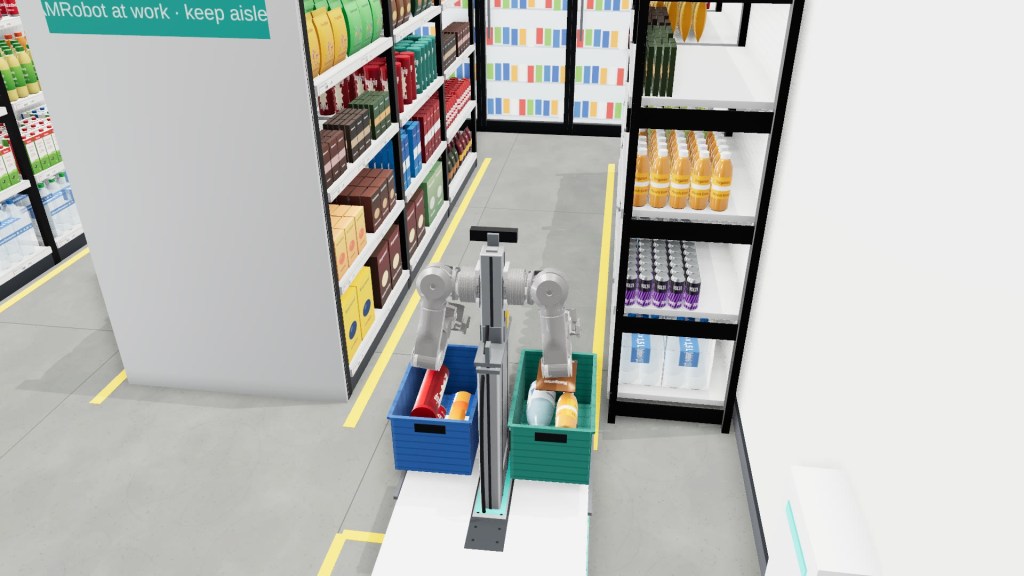
A wheeled robot can carry a parcel across a warehouse, but retrieving objects from shelves requires a different combination of motion planning, perception and manipulation. Botshare’s OpenAMRobot 2.0 project combines two robotic arms with a mobile base and a height-adjustable upper body. A November 2 developer update confirmed that the combined model had been integrated into its robotics software and run in simulation. Physical acceptance testing remains a separate milestone.
Developer simulation: OpenAMRobot picking orders in a virtual grocery environment. The video is linked from the project’s October 20 announcement. It is not footage of a functioning warehouse installation. Watch directly on YouTube.
Featured image: Botshare’s October 20 project simulation, depicting a proposed grocery-order workflow, not a completed physical installation.
Why the robot needs more than two arms
The proposed design uses two OpenArm 2.0 manipulators, each with seven degrees of freedom. A redundant joint arrangement allows an arm to approach an object from different configurations while maintaining an intended gripper pose. Both arms sit above a lift that extends their shoulder height from approximately one meter to 1.35 meters, according to the development announcement.
Coordinating the base, lift and arms expands the space in which the robot can work. It also creates a planning problem: a movement that is safe for one arm may collide with the other arm, a shelf or the robot itself. MoveIt 2 helps calculate collision-aware trajectories, while Nav2 handles mobile navigation. The project’s combined robot model allows developers to experiment with those systems before constructing hardware. A November 9 engineering snapshot reports a Gazebo physics fault: odometry could report movement while the simulated base and lift remained stationary. Results relying solely on odometry require new validation.
A computer for perception, a controller for motion
The published architecture assigns high-level processing to an NVIDIA Jetson Orin NX and base control to an STM32H723 microcontroller. Cameras and lidar provide environmental information, while motor controllers execute movement commands. Its specified 25.6-volt, 105-amp-hour lithium iron phosphate battery represents roughly 2.69 kWh of nominal stored energy. Actual operating time depends on average electrical consumption, usable battery capacity and duty cycle; no measured endurance figure was verified.
Developer community update: the combined model of the base, lift and dual arms. Read the original Reddit discussion.
Teaching a task rather than programming every movement
Botshare describes a learning workflow in which people demonstrate work and provide corrections. Imitation learning can use recorded observations and actions to train a policy that generates commands for new observations. Demonstrations still need appropriate coverage of variations in object position, lighting and grasping conditions. The project’s status page describes the embodied AI pipeline as experimental: dataset quality checks exist, while episode capture and policy execution remain skeleton implementations. A simulated demonstration does not establish reliable handling of unfamiliar objects or safe operation around people.
Botshare’s earlier mobile-platform demonstration, published before the dual-arm release. Watch directly on YouTube.
Open development and the remaining engineering gates
The developers identify MIT licensing for software, CERN-OHL-P-2.0 for hardware and CC BY 4.0 for documentation. Their release repository describes versioned archives with pinned component commits and checksums, a useful foundation for reproducible engineering. It lists November 20 as a planned release-candidate date and December 18 as the planned final release. A published candidate tag and completed physical acceptance were not independently confirmed.
OpenAMRobot complements our reporting on robot joint motor control, integrated 3D vision, smartphone-based humanoids and edge AI processing. The opportunity lies in making robotic hardware and software easier to reproduce and modify. The next evidence to watch is physical integration, repeatable manipulation performance and documented safety validation.
We volunteer daily to ensure the credibility of the information on this platform is Verifiably True. If you would like to support to help further secure the integrity of our research initiative, please scan the QR code below.



Leave a Reply