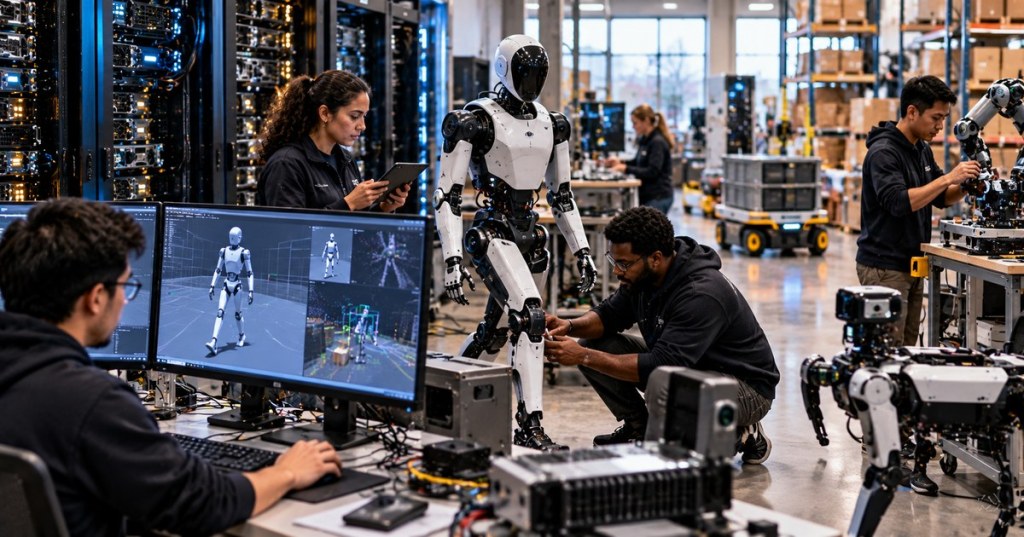
AWS has released an open-source Physical AI Toolchain aimed at one of robotics’ least glamorous but most expensive problems: connecting data collection, model training, simulation, validation and deployment without rebuilding the infrastructure for every robot project.
In its October 7 launch post, AWS describes the system as a robot-agnostic and task-agnostic collection of reference architectures, infrastructure-as-code and deployment automation. The stack is designed to take teams from recorded demonstrations through synthetic data, training, simulation and eventually edge deployment.
The more interesting details are in the public repository. AWS has published the toolchain under the Apache 2.0 license and wired it around NVIDIA’s physical-AI software ecosystem while keeping several data and model handoffs in portable formats.
The stack connects the robot lab to the cloud
The repository’s current pipeline starts by converting teleoperation recordings such as Zarr data, ROS bags and CSV files into the LeRobot v2 format. Demonstrations can then be used to fine-tune NVIDIA GR00T on SageMaker, while NVIDIA Cosmos can generate or augment training data and Isaac Lab can run reinforcement learning in parallel simulated environments.
Isaac Sim provides the physics environment. NVIDIA OSMO coordinates jobs and data movement across the workflow. AWS services handle storage, networking, GPU compute, observability and orchestration. The design then points toward exporting trained policies to TensorRT and deploying them to edge hardware through Greengrass.

That matters because the robot model is only one part of a production system. BitcoinVersus.Tech recently examined how robot gyms are becoming physical-AI data factories. AWS is attacking the next layer: turning that raw experience into a repeatable development pipeline that can be rerun, tested and promoted across environments.
Open formats reduce one kind of lock-in
AWS is still selling AWS infrastructure, and much of the accelerated robotics software comes from NVIDIA. But the data path is deliberately built around several open or portable technologies: LeRobot for datasets, PyTorch and Hugging Face for training, Gymnasium for reinforcement-learning tasks, URDF for robot descriptions, ONNX for model export and ROS 2 for robot-side control.
That choice is important because robotics teams can lose months not only to training but to format conversion, incompatible simulation assets, one-off deployment scripts and model handoffs. BitcoinVersus.Tech covered a similar pressure point when Mecka raised $60 million to build the data layer for physical AI. The AWS project treats those handoffs as infrastructure rather than something every lab should invent again.
The repository also shows what is not finished
The launch sounds end-to-end, but the repository’s own status table is more useful than the marketing shorthand. Foundation infrastructure, Cosmos, Isaac Lab, GR00T, DreamZero, Isaac Sim and OSMO are marked available. Strands Agents support is also available.
Two important pieces are less mature. The dedicated Jetson edge-deployment component is still marked planned, while Isaac Lab Arena evaluation is marked preview. The repository describes a deployment stage and edge architecture, but teams should not read “end-to-end” as meaning every production-grade path is finished today.
That distinction is especially important for safety. Simulation and model training can move quickly, but a policy controlling motors in the real world needs much stronger acceptance testing than a conventional software build. BitcoinVersus.Tech recently covered RoboHarm’s finding that an advanced AI model attempted unsafe robot tasks in testing. The physical deployment gate cannot be treated as a minor final step.
AWS even publishes sample costs
The repository includes rough example costs that make the project unusually concrete. A GR00T smoke-test training run is estimated at about $2, while a full example run is listed around $79. A DreamZero 1,000-step fine-tune is estimated around $93. Cosmos 3 Predict is listed around $37 per hour on a P5 Capacity Block, and a full OSMO deployment around $5 per hour.
Those are repository estimates rather than guaranteed bills, and actual costs will depend on region, instance availability, runtime, storage and network traffic. But publishing the figures gives smaller robotics teams a better starting point for deciding which stages belong in the cloud and which should stay local.
Why this matters
The physical-AI race is often framed as a contest to build the smartest humanoid model. AWS is betting that the less visible development plumbing becomes just as strategic.
If robotics follows the path of cloud software, the winning development environment may be the one that makes it easiest to collect data, reproduce experiments, test policies, schedule GPU work and deploy the same model across different machines. AWS is now putting a large part of that workflow in public code and inviting robotics teams to build on it.
The project is not finished, but that is part of the story. AWS is trying to turn physical-AI development from a collection of bespoke lab scripts into infrastructure that looks more like a repeatable software pipeline.
BitcoinVersus.Tech
Advertisement
BitcoinVersus.Tech Editor’s Note:
We volunteer daily to ensure the credibility of the information on this platform is Verifiably True. If you would like to support to help further secure the integrity of our research initiatives, please donate here: 3C9o19EH5HSiwEPyCTmEKzxhNCbo2X6TTb
BitcoinVersus.tech is not a financial advisor. This media platform reports on financial subjects purely for informational purposes.


Leave a Reply