
Hugging Face released LeRobot v0.7.0 on November 5, 2026, adding a way to give robots new text instructions while their AI controllers are running. Operators can switch tasks, ask a model about its camera view or request a broader goal without unloading the robot policy. The release also introduces remote GPU inference and streaming access to a collection approaching 300 terabytes of open robotics data. The upgrade connects training data, model execution and live interaction rather than introducing one new robot.
Robot-learning software typically records demonstrations from camera feeds and joint sensors, trains a policy to predict actions, then executes the policy on hardware. Previously, changing high-level instructions could require interrupting a session. The new interactive-rollout workflow keeps robot connections, model weights and processors loaded between commands.
Hugging Face’s official June 3, 2026 LeLab demonstration shows recording, training and testing robot policies. Background on LeRobot’s workflow, not footage of the November 2026 upgrade. Source: Hugging Face / YouTube.
Robot commands can change without restarting the policy
With lerobot-rollout --interactive=true, the operator can issue /subtask to change an instruction, /vqa to ask about the scene and /autosteer to set a goal that the system divides into smaller tasks. Text responses and autonomous planning require a compatible language-generating policy, such as FineART-VLA or Wall-OSS-0.5, or an external vision-language planner. The commands do not guarantee reliable task completion, accurate visual answers or safe operation.
The feature builds on language-annotated robot datasets. Hugging Face cites FineART’s more than 40,000 bimanual episodes and 533,000 subtask annotations, showing how instructions can become training targets rather than static captions. Earlier BitcoinVersus.Tech coverage of 85,336 simulated robot demonstrations describes a separate dataset; simulated examples and real-world outcomes must not be treated as equivalent.
Remote GPUs reduce the computer needed on the robot
LeRobot’s new lerobot-policy-server places large models on a GPU workstation while cameras and motors remain local. The robot sends observations through Zenoh networking and receives action chunks; buffering can overlap movement with model computation. Hugging Face provides transport security and access-control options, but network loss, command delays and expired actions still require hardware-specific safeguards.
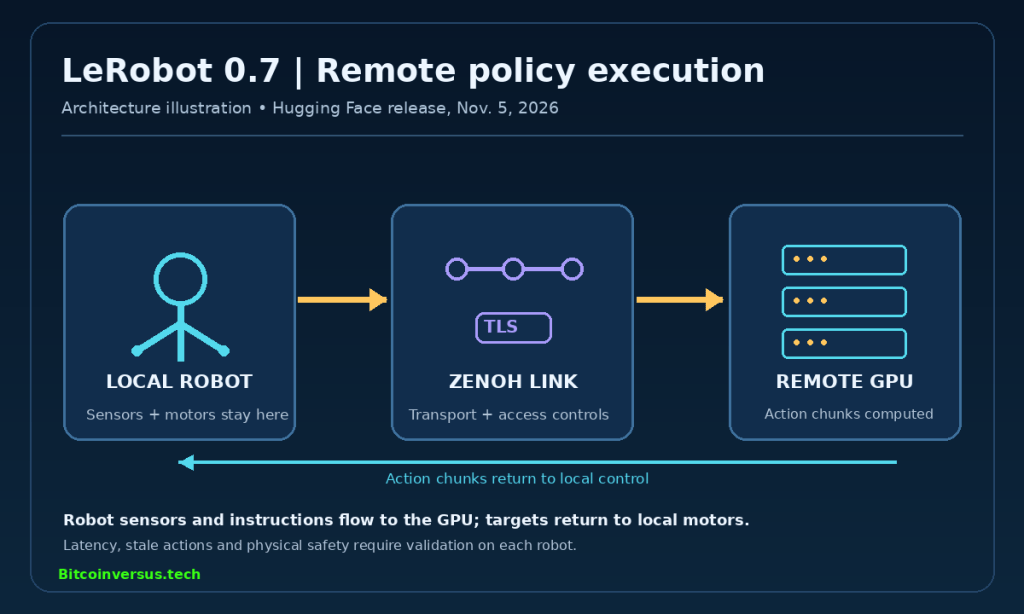
The change makes external compute practical for lightweight robots, including supported Unitree G1 configurations. It does not remove the need for emergency stopping, safe motion limits and local control. Related robot-planning latency research illustrates why timing, not just model size, matters.
Training improvements are substantial but workload-specific
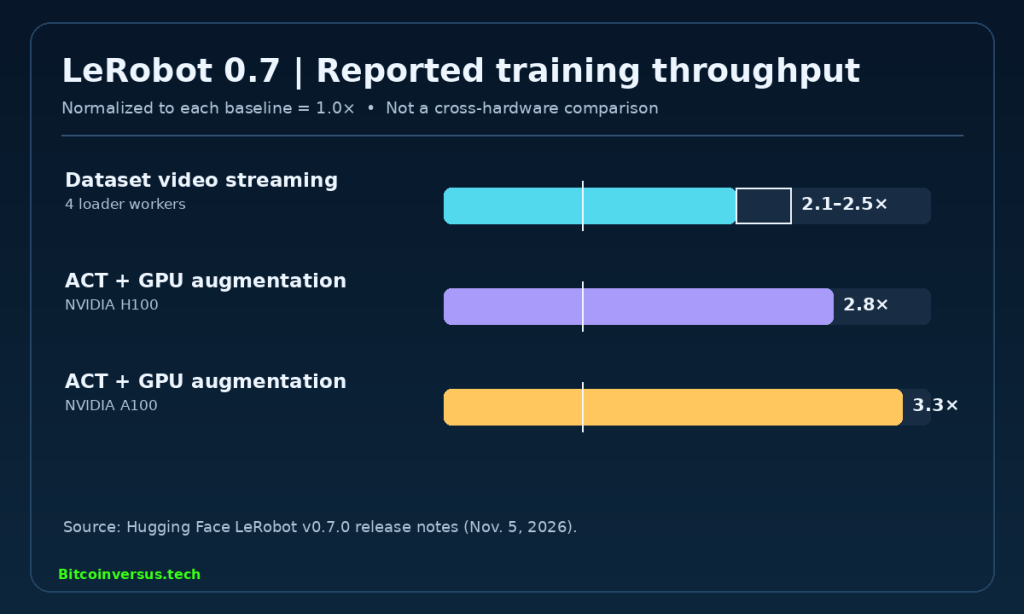
Hugging Face says the Hub holds almost 300 TB of robot data in LeRobot format. New video-range streaming avoids downloading an entire dataset before training; its release tests report 2.1–2.5 times more samples per second with four data-loader workers. GPU-side image augmentation increased ACT training throughput by 2.8 times on an H100 and 3.3 times on an A100. Those comparisons have separate baselines and cannot be combined into one overall speedup.
Hugging Face’s July 23, 2024 research presentation on ALOHA and Action Chunking with Transformers explains an earlier robot-learning architecture. Historical background only, not a LeRobot 0.7 demonstration. Source: Hugging Face / YouTube.
Version 0.7 also adds world-action models including NVIDIA Cosmos 3 and supports sharded training for larger policies. The model integrations complement earlier reporting on NVIDIA Cosmos 3 simulation models and AWS open robotics tooling. Hugging Face’s reported benchmark successes remain simulation or test-set measurements, not evidence of unsupervised factory reliability.
What developers still need to verify
The official GitHub release documents breaking changes, including removal of the older asynchronous-inference module in favor of the remote server workflow. Developers should check installation dependencies, model licensing, dataset provenance, latency under load and emergency-stop behavior before upgrading deployed equipment. An estimated 300 TB of available recordings describes storage scale, not dataset quality, unique task count or certification of physical safety.
The achievement is a more integrated open-source robotics workflow. Its value will depend on whether teams can reproduce the reported improvements and maintain safe, predictable control outside controlled demonstrations.
Editor’s Note
Reporting sources: Hugging Face LeRobot v0.7.0 release, November 5, 2026; official GitHub release notes; LeRobot documentation. Performance figures are developer-reported benchmark comparisons, not independent measurements. The diagrams are conceptual originals and the featured cover is an editorial illustration. Both Hugging Face YouTube videos predate v0.7.0 and serve only as technical background. A rendered iframe does not establish successful playback or embedding permission.
Support BitcoinVersus.Tech
Readers wishing to contribute 5,000 satoshis may scan the original QR with a compatible Bitcoin wallet. When using one phone, display the QR on a second device or use supported saved-image scanning. Confirm the destination and amount before sending.

We volunteer daily to ensure the information on this platform is Verifiably True. If you would like to support the research, please scan QR code.


Leave a Reply