NVIDIA released four open-weight Cosmos 3 Nano checkpoints on November 5, expanding its physical-AI toolkit for robots and autonomous vehicles. The new models generate simulated observations conditioned on actions, sensor inputs and environmental controls, allowing developers to study how machines might behave before running physical experiments.
World models predict how an environment changes as an agent moves or acts. Unlike a conventional image generator, an interactive simulation must account for successive actions and maintain useful relationships between objects, camera views and sensor measurements. NVIDIA describes the release as a set of post-trained examples rather than finished autonomous-driving or robotics products.
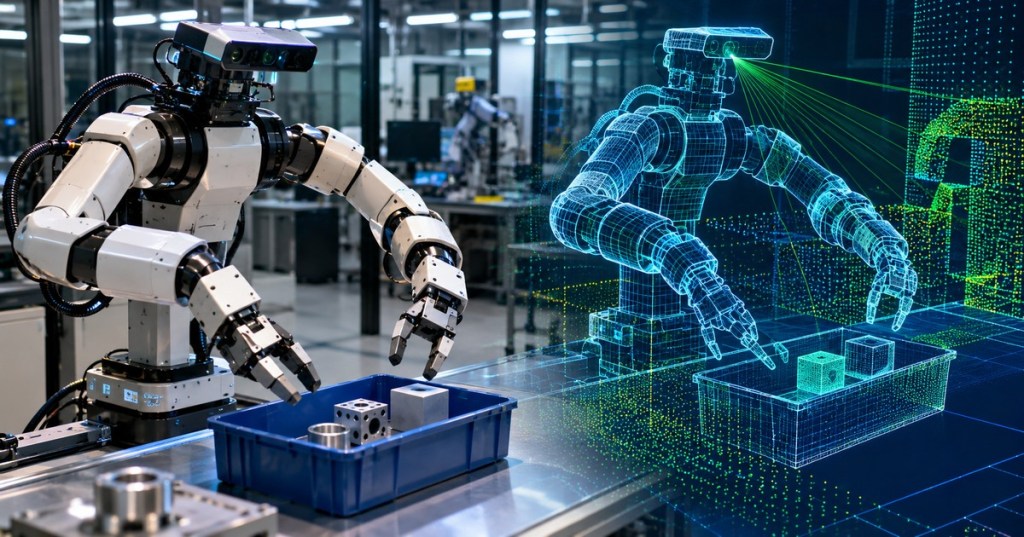
Four checkpoints target different simulation tasks
Cosmos3-Nano-Transfer-Auto generates multi-camera driving scenes with changes in lighting, weather and time of day. It supports synchronized camera observations and LiDAR data, which can help researchers test perception systems under varied conditions. Cosmos3-Nano-Sim-Auto instead streams observations as a simulation updates, making it more suitable for interactive driving experiments.
Cosmos3-Nano-Sim-Transfer converts simulator-derived spatial controls, including depth, segmentation and edges, into detailed RGB video. The underlying physics simulator remains responsible for the actual physical state. Cosmos3-Nano-Sim-Bimanual predicts observations following robot and camera actions, supporting experiments with two-arm manipulation. NVIDIA says each checkpoint has 16 billion trainable parameters.
Those distinctions matter because a visually convincing video is not necessarily a physically accurate simulation. For autonomous machines, inconsistent geometry, object motion or sensor alignment can produce training data that looks realistic while teaching an unsafe behavior. NVIDIA’s research demonstrations provide model-specific examples and technical details, while the release documentation explains the available checkpoints.
Open weights broaden experimentation
The four checkpoints are distributed under NVIDIA’s OpenMDW1.1 terms for commercial and noncommercial use. Open weights can lower barriers for laboratories adapting a model to new cameras, robotic hands or warehouse settings. However, deployment still requires compatible hardware, software integration, testing and substantial engineering work.
NVIDIA reports 48.1 frames per second for its bimanual simulation configuration on one GB300 GPU, while a transfer configuration reached 15.85 frames per second on one GB200. The multi-view driving configuration ran at 16.7 frames per second using 16 GB200 GPUs. Such measurements describe specific demonstrations and hardware configurations, not universal real-world performance.
The development follows broader work on interactive robotics world models and real-time simulated environments. Earlier open-source robotics tooling and CMU robotic manipulation research also illustrate growing interest in reproducible physical-AI development workflows.
Simulation still needs physical validation
Generated environments can help expose edge cases, reduce some data-collection costs and accelerate iteration, but no synthetic test alone establishes a robot’s safety or reliability. Researchers must compare predictions with real sensor recordings and measured physical outcomes, especially for rare hazards. NVIDIA acknowledges that faithful policy-learning evaluation remains an open challenge.
Developers can inspect the released model cards, weights and technical report before choosing a configuration. The next meaningful evidence will come from independent reproduction of the performance figures and controlled tests showing whether simulation-trained policies transfer to real machines.
Editor’s Note: We volunteer daily to ensure the information on this platform is Verifiably True. If you would like to support the research, please scan the QR code below.

We volunteer daily to ensure the information on this platform is Verifiably True. If you would like to support the research, please scan QR code.


Leave a Reply