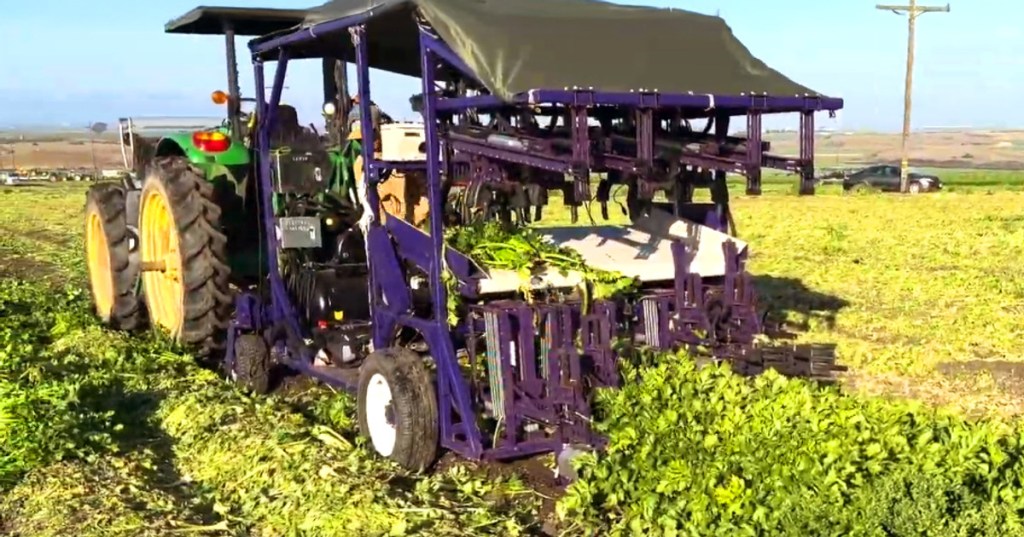
California agricultural robotics startup Beagle Technology is drawing attention for an AI-guided vegetable harvester built to work with tractors growers already own. Its V100 machine combines cameras, onboard machine vision and mechanically actuated cutting equipment to identify individual plants and cut their stems as the tractor moves. The company markets the system for romaine and iceberg lettuce, celery, napa cabbage and bok choy—not merely for a single crop.
A social-media post shared by @bernsteinres has brought renewed attention to the harvesting technology. The machine represents a practical form of farm robotics: its computer controls the harvesting mechanism, while the existing tractor supplies mobility. A robotic cutter on a tractor should not be confused with a fully self-driving agricultural vehicle.
How Beagle’s See and Cut system works
According to Beagle’s V100 technical description, the camera recognizes a plant’s position and structure while software estimates the appropriate cutting height. An attached cutting mechanism performs the stem cut, and a guiding assembly helps handle the vegetable. The process must repeat for plants that vary in size, leaf shape and position. A fixed-height blade can damage marketable crops or leave inconsistent cuts; vision guidance aims to reduce those problems.
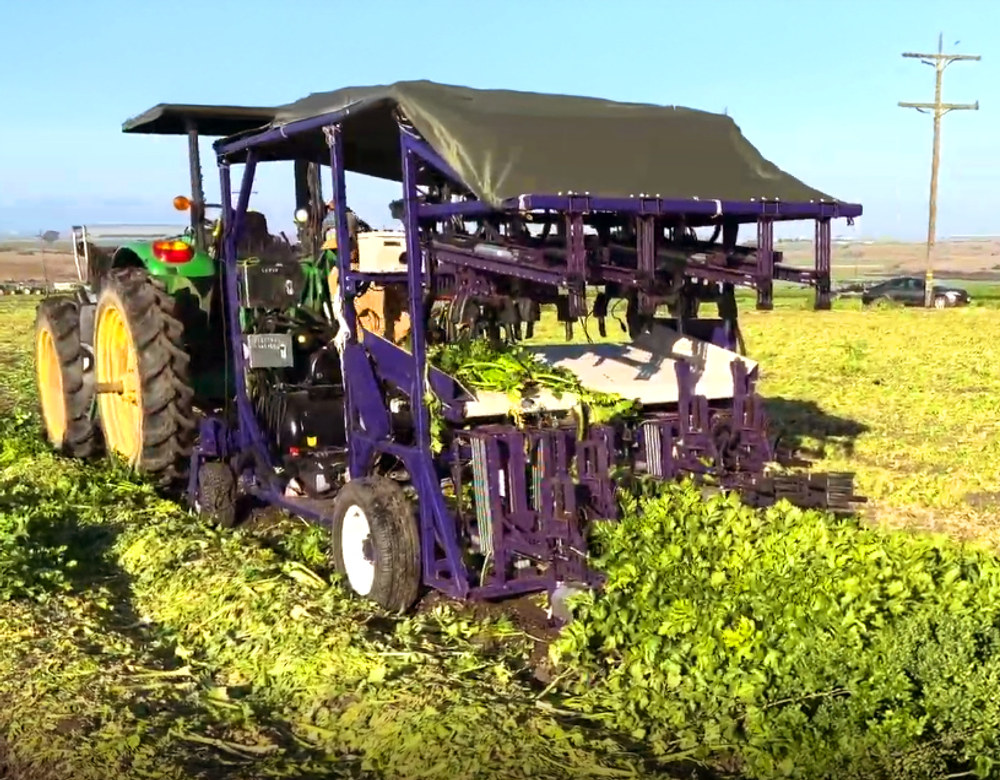
Beagle says its AI Control Box communicates with standard hydraulic or pneumatic machinery, with camera-guided cutting precision of one-eighth of an inch under company-described conditions. Growers can add automation to an existing workflow instead of purchasing an entirely new vehicle. The vendor also advertises installation without manual calibration and field operation at normal tractor speeds, although independent tests across different crops and weather conditions are limited.
The economics depend on more than the blade
The manufacturer claims its technology can reduce manual labor costs by at least 50%, but offers no publicly audited cost model covering every field configuration. Worker savings depend on the existing crew, machine utilization, seasonal crop conditions, maintenance, training and the speed of packing. Cutting vegetables faster does not guarantee that sorting, boxing and shipment can keep pace.
An AUSVEG report on U.S. harvesting demonstrations provides a useful operational check. Australian grower Adam Schreurs described output of approximately 4,000 celery plants daily per Beagle cutting unit during discussions about the equipment. He also identified packing after the cutter as an unresolved bottleneck. The celery figure cannot be transferred directly to lettuce fields, where spacing, handling and packing requirements differ.
Harvesting is harder than a controlled robot demonstration
Outdoor harvesting systems must handle mud, crop variability, shifting sunlight, shadows, dust, rainfall and mechanical vibration. Their software must recognize the produce while their actuators make safe, repeatable cuts around fragile leaves. The agricultural environment poses a different engineering challenge from controlled warehouse or factory automation.
Earlier BitcoinVersus.Tech reporting covered Serve Robotics’ commercial robot data tools and Menlo’s open-source humanoid robotics kit. Beagle takes a different route: computer vision and mechanical cutters are integrated into established farm equipment rather than requiring a general-purpose humanoid robot.
The distinction matters for industrial deployment. AGCO’s planned Digit factory-robot pilot involves internal manufacturing logistics, whereas Beagle’s V100 must operate among living crops in uncontrolled fields. Basic mechanical safety principles, including load and motion verification described in BitcoinVersus.Tech’s robot payload lesson, remain important even when AI selects the target.
Commercial readiness still needs field measurements
Beagle has conducted grower demonstrations and offers farm trials, but public data remain insufficient to establish a universal harvesting rate, payback period or damage rate for lettuce. The essential independent tests are harvested heads per productive hour, accepted marketable yield, labor hours per packed box, equipment downtime and total cost per acre. For growers, the meaningful result is whether the machine improves the entire harvest—not merely whether a camera can recognize a head of lettuce.
Editor’s Note: Technical features and crop compatibility were checked against Beagle Technology’s V100 product page, its Control Box description and the company’s official harvester demonstration. Operational caveats draw on AUSVEG’s account of grower visits and field trials. The reader-supplied November 6 X post is embedded using its original ID. Its author, date and text were visible in the WordPress-rendered native X blockquote; end-to-end video playback remains unverified. Vendor labor savings, precision and harvesting rates are claims or context-specific observations, not universal audited performance. The featured cover is a resized crop of Beagle Technology’s official product photograph, not an AI-generated depiction.

To donate 5,000 sats, open the article on a separate display and scan the original QR code with a compatible Bitcoin wallet. On mobile, use another screen or your wallet’s supported image-scanning feature. Verify the destination 3C9o19EH5HSiwEPyCTmEKzxhNCbo2X6TTb before sending.
We volunteer daily to ensure the information on this platform is Verifiably True. If you would like to support the research, please scan QR code.
BitcoinVersus.tech is not a financial advisor. Technology and farming coverage is published for informational purposes.


Leave a Reply