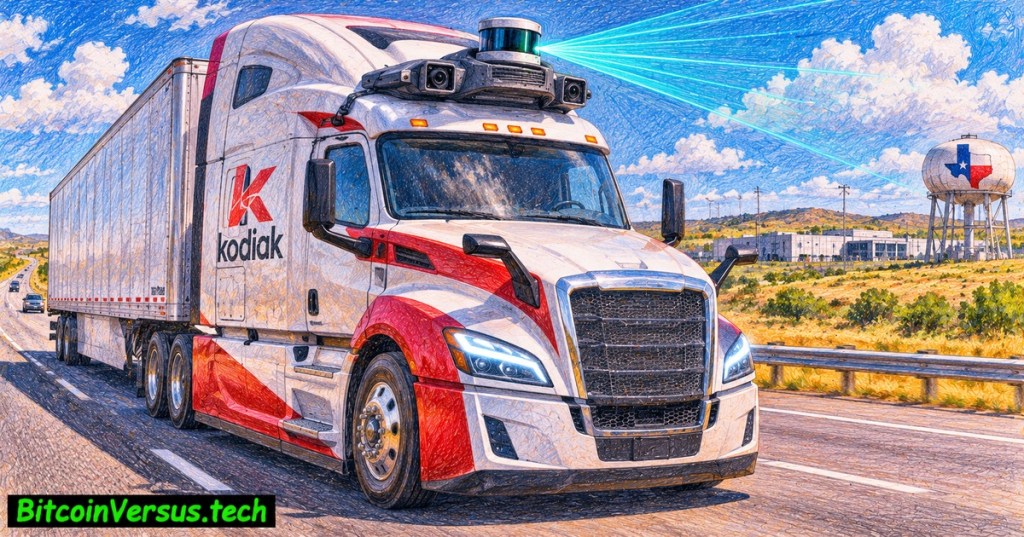
Autonomous trucks are getting a new long-range eye. On November 16, 2026, Kodiak AI and MicroVision announced the integration of MicroVision’s IRIS lidar into Kodiak’s sixth-generation autonomous driving platform. The companies say the sensor can detect hazards beyond 250 meters, supporting a planned driverless long-haul freight launch by the end of 2026. That highway launch remains a target, not a completed nationwide deployment.
The companies also reported 37 trucks using Kodiak technology in a customer-owned fleet as of November 3. Those trucks are already part of commercial operations, primarily industrial work in the Permian Basin. The disclosed figure does not establish that every truck in the fleet is equipped with IRIS, nor that all 37 are operating driverless on interstate highways. The new partnership concerns the perception hardware, not a new 37-truck order.
Official Kodiak AI video, January 2026, showing how Roush Industries integrates Kodiak Driver systems into production trucks. Archival engineering footage, not a demonstration of the new MicroVision IRIS agreement. Watch the verified source video.
Why a Class 8 truck needs longer-range sensing
Lidar sends laser light into the environment and measures returning signals to create a distance-based picture of surrounding objects. MicroVision’s IRIS sensor supplies one layer of perception, working with cameras and radar rather than replacing them. Radar can provide useful relative-velocity estimates; cameras capture signs, colors and road markings; lidar contributes three-dimensional geometry.
At highway speeds, a fully loaded Class 8 tractor-trailer requires substantial distance to react and brake. Seeing an object farther away provides more time for software to classify the obstacle, select a maneuver and command steering or braking. The claimed 250-meter detection range is a manufacturer-reported capability, not a guarantee of safe stopping distance in rain, heavy traffic or every lighting condition.
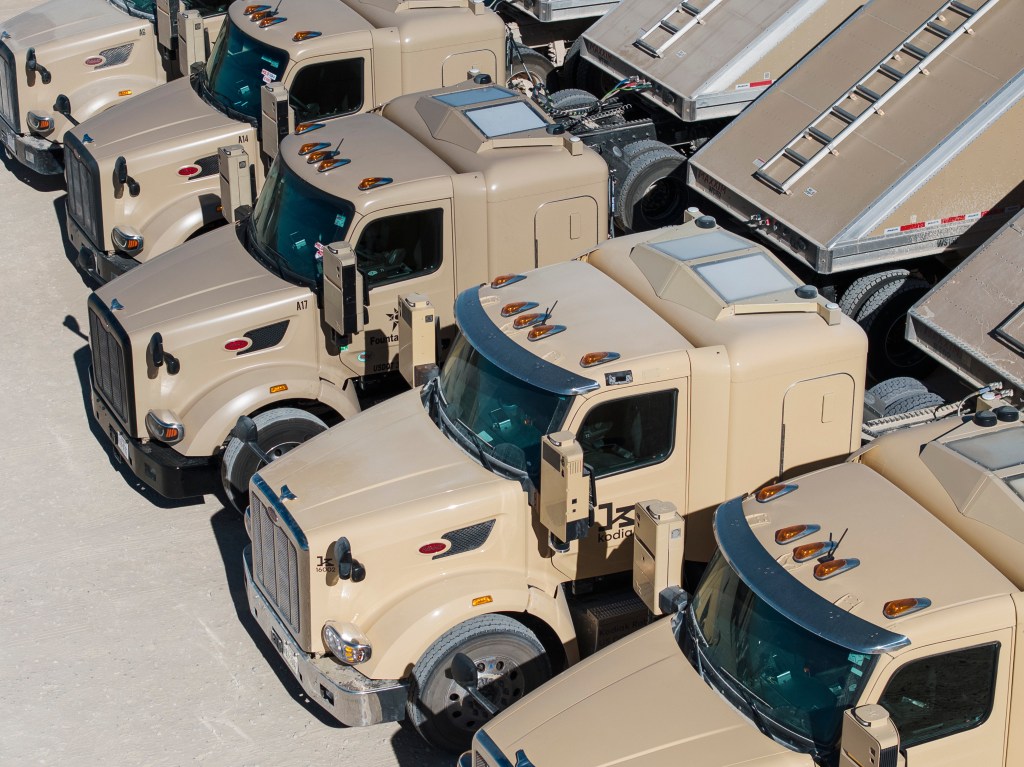
SensorPods are built for commercial maintenance
Kodiak’s modular SensorPod groups lidar, cameras and radar into a compact unit that technicians can service or replace. A sensor damaged by gravel or vibration could otherwise immobilize expensive fleet equipment for longer than necessary. The companies say IRIS has been validated under dust, vibration, challenging weather and changing illumination, although the announcement does not provide independent test protocols or failure rates.
Manufacturing matters as much as the driving algorithms. Kodiak’s Dallas–Houston highway plans depend on integrating sensors and redundant control systems into repeatable truck builds. Its 75-truck freight agreement describes another commercial commitment, not 75 completed autonomous deliveries.
Official Bosch USA video, January 2026, explaining its production-grade autonomous trucking partnership with Kodiak, including sensors, steering and redundant hardware. The footage predates MicroVision’s announcement. Watch the verified source video.
A working industrial fleet is not a long-haul safety certification
Kodiak describes an existing customer-operated fleet and a binding 100-truck order from Atlas Energy Solutions. The 37 deployed trucks are a snapshot of operational scale; the larger order is a contractual commitment with future deliveries. Kodiak’s earlier fleet-order comparison with Aurora explains why deployed vehicles, binding orders and projections must be counted separately.
Unsupervised industrial hauling on familiar routes differs from highway freight that encounters unpredictable construction, merges, debris, pedestrians and severe weather. Regulators, insurers and customers will expect evidence covering the combined sensors, software, actuation, maintenance and remote assistance. Adding a better lidar unit alone does not demonstrate that an entire autonomous driving system has passed those checks.
What happens next
MicroVision says IRIS is already integrated into the sixth-generation platform and that its future HALO lidar may align with later designs. Kodiak is targeting its long-haul service launch before year-end and further scaling in 2027. Dates remain forward-looking; fleet additions, route approvals and operational performance will determine commercial progress.
The broader shift is from prototype sensing to serviceable, production-oriented equipment. Similar challenges also appear in Aurora’s autonomous freight operations. For Kodiak, the next proof point is not a larger sensor specification but reliable driverless highway delivery under real operating conditions.
Sources and verification
Primary sources: Kodiak and MicroVision, November 16, 2026; MicroVision investor release; Kodiak/Bosch manufacturing announcement, January 5. Independent corroboration: Truck News, November 16. Detection range and field-validation claims originate with the companies and are not independently benchmarked here.
Reporting Note: The colored-pencil cover is original conceptual art and its visible lidar beams are illustrative. The in-story company fleet photograph and two official videos predate the MicroVision announcement. None should be interpreted as direct documentation of a specific truck’s new IRIS hardware or as proof of an unsupervised highway rollout. Coverage is informational rather than investment advice.
Editor’s Note: We volunteer daily to ensure the credibility of information on our platform is Verifiably True. Support our research by scanning the QR code below to donate 5,000 sats.

For mobile scanning, open the article on another display and scan the QR code with a Bitcoin wallet. Verify receiving address 3C9o19EH5HSiwEPyCTmEKzxhNCbo2X6TTb before sending.
BitcoinVersus.tech provides technical and financial journalism for informational purposes only and does not provide investment, legal or cybersecurity assurance.


Leave a Reply