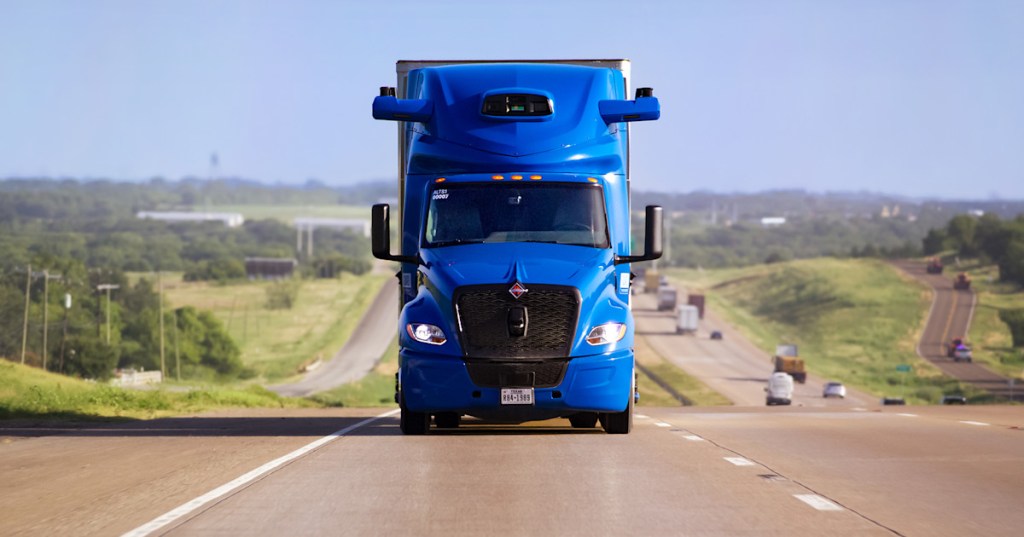
Autonomous semi-trucks are already transporting paying customers’ freight on American highways. Aurora began commercial driverless operations in Texas in May 2025, and its October 28, 2026 shareholder letter reports more than 500,000 cumulative commercial driverless miles reached in September. The question is no longer whether a tractor-trailer can operate without a driver, but how quickly the technology can expand beyond validated routes. Our earlier Aurora freight report provides historical context.
CNBC’s September 22, 2026 ride-along and interview with Aurora CEO Chris Urmson. Watch directly on YouTube.
Commercial trucking is moving beyond demonstrations
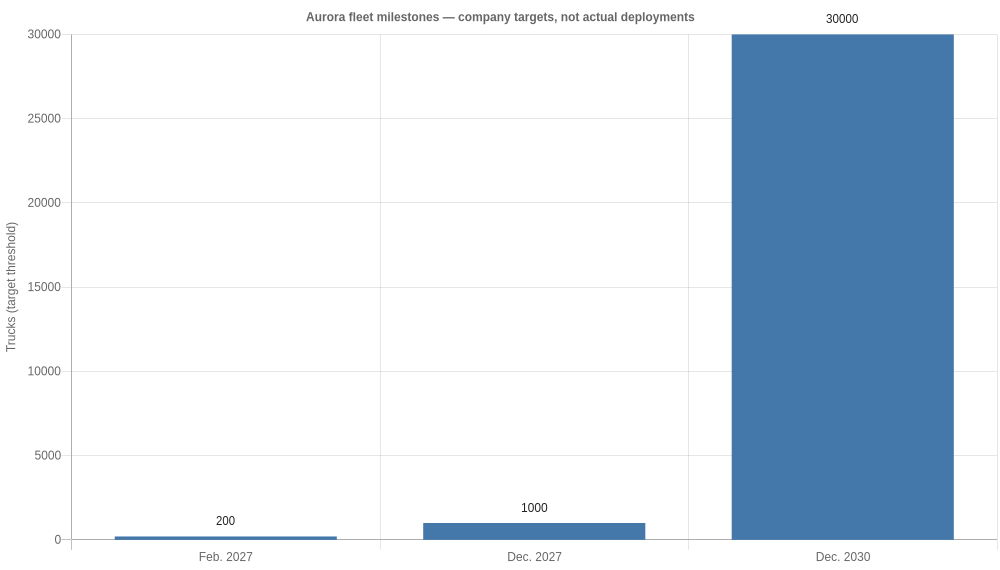
Aurora reported more than 20 driverless trucks built and entering its fleet in October. Its July launch update identified ten driverless routes in the Sun Belt, although roadside support personnel may ride in some vehicles without supervising the driving. Management targets exceeding 200 trucks by the end of February 2027 and 1,000 by the end of 2027, with a 30,000-truck ambition for 2030. Manufacturing constraints have already delayed the production ramp, so these targets are not guaranteed.
Kodiak AI’s November 5 quarterly filing identifies 37 customer-owned driverless trucks operating in industrial applications and a binding agreement for 75 DTL Transport trucks. Its public-highway driverless launch remains a year-end 2026 target in the filing. The distinction between orders, delivered vehicles and actual driverless service matters, as our comparison of trucking commitments explains. Daimler-backed Torc targets commercial availability in 2027, while Waabi announced routine customer freight operations in October; autonomous freight alone does not establish an empty cab.
The engineering and regulatory bottlenecks
Level 4 autonomy means the system performs the driving task and manages fallback within defined operating conditions. It does not imply unrestricted operation on every road. Redundant steering, braking, power distribution, cameras, radar and lidar help manage failures and perception uncertainty. Our Kodiak lidar analysis examines sensing distance; our steer-by-wire explainer describes electronic steering architectures.
Operational barriers include snow, roadworks, urban turns, loading docks, inspections, mechanical failures and remote assistance. In October, the Federal Motor Carrier Safety Administration granted a limited five-year exemption allowing qualifying Level 4 commercial vehicles to use cab-mounted warning beacons instead of manually placed roadside warnings. That is a specific regulatory adaptation, not blanket nationwide approval.
Aurora’s October 2026 business review discusses operations and management’s forward-looking manufacturing plans. Watch directly on YouTube.
When will driverless trucks become common?
Our conditional editorial forecast places broader commercial corridor expansion in 2027–2029, substantial interstate adoption in favorable operating regions in 2030–2035, and widespread all-weather door-to-door service in 2035–2045 or later. These windows are judgments, not measured probabilities or company promises. Human drivers will remain important for complex routes, exceptional conditions, local deliveries and specialized freight. Adoption will depend on independently evaluated safety, fleet economics, manufacturing capacity, insurance, public acceptance and regulation.
The near-term opportunity is highway freight on repeatable routes. Replacing every human-operated semi-truck is a considerably harder engineering and economic problem, and no defensible nationwide completion date exists.
Featured photograph: Aurora’s July 22, 2026 second-generation truck announcement, cropped for editorial presentation.
We volunteer daily to ensure the credibility of the information on our platform is Verifiably True. If you would like to support to help further secure the integrity of our research initiative, please scan the QR code below.



Leave a Reply