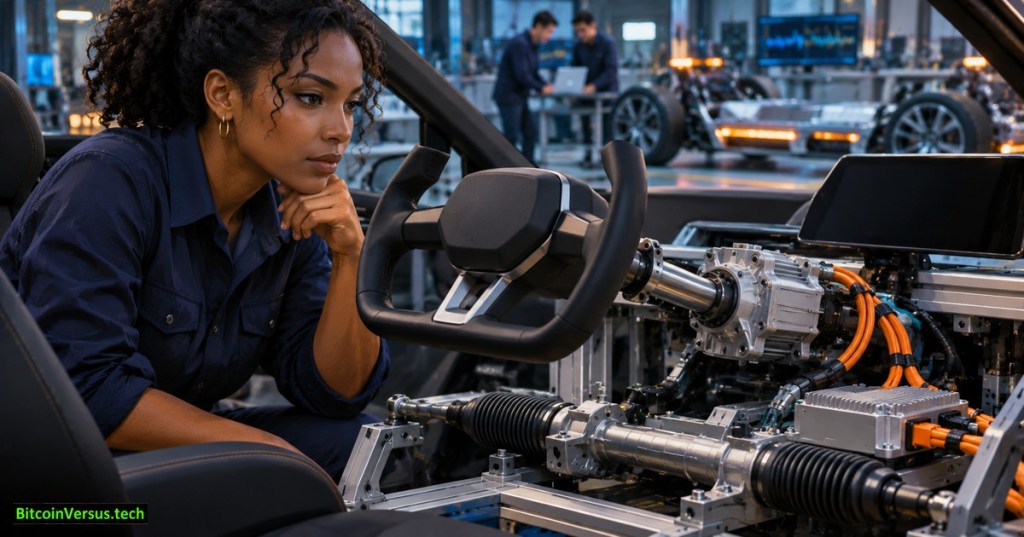
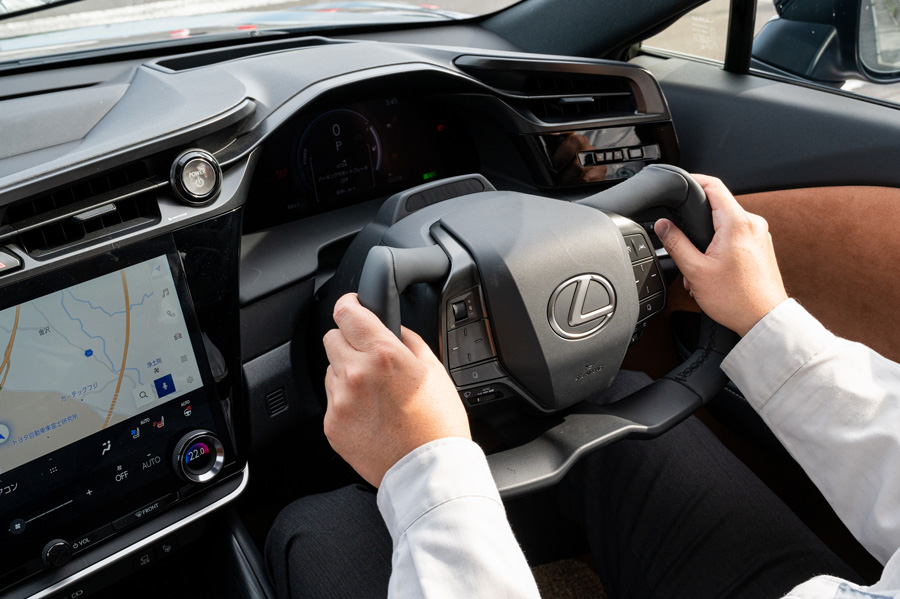
Steer-by-wire is a vehicle steering system that transmits a driver’s steering command electronically rather than through a permanent mechanical shaft linking the steering wheel to the road-wheel rack. Sensors, controllers and electric actuators replace the command path; mechanical tie rods still move the front wheels. Commercial examples include Tesla’s Cybertruck and selected international versions of the Lexus RZ, illustrating how software increasingly governs the driving interface.
| Engineering category | Electronically commanded vehicle steering |
|---|---|
| Driver input | Steering-wheel position and torque sensors |
| Road-wheel actuation | Electronic control system driving an electric steering motor |
| Mechanical driver-to-rack link | Absent in fully linkless designs |
| Steering ratio | Software-variable in applicable implementations |
| Example applications | Tesla Cybertruck; selected global-market Lexus RZ variants |
How electronically commanded steering works
Sensors determine the driver’s intended direction and steering effort. A controller interprets the signals and commands a motor at the steering rack; another actuator can produce force feedback at the steering wheel. Unlike conventional electric power steering, a genuinely linkless arrangement does not rely on the driver physically turning the road-wheel mechanism through a steering shaft. Lexus’s February 2026 engineering description identifies separate steering torque and steering control actuators.
Discover Lexus official technical video demonstrates the new RZ’s steer-by-wire steering and feedback system. Watch on YouTube.
Software-defined steering ratio
The controller may vary the relationship between steering-wheel rotation and road-wheel angle with vehicle speed. A lower effective steering ratio favors compact parking movements; a higher ratio supports stability at highway speeds. Lexus specifies approximately 200 degrees of steering-wheel motion from the neutral position toward either lock, or roughly 400 degrees from extreme left to extreme right. The figure is specific to the described Lexus system, not a universal standard.
For illustration, if 90 degrees of driver input produces 15 degrees of front-wheel steering, the instantaneous geometric ratio is 90 ÷ 15 = 6:1. The arithmetic is a hypothetical example, not a tested Lexus or Tesla setting. Real systems apply variable mappings, limits and filtering.
Redundancy and backup power
Removing a mechanical steering link makes electrical and electronic fault tolerance especially important. Steering control must remain manageable during defined faults, including failures affecting power, sensors or control electronics. Steering-supplier JTEKT confirms that the Lexus RZ system has a redundant design and uses a dedicated high-temperature-tolerant Libuddy lithium-ion capacitor as an auxiliary supply. According to JTEKT, the reserve aims to permit movement to a safe location after a vehicle power failure. It is not a promise that steering remains available indefinitely.
The absence of a mechanical link does not establish autonomous-driving capability or guarantee safety. Validation must address diagnostic coverage, steering response latency, electromagnetic interference, motor faults, backup-energy availability and degraded operating modes.
Tesla’s official Cybertruck video illustrates a separate commercially deployed implementation of steer-by-wire. Watch on YouTube.
Deployment and market differences
In the United Kingdom, Lexus listed steer-by-wire as standard on the 2026 RZ 550e F Sport and F Sport Takumi. Lexus did not offer the technology on the U.S.-specification 2026 RZ, a distinction confirmed in American reporting and regional product disclosures. Vehicle equipment varies by market and model year; an international demonstration should never be interpreted as proof of U.S. availability.
| System | Driver-to-rack linkage | Steering assistance/control |
|---|---|---|
| Hydraulic power steering | Mechanical | Hydraulic pressure assists |
| Electric power steering (EPS) | Mechanical | Motor assists driver’s torque |
| Linkless steer-by-wire | No rigid mechanical path | Electronic command and motor actuation |
Why the technology matters
Linkless steering enables new cockpit packaging and programmable feedback, while increasing dependence on automotive electronics and rigorous verification. Related systems in our archive include automotive RISC-V control processors, Aptiv’s driver-assistance platform, EV onboard power conversion, and the difference between vehicle control and self-driving claims. Steering precision, electrical resilience and trustworthy driver feedback remain engineering requirements, regardless of cockpit design.
Primary references
- Lexus UK, “Steer-by-Wire: Driving Reinvented,” February 16, 2026.
- JTEKT, steer-by-wire system and Libuddy auxiliary power, October 1, 2025.
- Toyota Global Newsroom, Lexus RZ international launch specifications.
- Lexus USA, 2026 RZ regional product announcement.
- Car and Driver, U.S. steer-by-wire availability confirmation.
We volunteer daily to ensure the credibility of the information on this platform is Verifiably True. If you would like to support to help further secure the integrity of our research initiative, please scan the QR code below.



Leave a Reply