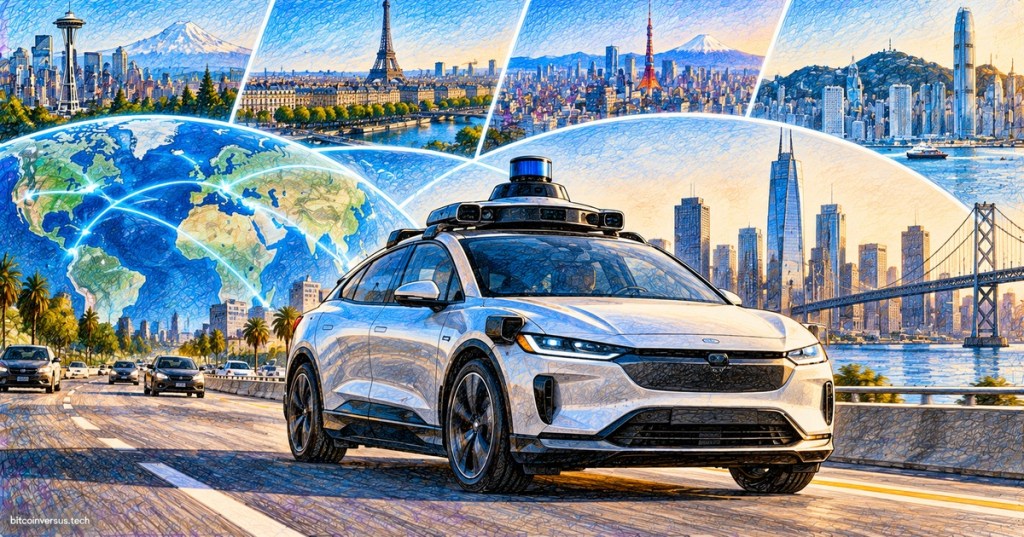
Waymo has closed a $5 billion term loan—its first debt financing—as Alphabet’s autonomous-driving unit accelerates a robotaxi expansion that is moving from a handful of U.S. cities toward a global transportation network. The new loan comes after Waymo raised $16 billion in equity earlier in 2026 at a $126 billion valuation, meaning the company has now announced or closed roughly $21 billion of new equity and debt financing this year.
Reuters reports that PIMCO, Blackstone, and Sixth Street participated as lead syndicated lenders, with Capital Group, Loomis Sayles, and T. Rowe Price as significant lenders. Goldman Sachs served as sole lead bookrunner. The financing gives Waymo another pool of capital for vehicles, depots, mapping, compute, operations, maintenance, insurance, and the other expensive infrastructure required to turn autonomous-driving software into a real transportation business.
Waymo Is Moving From Venture Funding Into Debt
The important shift is not only the size of the financing but the type. Waymo historically relied on Alphabet support and outside equity investors. A term loan introduces debt into the capital structure, which means lenders are now willing to underwrite Waymo as an operating business rather than only as a long-duration technology bet.
That does not make robotaxis cheap. Autonomous ride-hailing requires a large physical stack: vehicles, cameras, lidar, radar, onboard compute, charging infrastructure, fleet depots, maintenance, remote assistance, mapping, insurance, and city-by-city operations. BitcoinVersus.Tech has previously looked at the broader physical-AI opportunity through Mobileye, where value increasingly comes from combining AI models with sensors, silicon, robotics, and real-world service networks.
The $5B Loan Follows a $16B Equity Round
Waymo’s February 2026 financing was already enormous. In its official announcement, Waymo said it raised $16 billion at a $126 billion post-money valuation. The round included Alphabet and major institutional investors including Dragoneer, DST Global, Sequoia Capital, Andreessen Horowitz, Mubadala Capital, Bessemer Venture Partners, Silver Lake, Tiger Global, T. Rowe Price, CapitalG, Fidelity, GV, Kleiner Perkins, Perry Creek Capital, and Temasek.
Adding the new $5 billion term loan gives Waymo access to a much broader financing toolkit. Equity investors absorb business risk in exchange for ownership. Debt can fund expansion without issuing the same amount of additional equity, but it also adds interest expense, covenants, and repayment obligations. The financing mix therefore starts to look more like a capital-intensive transportation or infrastructure company than a conventional software startup.
Waymo Is Already Operating Across 15 U.S. Cities
Reuters says Waymo launched operations in its 15th U.S. city in September. Waymo’s own expansion updates show how quickly the footprint has widened: Denver, San Diego, Tampa, Las Vegas, Houston, Dallas, Austin, Atlanta, Miami, Phoenix, Los Angeles, San Francisco, and other metros are now part of a rapidly growing service map.
This scale matters because autonomous driving is not only an AI benchmark. It is an operations problem. Each city introduces different road geometry, weather, construction patterns, pedestrian behavior, emergency-vehicle interactions, local regulation, fleet-service requirements, and edge cases. Waymo’s expansion strategy is therefore a real-world test of whether one autonomous-driving platform can generalize across increasingly diverse environments.
Waymo’s official social update says its fully autonomous service is now operating across 15 cities, underscoring how quickly the deployment footprint has expanded.
Singapore Turns the Expansion Into a Global Story
Waymo is also moving beyond the United States. In September, the company announced a phased launch in Singapore, targeting public commercial service in 2028 after an initial fleet and readiness phase. Waymo said the Singapore program follows more than 20 million fully autonomous rides and more than 300 million fully autonomous kilometers.
The company is also building toward service in Tokyo, London, and Munich. That makes the new debt financing easier to understand: international expansion requires more than translating an app. Waymo must build local operations, obtain regulatory approvals, adapt to road rules, map new regions, train fleet-support teams, secure charging and service locations, and prove safety performance to regulators and the public.
The Waymo Driver Is Physical AI, Not Just Software
Waymo’s system combines multiple sensing modalities with onboard AI compute. The company has argued that cameras alone are not enough for its fully autonomous operating model, instead using lidar, radar, and cameras to build a 360-degree representation of the environment. That makes Waymo an example of physical AI: models perceive the real world, predict how other road users may move, plan a path, and continuously control a machine in a changing environment.
This is also why autonomous vehicles overlap with the same technology stack appearing in robotics, robotaxis, AI accelerators, simulation, high-bandwidth memory, networking, and edge computing. The vehicle is essentially a mobile robotics platform with a safety-critical perception-and-control loop.
Debt Means Waymo Now Has to Prove the Unit Economics
Equity investors can wait years for growth. Debt investors eventually expect principal and interest to be paid. That raises the importance of Waymo’s unit economics: vehicle cost, sensor cost, utilization, maintenance, charging, cleaning, insurance, remote support, depot expense, and revenue per vehicle-hour.
Robotaxis have a theoretical economic advantage because there is no paid human driver in the vehicle. But removing the driver does not remove operating cost. The business only becomes structurally attractive if autonomy allows high vehicle utilization while the hardware, service, insurance, and support stack becomes cheaper per mile as the fleet scales.
The Financing Also Raises the Pressure on Rivals
Waymo is not the only company chasing autonomous mobility. Tesla continues to position its Cybercab around a lower-cost vehicle architecture, while Mobileye is building a broader autonomous-driving and physical-AI platform. Amazon-backed Zoox and autonomous-trucking companies are attacking adjacent segments.
Waymo’s advantage is operating scale. Its challenge is converting that lead into a business that can expand faster than its cost base. The $5 billion loan gives it more time and capital to do that—but because it is debt, it also adds a new financial clock.
From a Weird Traffic Stop to a Global Fleet
The change over just two years is striking. In 2024, BitcoinVersus.Tech covered an autonomous vehicle being pulled over by Phoenix police—the kind of edge-case story that made driverless cars feel experimental and strange. By 2026, Waymo is serving riders across 15 U.S. cities, preparing international launches, and borrowing billions from some of the world’s largest institutional lenders.
That transition is the real story behind the financing. Autonomous driving is moving out of the research-project phase and into the capital-intensive scaling phase. The next test is no longer whether a robotaxi can drive itself around one city. It is whether Waymo can build a global autonomous transportation network with economics strong enough to support both equity and debt.
BitcoinVersus.Tech
Advertisement
BitcoinVersus.Tech covers artificial intelligence, robotics, autonomous vehicles, semiconductors, data centers, software, and the infrastructure behind modern computing.
Editor’s Note
The $5 billion financing is debt, while Waymo’s earlier $16 billion round was equity. Adding the two shows the scale of capital raised or borrowed in 2026, but the instruments have different economics and should not be treated as equivalent funding.
We volunteer daily to help keep the information on this platform verifiably accurate. Support our independent research through the support options available on BitcoinVersus.Tech.
BitcoinVersus.tech is not a financial advisor. Content is provided for informational purposes.


Leave a comment