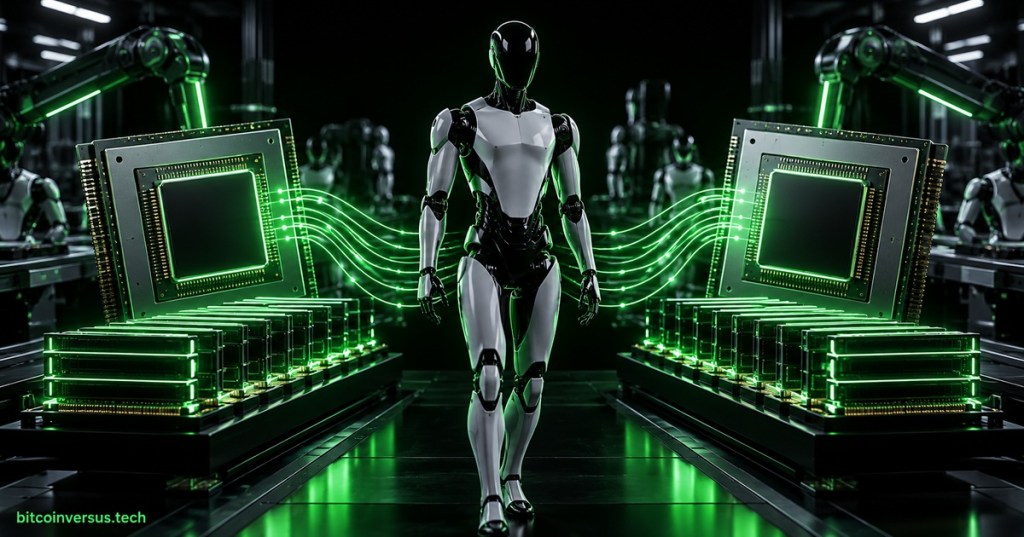
Tesla has already revised one of the most important specifications for its next-generation AI5 processor. After Elon Musk said the chip would drop to 72GB of LP5 memory to secure enough supply for Optimus production, he followed up less than a day later and said AI5 would instead use 96GB.
The change is small in time but large in implication. Tesla is now tuning a core AI-compute component around memory availability before Optimus reaches mass production, a sign that physical AI may be starting to compete with data centers, phones and PCs for advanced memory capacity.
AI5 moved from 72GB back to 96GB in less than a day
On October 1, Musk said Tesla had cut AI5 memory to 72GB of LP5 and AI6 memory to 144GB of LP6. He said the reductions were intended to secure enough volume for Optimus production while preserving memory bandwidth. TrendForce’s semiconductor coverage documented the initial change and the wider supply pressure behind it.
Then Musk changed the AI5 figure. In his October 2 update on X, he said Tesla had decided to “nudge” AI5 upward to 96GB because the company would otherwise be the only buyer using the minimum-RAM version of LP5. No corresponding change was announced for AI6, which remained at 144GB.
The revision says more about supply than raw performance
The unusual part of the announcement is not merely the final number. It is the speed with which Tesla changed the specification after considering the supply consequences of an uncommon memory configuration.
A custom low-capacity configuration can look efficient on a bill of materials but become less attractive if few other customers buy it. Suppliers gain scale by producing standard configurations in large volumes. By moving AI5 to 96GB, Tesla can still use less memory than the earlier 144GB plan while avoiding a configuration that Musk said would leave Tesla alone at the bottom of the LP5 capacity stack.
That matters because BitcoinVersus.Tech has been tracking Tesla’s attempt to move Optimus from prototype demonstrations toward industrial scale. The company has already been pushing suppliers toward an Optimus mass-production ramp, where component availability matters as much as laboratory performance.
Bandwidth is becoming the architectural argument
Musk’s original explanation also separated memory capacity from memory bandwidth. His position was that Optimus performance would be affected only slightly because bandwidth was a larger constraint than the total amount of memory attached to the processor.
That distinction is increasingly important in AI hardware. A processor can have a large memory pool and still wait on data if the architecture cannot move information quickly enough. For a humanoid robot, inference workloads must continuously process cameras, sensors, control loops and planning data under tight latency limits. More capacity helps only when the system can feed the compute engines fast enough.
The same design pressure is showing up across the semiconductor industry. BitcoinVersus.Tech recently examined how OpenAI used AI-assisted engineering to compress the design cycle for its Jalapeño chip. AI silicon is increasingly being optimized as a complete system of compute, memory, interconnect and software rather than as an isolated processor.
Optimus could turn robots into another major memory buyer
If Tesla produces humanoid robots at the scale Musk envisions, each specification choice multiplies across a very large hardware fleet. A difference of tens of gigabytes per processor becomes a procurement problem long before it becomes an engineering footnote.
That is why the AI5 revision is useful beyond Tesla. Data-center operators already compete for high-bandwidth memory, DRAM, storage and advanced packaging. Large robot fleets would add a new source of demand that must also satisfy automotive-style reliability, power and latency requirements.
Tesla is building the surrounding infrastructure too
The memory decision is arriving alongside a broader expansion of Tesla’s AI infrastructure. Reuters reported on Tesla’s accelerating AI-compute and semiconductor-manufacturing push, including new infrastructure and deeper manufacturing ambitions around its future chips.
BitcoinVersus.Tech has also examined the physical scale behind that strategy. The proposed Terafab concept would dwarf conventional semiconductor facilities if built at the scale Musk has described. AI5 therefore sits inside a much larger attempt to control more of the compute stack from chip design through manufacturing, training and robot deployment.
The 96GB decision is a supply-chain signal
Tesla’s final AI5 configuration can still change before volume production, but the 72GB-to-96GB revision already reveals the constraint shaping the design. The company is not optimizing only for benchmark performance. It is optimizing for what suppliers can manufacture at enormous scale.
That is a familiar problem in data centers and ASIC fleets: the best theoretical component is not always the component that can be sourced, powered, cooled and replaced across millions of deployed systems. Optimus is beginning to encounter the same engineering reality before the fleet is even large.
BitcoinVersus.Tech
Advertisement
Editor’s Note
If you value independent technology reporting, consider supporting BitcoinVersus.Tech with a Bitcoin donation: 3C9o19EH5HSiwEPyCTmEKzxhNCbo2X6TTb
BitcoinVersus.tech is not a financial advisor. This media platform reports on financial subjects purely for informational purposes.


Leave a Reply