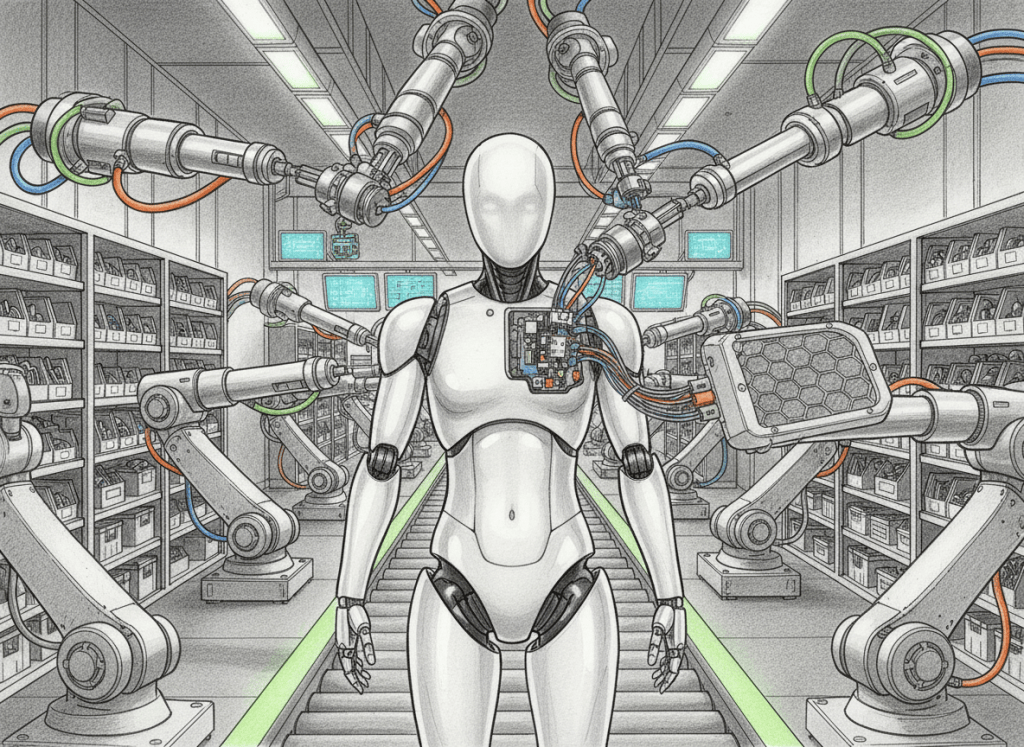
Tesla’s humanoid robot program is moving into a less glamorous but more important phase: proving that thousands of complex machines can be built repeatedly, not just demonstrated on stage. Fresh supply-chain reporting says Tesla robotics teams have been auditing component suppliers across China’s Yangtze River Delta as the company prepares Optimus for higher-volume production.
Reports published September 21–22 identify Tuopu Group, Sanhua Intelligent Controls and Joyson Electronics among companies connected to the audit activity. These companies already have automotive manufacturing experience, which matters because a humanoid robot requires many of the same industrial disciplines: tight tolerances, traceable parts, high-volume quality control and reliable electromechanical assemblies.
The Hard Part Is Repeatability
A prototype robot can be hand-tuned by engineers. A mass-produced robot cannot. Every actuator, joint, sensor, harness, bearing and structural component has to fit and behave closely enough to specification that the next robot coming off the line performs like the one before it.
That is why supplier audits matter. Engineers are not simply checking whether a supplier can manufacture one good part. They are checking process capability: whether the factory can make thousands of parts within tolerance, inspect them, document failures and keep output stable as production rises.
Actuators Are the Robot’s Muscles
Humanoid robots depend heavily on actuators. An actuator converts electrical energy into controlled mechanical movement. In a robot joint, that usually means combining an electric motor, gearing, bearings, position sensing and control electronics into a compact assembly.
The engineering tradeoff is difficult. An actuator needs enough torque to lift and move the robot, but it also needs low mass, low backlash, precise position control, reasonable power consumption and long service life. Multiply those requirements across the many joints in a humanoid body and actuator manufacturing becomes one of the largest hardware challenges in scaling production.
Sensors Turn Motion Into Control
A robot also needs continuous feedback. Encoders tell controllers where joints are positioned. Force and torque sensors can help determine how strongly the robot is pushing or gripping. Cameras and other perception sensors provide information about the surrounding environment.
The software can only control the machine as well as the hardware reports its state. A small sensor error repeated across thousands of robots can become a manufacturing problem, which is another reason automotive-grade supplier experience is valuable.
Reported Production Targets Need Caution
Some current supply-chain reports attach aggressive unit targets and cost estimates to the audits. Those numbers should not be treated as confirmed production results. Tesla’s own public filings have described Optimus production facilities in Fremont and Texas as being built out while early robots collect training data internally. Supplier orders, factory capacity and finished robots delivered are different milestones.
The more useful signals are physical ones: certified suppliers, installed production equipment, stable yield, actual weekly output and robots performing useful work for long periods without intervention.
Robotics Is Becoming a Manufacturing Story
The humanoid-robot race is increasingly about industrial engineering rather than demonstrations. Boston Dynamics is also expanding factory testing of Atlas with Hyundai, while Chinese manufacturers are pushing their own humanoid systems toward production. The companies that succeed will need more than capable AI. They will need supply chains capable of producing electromechanical hardware with automotive-style consistency.
That makes Tesla’s supplier-audit activity worth watching. It does not prove Optimus has reached true mass production, but it shows the problem is shifting from “can the robot move?” toward “can the same robot be manufactured reliably thousands of times?” That is a much harder—and ultimately more important—engineering test.
BitcoinVersus.Tech Editor’s Note:
We volunteer daily to ensure the credibility of the information on this platform is Verifiably True. If you would like to support to help further secure the integrity of our research initiatives, please donate here: 3C9o19EH5HSiwEPyCTmEKzxhNCbo2X6TTb
https://x.com/1BitcoinVersus/status/1937006164555993338
BitcoinVersus.tech is not a financial advisor. This media platform reports on financial subjects purely for informational purposes.


Leave a Reply