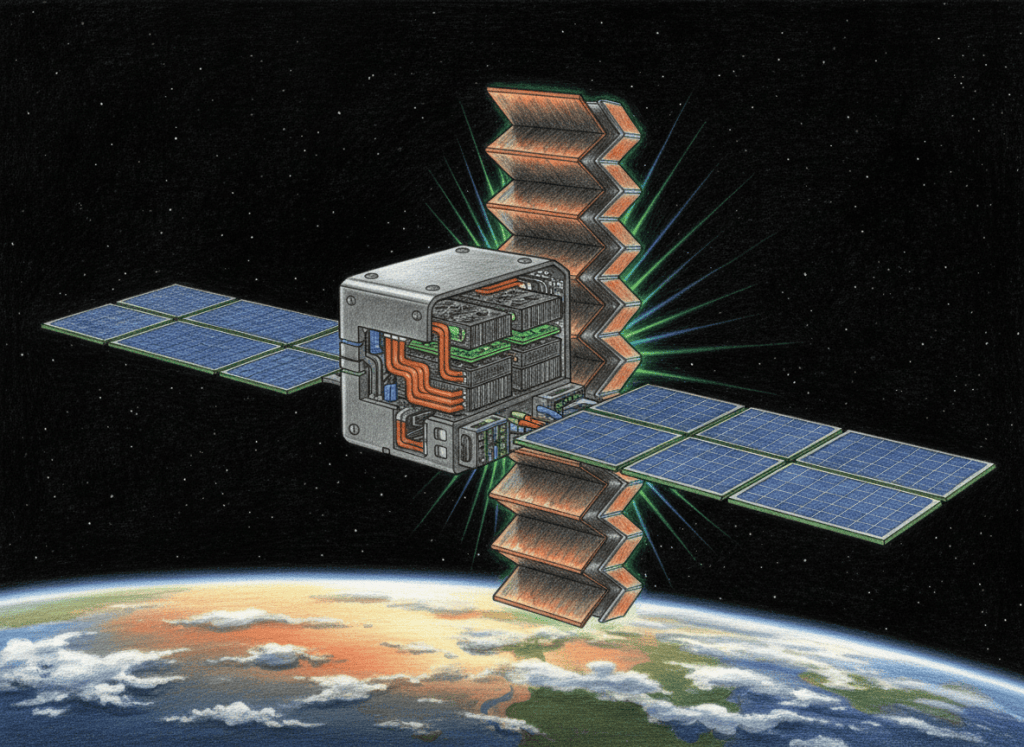
Bitcoin miners have spent years looking for cheaper electricity on Earth. Starcloud is preparing to test a much stranger option: putting dedicated Bitcoin-mining ASICs aboard an orbital data-center spacecraft.
Starcloud CEO Philip Johnston says the company’s next commercial spacecraft will carry Bitcoin mining hardware alongside its GPU compute systems. Tom’s Hardware reported the plan on September 22. The company’s broader orbital-compute program has already flown an Nvidia H100 GPU, while reporting from TechCrunch earlier this year also identified a Bitcoin mining computer among the planned Starcloud-2 payloads.
Solar Power Is the Easy Part
The basic attraction is straightforward. A spacecraft in the right orbit can spend most of its time in sunlight, allowing large solar arrays to generate electricity without buying grid power, negotiating utility interconnections or building terrestrial generation next to a mining site.
ASICs are also much cheaper than cutting-edge AI accelerators for a given amount of electrical load. Johnston has compared roughly one kilowatt of high-end GPU hardware with much cheaper ASIC hardware consuming a similar amount of power. That is a hardware-cost comparison—not a claim that an ASIC is universally more computationally efficient than a GPU, because the two chips perform very different workloads.
Cooling in Space Is Harder Than It Sounds
Space is cold, but vacuum is not an easy cooling medium. On Earth, air-cooled miners move heat from heatsinks into flowing air. Immersion and hydro systems transfer heat into liquids and ultimately reject it through heat exchangers. In a vacuum there is no surrounding air for convection.
An orbital miner must conduct heat away from the chips and ultimately radiate that energy into space as infrared radiation. That makes radiator area, surface temperature and thermal design fundamental limits on how densely compute hardware can be packed into a spacecraft. Starcloud’s commercial spacecraft program is therefore testing large deployable radiators as seriously as it is testing processors.
ASIC Obsolescence Becomes a Launch Problem
Bitcoin ASICs also age economically. New generations can produce more terahashes for each joule of electricity, making older hardware less competitive. On Earth, a mining operator can replace a machine, repair a hashboard or move equipment to a site with cheaper energy. None of those jobs is simple once the miner is orbiting hundreds of kilometers above Earth.
Launch cost therefore becomes part of the mining-hardware lifecycle. An orbital ASIC needs enough useful operating time to justify not only its purchase price and power system, but also the mass and volume used to launch it, its thermal hardware, radiation protection, communications and the inability to perform ordinary field maintenance.
Radiation and Reliability Matter Too
Terrestrial mining hardware is already exposed to demanding operating conditions, but orbit adds radiation and launch vibration. High-energy particles can cause faults in electronics, while a rocket launch subjects boards, connectors and cooling assemblies to mechanical loads they would never experience in a conventional data center.
Starcloud’s first mission has already produced useful evidence about operating terrestrial data-center processors in orbit. Nvidia now lists Starcloud among the companies working with its space-computing platforms, illustrating how the experiment fits into a broader push to move high-performance compute beyond Earth.
Can Space Mining Compete With Earth?
That remains unproven. Terrestrial Bitcoin miners can already locate near hydroelectric power, stranded energy, flare gas and other low-cost energy sources while retaining the ability to repair and upgrade equipment. Orbital mining removes some grid constraints but adds launch economics, thermal-radiator requirements and a much harsher maintenance environment.
The experiment is valuable precisely because Bitcoin mining provides a clean engineering workload. Hashrate, electrical input and operating time are measurable. If Starcloud actually runs ASICs in orbit, engineers will be able to compare the practical performance of solar-powered orbital mining against an industry whose terrestrial efficiency is already intensely optimized.
For now, this is a planned hardware experiment rather than evidence that space is a cheaper place to mine Bitcoin. The most interesting result may not be the bitcoin produced. It may be what the mission teaches engineers about continuously operating high-power computing hardware away from Earth’s grid, atmosphere and maintenance crews.
BitcoinVersus.Tech Editor’s Note:
We volunteer daily to ensure the credibility of the information on this platform is Verifiably True. If you would like to support to help further secure the integrity of our research initiatives, please donate here: 3C9o19EH5HSiwEPyCTmEKzxhNCbo2X6TTb
https://x.com/1BitcoinVersus/status/1937006164555993338
BitcoinVersus.tech is not a financial advisor. This media platform reports on financial subjects purely for informational purposes.


Leave a Reply