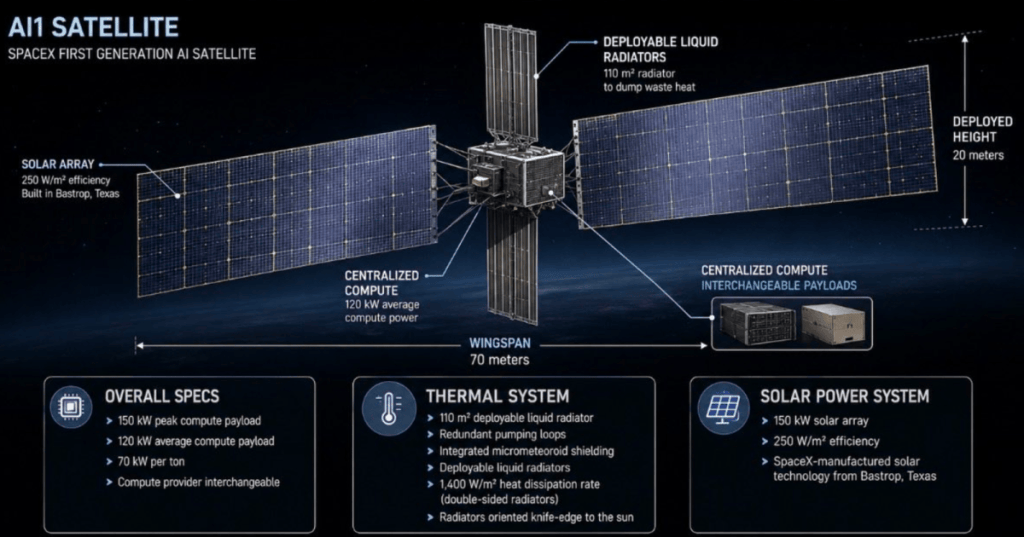
The United States has taken a major regulatory step toward moving artificial intelligence infrastructure into orbit. On November 25, 2026, Reuters reported that the Federal Communications Commission authorized SpaceX to deploy as many as one million satellites for its Starmind computing constellation. The FCC described the initiative as a response to growing AI computing demand.
The decision follows SpaceX’s January 30 application and the FCC’s February 4 public notice, DA 26-113. The newly issued authorization’s complete text was not available for independent examination at publication. Consequently, exact license conditions, deployment obligations and the disposition of requested waivers remain unconfirmed here. The approved ceiling is not an operational satellite count. Featured image: SpaceX’s June 2026 draft AI1 technical visualization.
June 8 technical presentation, reposted on YouTube. The original SpaceX announcement predates the FCC authorization.
How an orbital AI data center would operate
Starmind would combine onboard processors, photovoltaic arrays, power conversion electronics, optical communications and thermal control. Solar panels convert radiation into electrical energy, while semiconductor accelerators execute workloads. Laser links could exchange data between spacecraft and transfer traffic toward ground-connected satellites. The February FCC notice describes proposed orbital altitudes of 500 to 2,000 km; final authorized parameters require confirmation from the new order.
In August, NVIDIA confirmed that SpaceXAI plans to adapt the Vera Rubin NVL72 rack-scale architecture for its first-generation Starmind satellite. Engineering for orbit requires radiation tolerance, thermal management and reliability measures beyond those of conventional server racks.
The arithmetic of a million satellites
SpaceX’s preliminary June design, reported by Tom’s Hardware, described approximately 120 kW of average computing power per spacecraft. Multiplying that historical design assumption by one million gives 120 GW of aggregate computing load. A fully utilized fleet operating continuously at that rating would consume approximately 1,051.2 TWh of electricity per year, supplied in orbit under the proposed concept. Neither figure represents measured performance, a deployment forecast or an FCC-approved electrical capacity.
At the same illustrative rating, 1,000 spacecraft would provide 120 MW and 10,000 would provide 1.2 GW. Actual fleet capacity would depend on satellite generations, power availability, equipment utilization and operational lifetimes. SpaceX may revise the spacecraft design as development progresses.
Cooling, connectivity and orbital safety
Unlike terrestrial facilities, spacecraft cannot reject heat to surrounding air through convection. Internal coolant loops can transport heat to radiators, but the radiators must ultimately emit thermal energy into space. Larger computing payloads therefore require appropriate radiating surfaces, thermal isolation and carefully managed operating temperatures. Our earlier analysis of orbital cooling explains the underlying physics.
Optical links also face pointing, bandwidth and network scheduling constraints. Large distributed training workloads may require frequent synchronization, whereas independent inference workloads can sometimes tolerate greater communication delays. Orbital debris, collision avoidance, astronomical interference and end-of-life disposal introduce additional risks, as highlighted in Secure World Foundation’s March regulatory comments.
Earlier interview with Elon Musk at the Ron Baron conference, discussing expectations rather than verified deployment.
The milestone follows earlier Starmind launch forecasts, Google’s orbital AI launch plans and Starcloud’s GPU satellite development. Regulatory permission removes one barrier, but manufacturing capacity, launch economics, reliable in-orbit operation and customer demand remain decisive. The first operational demonstrations will provide a more meaningful measure of feasibility than the authorized spacecraft ceiling alone.
We volunteer daily to ensure the credibility of the information on this platform is Verifiably True. If you would like to support to help further secure the integrity of our research initiative, please scan the QR code below.



Leave a Reply