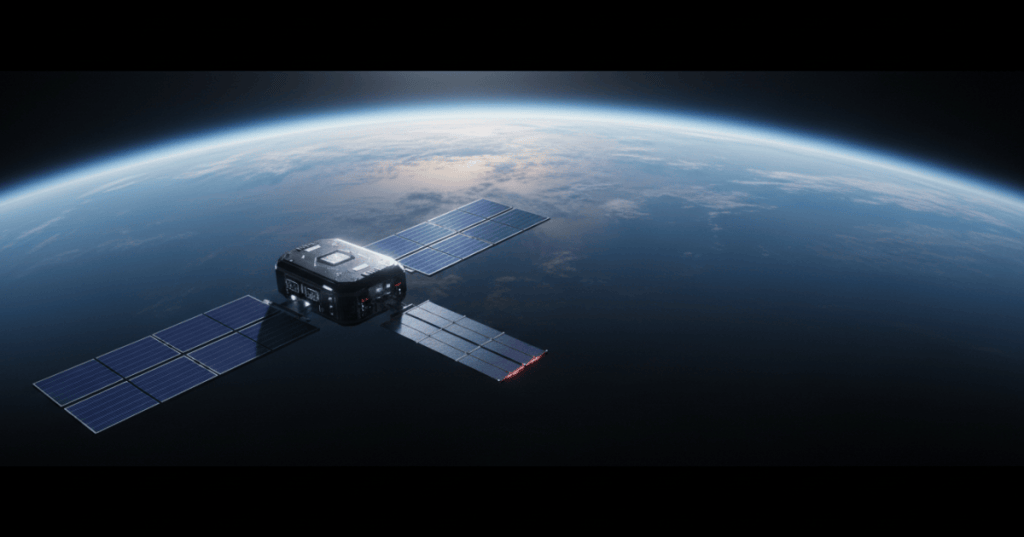
Baron Capital founder and chief executive Ron Baron predicted that space-based data centers could become significant by 2028 during a November 6, 2026, CNBC Squawk Box interview. Baron argued that orbital solar-powered computing could help overcome terrestrial electricity constraints while expressing confidence in Tesla and SpaceX. His timeline is an investor’s forecast, not a confirmed deployment milestone or a guarantee of commercial capacity.
Orbital data centers would combine AI accelerators, satellite communication links, solar arrays, energy storage and heat-rejection hardware in orbit. Continuous solar access in certain orbital configurations offers a potential advantage, but launch cost, radiation, networking and cooling remain major engineering and economic challenges.
A $30 billion gain becomes a much larger forecast
Baron said investments associated with Elon Musk have generated approximately $30 billion in gains for his firm’s clients and projected that they could produce “hundreds of billions” more over the next decade. The first figure is Baron’s account of historical investment gains; the second is an optimistic forecast, not a booked asset value, audited return or earnings guidance from Tesla or SpaceX.
His long-horizon strategy depends heavily on businesses whose valuations are sensitive to growth expectations and financing conditions. The exposure creates concentration risk alongside potential upside. Earlier BitcoinVersus.Tech reporting examined Musk’s long-range SpaceX valuation remarks and another entrepreneur’s $100 trillion forecast; none provides a reliable valuation floor.
Tesla–SpaceX merger still requires independent approval
Baron said he would support a merger or continued separation depending on what the two companies’ independent committees consider appropriate. He is not deciding transaction terms. SpaceX’s September-quarter SEC filing confirms that both companies formed special committees, that no decision has been made, and that the boards and shareholders would face additional approval requirements. The existence of talks does not mean a combination has been agreed.
Potential industrial links include AI computing, semiconductor production, electricity systems and robotics. Integration could also raise valuation, financing, conflict-of-interest and regulatory questions. Baron’s willingness to retain his positions reflects his own risk tolerance rather than independent evidence that a deal would benefit every shareholder.
The energy comparison needs careful units
Baron described China adding substantially more electrical capacity than the United States, citing an approximate 300-gigawatt-versus-20-gigawatt annual contrast. Those spoken estimates are not directly verified as like-for-like annual capacity additions. The U.S. Energy Information Administration recorded 53 GW of new utility-scale generating capacity installed in 2025 and reported plans for 86 GW in 2026. Plans are not completed projects, and the 2026 mix includes battery storage, which stores energy rather than producing it.
China’s National Energy Administration separately reported more than 430 GW of new wind and solar capacity in 2025. Comparing solar, storage, total generating capacity and actual kilowatt-hours requires consistent definitions. The grid challenge nonetheless matters: AI equipment needs dependable power at the time and location where workloads run.
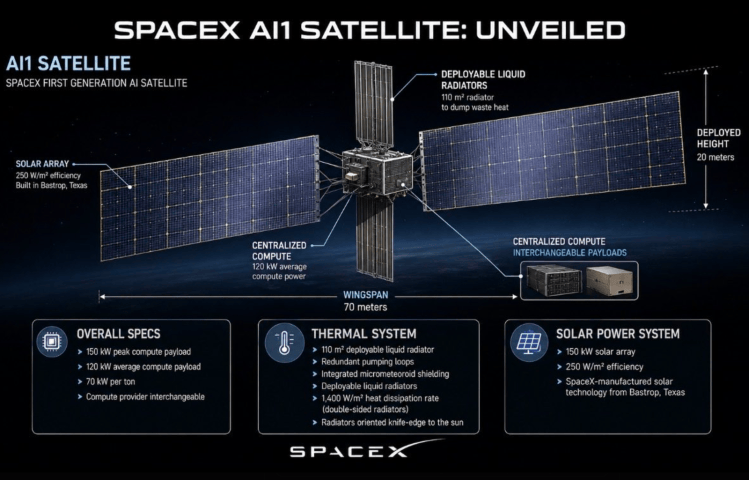
Solar power does not eliminate orbital heat
SpaceX has outlined an orbital AI computing concept and sought regulatory review for a large constellation. But a proposed spacecraft, launch permission and economically productive AI capacity represent different stages. An existing BitcoinVersus.Tech engineering analysis examined the radiator area required to reject GPU waste heat. Space has almost no surrounding air for convection; radiator area, temperature and orientation control radiative cooling. NASA’s spacecraft thermal guidance independently documents the limits of deployable radiators.
Higher launch cadence and reusable spacecraft could improve the economics of putting hardware in orbit, but sunlight, radiation shielding, heat rejection, data links, maintenance and hardware replacement must still be priced. BitcoinVersus.Tech has also documented Starcloud’s developing orbital GPU hardware, an example of experimental work rather than proof of commercial gigawatt-scale operations.
The near-term questions are measurable: which satellite designs reach orbit, how much sustained compute and usable electrical power they deliver, what cooling systems survive deployment, and whether the services generate returns after launch and replacement costs. Baron’s conviction supplies a financial thesis; engineering tests and financial statements will determine its outcome.
We volunteer daily to ensure the credibility of the information on this platform is Verifiably True. If you would like to support our work and help further secure the integrity of our research initiatives, please scan the QR code below to donate 5,000 sats.

To scan on mobile, open the article on another screen and scan the original QR code using a compatible Bitcoin wallet. Verify the destination 3C9o19EH5HSiwEPyCTmEKzxhNCbo2X6TTb before sending 5,000 sats.
Editor’s Note: Reporting covers Ron Baron’s November 6 CNBC interview, the SpaceX SEC merger disclosure, EIA capacity data, China’s NEA statement, and NASA thermal engineering guidance. Forecast returns and 2028 deployment estimates are Baron’s opinions, not measured future outcomes. The cover is original conceptual editorial art; the technical slide is a company design illustration. BitcoinVersus.tech is not a financial advisor. This media platform reports on financial subjects purely for informational purposes.


Leave a Reply