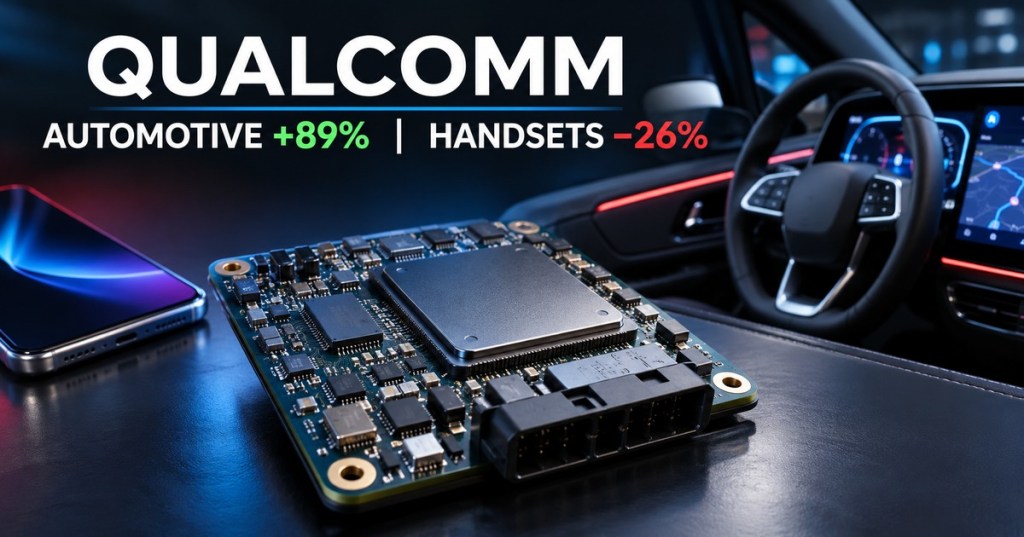
Qualcomm’s automotive-chip revenue rose 89% to $1.990 billion in its fiscal fourth quarter, while handset-chip revenue fell 26% to $5.137 billion, according to results released November 4, 2026. The quarter ended September 27. The divergent numbers reveal how quickly the chip designer’s vehicle business is expanding—and how much pressure remains on its smartphone operations.
Qualcomm Technologies’ QCT division supplies processors, modems, radio chips and integrated platforms; the separate QTL division primarily earns patent-licensing revenue. Phone processors such as the Snapdragon 8 Elite family remain central to QCT, but connected vehicles, industrial systems and AI infrastructure increasingly compete for engineering investment.
Automotive reaches a new quarterly high
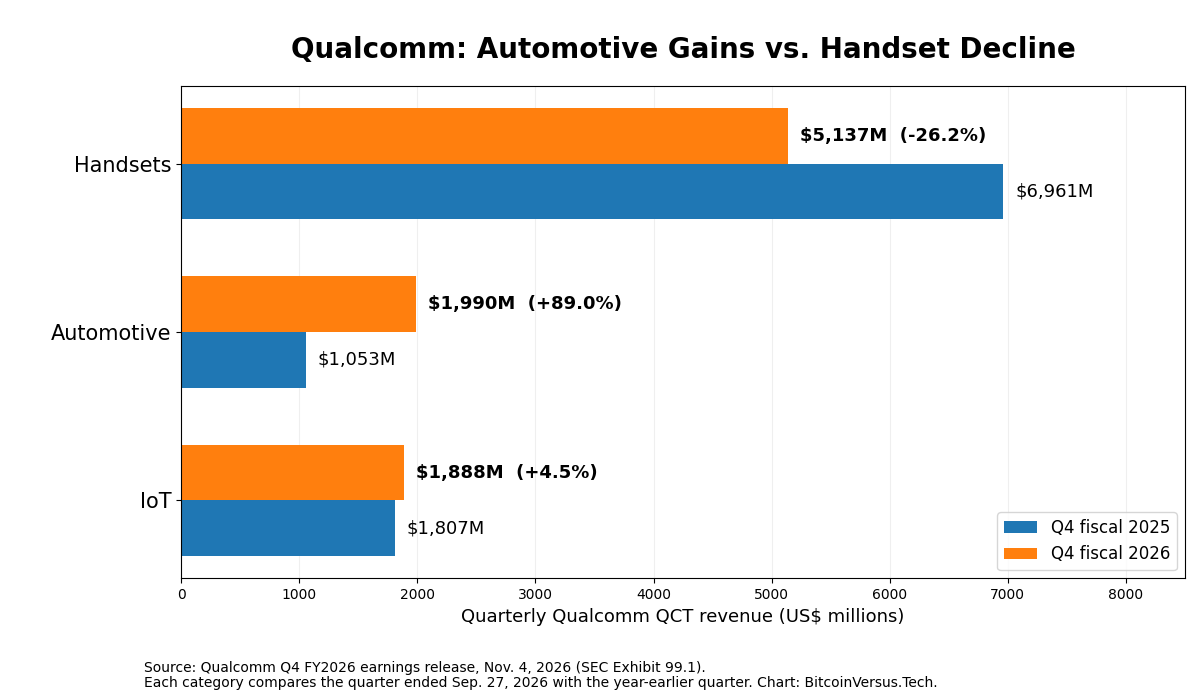
Automotive revenue increased by $937 million from $1.053 billion a year earlier, reaching approximately $2 billion on a rounded basis. Vehicle products accounted for 22.1% of quarterly QCT revenue, compared with 10.7% a year earlier. Qualcomm attributed accelerating demand to its fifth-generation Snapdragon Digital Chassis products and integrated compute modules, which combine more vehicle-electronics functions into higher-value packages.
Qualcomm’s July 22, 2026 Automobil-Elektronik Kongress presentation explains AI-enabled vehicle computing and its Digital Chassis strategy. Source: official Qualcomm YouTube channel; background presentation, not earnings-call footage.
Modern vehicle platforms process camera and sensor inputs, power dashboard displays, manage connectivity and support advanced driver-assistance systems. Hardware serving cockpit entertainment and safety-sensitive control has different real-time and certification requirements. Related automotive microcontroller developments at Infineon show how broader semiconductor suppliers are targeting separate electronic functions inside software-defined vehicles.
The smartphone decline is still larger
QCT handset revenue declined by $1.824 billion from the prior-year quarter. Qualcomm’s fiscal 2026 Form 10-K says handset customers reduced some chip orders as memory shortages and higher memory prices disrupted device production plans. The company also expects Apple to rely primarily on its internally developed modems rather than Qualcomm modem chips in future devices. Revenue declines cannot be interpreted directly as equivalent declines in smartphone unit sales.
The comparison exposes an important offset: the $937 million automotive increase covered only 51.4% of the handset shortfall. IoT revenue contributed another $81 million, rising 4% to $1.888 billion. Together, automotive and IoT added $1.018 billion—55.8% of the handset decline—leaving total QCT revenue down $806 million, or 8%, at $9.015 billion. QCT earnings-before-tax margin also narrowed from 29% to 24%.
The official Snapdragon channel introduced the Ride Flex system-on-chip in January 2023, showing how digital cockpit and driver-assistance workloads can share automotive compute hardware. Technical background; not a demonstration of 2026 shipments.
A diversification strategy with measurable limits
For the full fiscal year, automotive generated $6.004 billion, up 52% from fiscal 2025, while handset revenue fell 13% to $24.072 billion. Groupwide GAAP revenue declined 3% to $43.120 billion. Quarterly growth therefore marks a change in business mix rather than a reversal of the company’s overall revenue contraction.
Management projects more than 60% growth in non-handset QCT revenue during fiscal 2027 and reiterates a $5 billion data-center revenue target. Those are forward-looking estimates, not completed sales. Qualcomm’s Dragonfly AI infrastructure strategy illustrates another target market, while its new SpaceX network agreement adds a separate communications-infrastructure opportunity without a disclosed contract value.
Automotive sales may continue rising as approved vehicle programs enter production, but design wins do not guarantee sustained shipment growth or stronger profit margins. Vehicle schedules, component costs, customer concentration and memory-market conditions remain constraints. Future quarters will show whether automotive and AI revenue can close the handset gap without further weakening QCT profitability.
Primary sources
Qualcomm fiscal Q4 2026 earnings exhibit, filed November 4, 2026; Qualcomm fiscal 2026 Form 10-K, filed November 4, 2026; Qualcomm automotive platform overview, March 2026.
Editor’s Note: Quarterly revenues, percentage changes and year-end comparisons were verified against Qualcomm’s November 4, 2026 SEC filings. Offset percentages and segment shares were independently calculated from unrounded published US$-million figures. The cover is an illustrative depiction of automotive electronics, not a photograph of a specific Qualcomm chip or vehicle. Official videos explain the technology but were not recorded during the November earnings announcement. Revenue forecasts and management targets remain uncertain. Video playback and mobile browser rendering are not independently certified.
Support BitcoinVersus.Tech
To contribute an optional 5,000 satoshis, scan the original BitcoinVersus.Tech donation QR below with a compatible Bitcoin wallet. On a phone, display the article on another device or use a wallet’s saved-image scanning function, if supported. Verify the address and amount in the wallet before authorizing any payment.

We volunteer daily to ensure the information on this platform is Verifiably True. If you would like to support the research, please scan QR code.


Leave a Reply