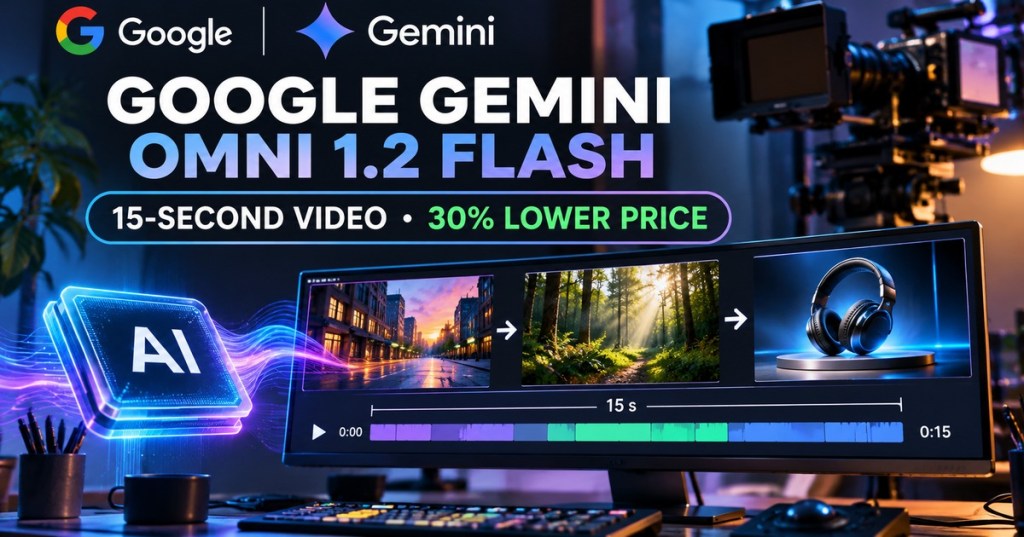
Google introduced Gemini Omni 1.2 Flash on November 5, 2026, expanding its AI video-generation system to clips of up to 15 seconds and cutting the listed price for 720p output by 30%. Google says the model is generally available through the Gemini API and Gemini for business, while consumer access varies by product and subscription. The release targets a persistent production problem: preserving characters, objects and visual details while editing AI-generated footage.
Video-generation models synthesize moving image sequences from text, images, audio or existing footage. Unlike a static image generator, a video model must maintain continuity across frames while producing plausible motion and camera changes. Google’s earlier Genie 4 research preview addresses interactive world simulation, a distinct technical goal from Omni’s finished-clip generation and editing workflow.
Google’s official May 19, 2026 introduction to Gemini Omni demonstrates multimodal inputs and conversational video editing. Background footage predates the November Omni 1.2 Flash release. Credit: Google.
Fifty percent more video at a lower listed rate
The maximum native clip duration rises from 10 seconds under Omni 1.1 to 15 seconds under Omni 1.2 Flash, an increase of five seconds or 50%. Google lists 720p video generation at $0.07 per second after a 30% reduction. At the stated rate, a full 15-second output costs $1.05 before any separately billed processing, editing, upscaling or platform charges. A 10-second output costs $0.70 at the new rate; the previous rate implied by a precisely 30% cut is approximately $0.10 per second.
Google says creators can draft at 360p or 720p, revise selected details with follow-up prompts, then upscale approved results to 1080p or 4K. The economics depend on how often clips must be regenerated. Three complete 15-second generations would total $3.15 at the listed 720p generation rate, excluding other charges. Lower per-second pricing does not automatically translate into lower final-project costs.
Editing without rebuilding every scene
Omni 1.2 Flash supports conversational changes to backgrounds, lighting, objects, camera movement and aspect ratio. Reference conditioning can incorporate product photographs, character images, short motion clips and audio cues. Google reports stronger consistency for garments, faces and packaging across camera transitions, although those performance descriptions are vendor claims rather than independently reproduced benchmark results.
Google’s official May 19 explainer shows natural-language, multi-turn edits and visual transformations in the original Gemini Omni family. It is not an independent benchmark of Omni 1.2 Flash. Credit: Google.
The production implications extend beyond marketing. Video editing requires persistent scene representations, temporal coherence and the ability to localize changes without unintentionally altering unrelated frames. Related advances in Pika’s open-weight video generation and Reactor’s interactive world models demonstrate competing approaches to video speed, control and real-time rendering.
Availability and reliability remain separate questions
Google lists the Gemini API, business products, Flow, Google Vids and other distribution channels, but some features or access tiers may roll out at different times. Generated videos carry Google’s imperceptible SynthID watermark. Watermarking offers provenance signals when supported detection tools are available; it does not by itself establish that every scene or spoken statement is factual.
Google acknowledges ongoing weaknesses in fast sports motion, rapid scene changes and complex physics. The competition in AI computing hardware and software also matters because video generation consumes substantial accelerator capacity, although Google has not disclosed a comparable per-clip energy figure for Omni 1.2 Flash. Independent tests should measure temporal consistency, editing success rates, latency and total production cost under identical prompts.
Primary sources
Google’s November 5, 2026 Omni 1.2 Flash announcement; official Gemini Omni introduction; official Gemini Omni technical explainer. Pricing and capability claims are attributed to Google.
Editor’s Note: Publication date, 15-second limit, 30% price reduction and $0.07-per-second rate were checked against Google’s November 5 announcement. Calculated clip costs assume the stated 720p generation rate without additional charges. The featured cover is a conceptual illustration, not a Google product screenshot. Both embedded videos are official Google demonstrations from May 2026 and are labeled as background rather than evidence of the November release. Independent video playback, model benchmarking and mobile-browser layout tests are not claimed.
Support BitcoinVersus.Tech
To contribute an optional 5,000 satoshis, scan the original BitcoinVersus.Tech donation QR below with a compatible Bitcoin wallet. On a phone, open the article on another screen or use a wallet’s saved-image QR scanning feature if supported. Verify the destination and amount before sending.

We volunteer daily to ensure the information on this platform is Verifiably True. If you would like to support the research, please scan QR code.


Leave a Reply