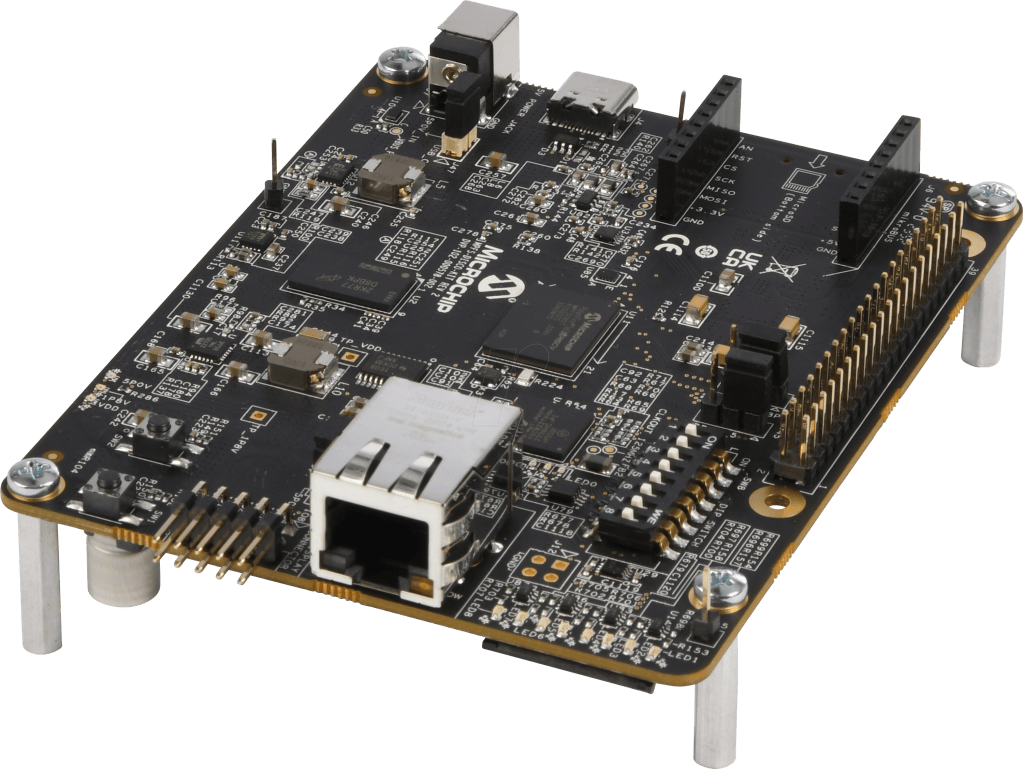
A processor operating aboard a spacecraft has to do more than execute instructions quickly. It must remain dependable while exposed to energetic particles, limited electrical power and difficult thermal conditions. On November 19, 2026, Microchip announced new reliability qualifications for two radiation-tolerant PolarFire devices, including a chip that combines programmable hardware with five RISC-V processor cores.
The standalone RTPF500ZT FPGA received QML Class V qualification, while the RTPFS460ZT system-on-chip FPGA completed QML Class Q and MIL-STD-883 Class B qualification. The distinctions matter: the announcement does not establish Class V qualification for both devices.
A processor that can change its circuitry
A conventional CPU executes instructions using largely fixed circuitry. A field-programmable gate array (FPGA) lets engineers configure logic and interconnects to implement application-specific datapaths. Unlike an ASIC, whose fabricated logic is fixed, an FPGA can be reconfigured for new functions. A spacecraft could therefore use dedicated hardware for filtering sensor data, while software coordinates tasks and handles exceptions.
The RTPFS460ZT combines these approaches. Microchip’s product specifications list four 64-bit U54 application cores and one E51 monitor core at up to 625 MHz, 461,000 programmable logic elements, 1,420 multiply-accumulate blocks and 31.6 megabits of FPGA fabric RAM. Its 24 serial transceiver lanes are rated up to 12.7 Gbps each. Multiplying yields a theoretical aggregate 304.8 Gbps in one direction before protocol overhead and system constraints; it is not a measured application throughput.
Why radiation changes the design
Energetic particles can deposit charge in semiconductor circuits. In ordinary SRAM-based FPGAs, a configuration bit may flip and alter the hardware function. Periodic configuration scrubbing detects and repairs such corruption, but requires supporting logic and consumes resources. PolarFire uses nonvolatile configuration designed to avoid that particular failure mechanism. Ordinary working memory, processor registers and other circuitry still need appropriate protection; configuration immunity is not immunity to every radiation effect.
Spacecraft also face cumulative ionizing radiation and potentially destructive single-event latch-up. Microchip lists a 100 krad total ionizing dose rating for its RT SoC family, but mission-specific radiation analysis remains essential. Reliability qualification establishes manufacturing and test requirements rather than guaranteeing survival in every orbital environment. The Defense Logistics Agency’s MIL-PRF-38535 specification provides the framework for qualified microcircuit manufacturing.
Why programmable space processors matter
Onboard image processing can reduce the amount of raw sensor data that a satellite must transmit. A reconfigurable datapath can handle repetitive operations while embedded software changes operating modes. A smaller workload sent through a downlink can free communications capacity, although the benefit depends on compression ratios, processing power and mission requirements.
The same CPU-plus-programmable-logic concept appears in our coverage of Lattice and NXP’s robotics platform, PolarFire industrial networking, Altera’s Agilex FPGA architecture and Infineon’s RISC-V automotive platform. Space systems add radiation assurance and mission-lifetime constraints to the engineering tradeoffs.
Microchip supports development through Libero SoC tools and the Mi-V software ecosystem. The November milestone is qualification, not a new clock-speed record or an announced spacecraft deployment. The next useful evidence will be mission-specific radiation test reports, delivered flight hardware and measured power and throughput in representative payload applications.
Sources: Microchip, November 19, 2026; RT PolarFire SoC specifications; DLA MIL-PRF-38535; Microwaves & RF, November 20, 2026.
We volunteer daily to ensure the credibility of the information on this platform is Verifiably True. If you would like to support to help further secure the integrity of our research initiative, please scan the QR code below.



Leave a Reply