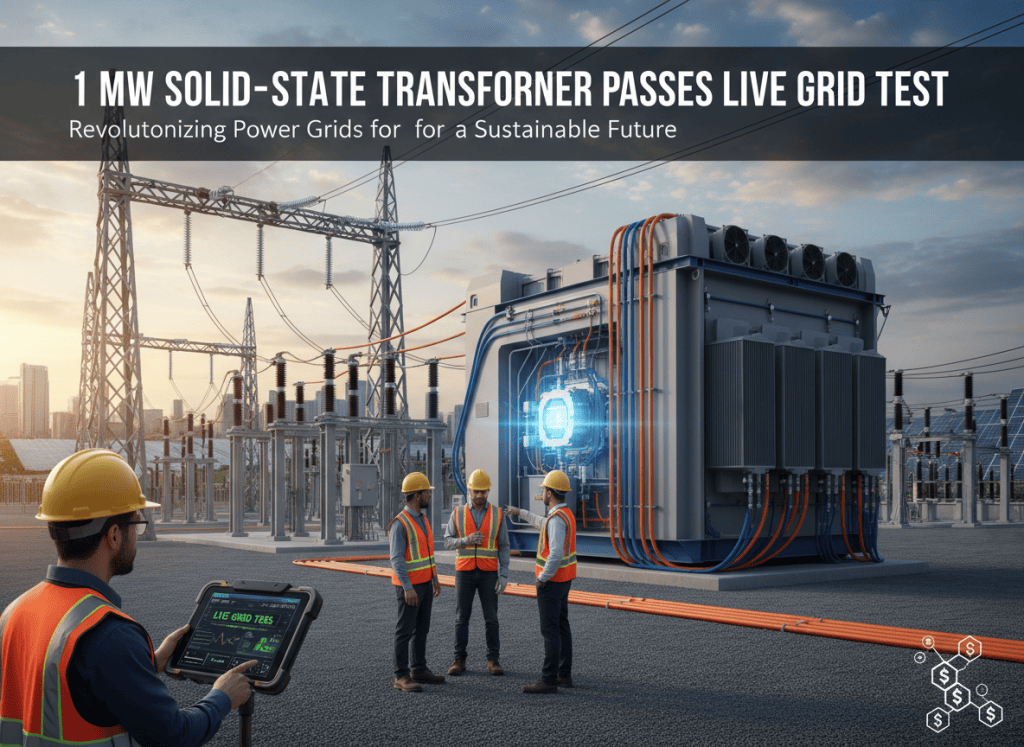
Power electronics are moving closer to the point where they can replace multiple pieces of conventional grid hardware with a single integrated system.
North Carolina State University, working with the New York Power Authority (NYPA) and EPRI, has designed and tested a solid-state transformer (SST) capable of handling up to 1 MW under real-world conditions. The prototype was demonstrated at EPRI’s power-delivery laboratory in Lenox, Massachusetts, on a live utility distribution feeder.
What Makes a Solid-State Transformer Different?
Traditional power systems typically use a transformer to change voltage and a separate rectifier when equipment ultimately needs direct current. An SST combines high-frequency power electronics with transformer and AC/DC conversion functions.
That matters for modern electrical loads. AI data centers, battery systems and electric-vehicle chargers all rely heavily on DC power downstream. Every conversion stage adds equipment, heat and electrical losses.
NC State says the demonstrated SST can handle up to 1 MW. Project materials describe the medium-voltage design as a 1 MVA, 13.2 kV three-phase AC system. The university says the system is more compact than a conventional transformer-plus-rectifier arrangement and could be useful where electrical space is constrained.
Efficiency Is the Bigger Engineering Story
NC State reports that conventional transformer-and-rectifier combinations are typically around 96% efficient, while its SST architecture targets losses of roughly 2%. At megawatt scale, even small percentage improvements can matter because wasted electricity becomes heat that must also be managed.
The efficiency figures should still be read in context: laboratory module measurements and complete field-system efficiency are not the same measurement. Long-duration commercial operation will be needed to establish how the architecture performs across varying loads, temperatures and grid conditions.
Why Data Centers Are Watching
Data centers are becoming unusually demanding electrical facilities. More compute density means more power must move through a limited footprint, while AI accelerators and other semiconductor systems ultimately consume low-voltage DC.
Solid-state transformers could eventually help simplify the chain between medium-voltage utility AC and the DC buses feeding computing equipment. That makes the technology relevant alongside the higher-voltage DC architectures now being explored for future data centers.
For more coverage of the hardware behind these systems, see BitcoinVersus.tech’s Semiconductors and Electrical Engineering sections.
What Was Actually Proven?
The most important result is not that conventional transformers are suddenly obsolete. They are not.
The demonstration showed that a megawatt-class SST could move beyond a university laboratory and operate on real distribution infrastructure under independent test conditions. NC State describes it as the first independently verified megawatt-class SST validated on a live utility distribution feeder.
Utilities and data-center operators will still need evidence on lifetime, fault behavior, protection coordination, thermal cycling, maintainability, semiconductor reliability and cost before SSTs can compete broadly with conventional transformer systems.
But moving a 1 MW-class design onto a live feeder is a meaningful engineering step. It changes the question from whether semiconductor-based transformers can work at this scale to how reliably and economically they can be deployed.
Sources
- NC State — Solid State Transformer Success Under Real World Conditions
- American Public Power Association — NYPA, EPRI and NC State Demonstration
BitcoinVersus.Tech Editor’s Note:
We volunteer daily to ensure the credibility of the information on this platform is Verifiably True. If you would like to support to help further secure the integrity of our research initiatives, please donate here: 3C9o19EH5HSiwEPyCTmEKzxhNCbo2X6TTb
https://x.com/1BitcoinVersus/status/1937006164555993338
BitcoinVersus.tech is not a financial advisor. This media platform reports on financial subjects purely for informational purposes.


Leave a Reply