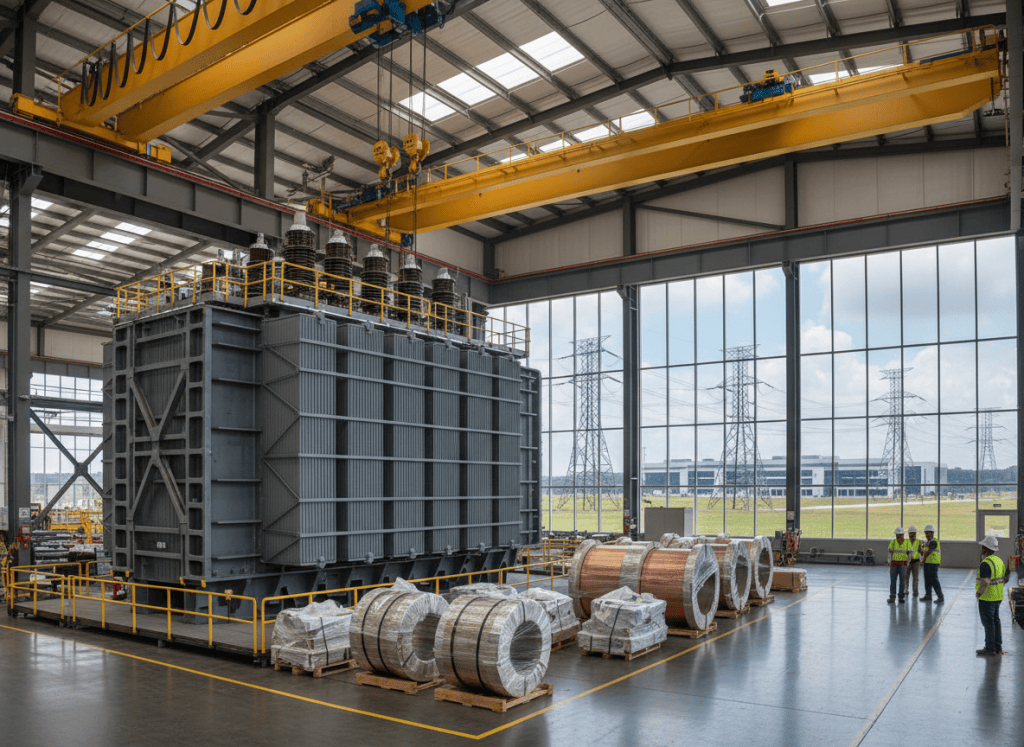
Hitachi Energy is putting $528 million into a new Mississippi transformer factory as the U.S. power system runs into one of the least glamorous but most consequential bottlenecks of the AI and electrification boom: not enough transformer manufacturing capacity.
On September 15, Hitachi Energy announced a new power-transformer manufacturing facility in Gallman, Mississippi. The company says the plant will be more than twice the size of its existing Crystal Springs operation, more than double local transformer production capacity, and create more than 700 jobs.
The factory is expected to begin transformer production in 2029. That date matters. Transformer shortages are already affecting grid expansion, data-center interconnections, industrial electrification, and utility construction, so this is not a quick supply fix. It is a multi-year manufacturing response to a grid problem that is already here.
Transformers have become strategic infrastructure
Transformers sit at nearly every voltage transition in the electric system. Generation, transmission, substations, distribution networks, factories, data centers, and large campuses all depend on them to move usable power between voltage levels.
Reuters reported that record U.S. power demand—driven by giant data centers, building electrification, and transportation electrification—is colliding with shortages of critical electrical equipment including transformers and circuit breakers.
That equipment constraint helps explain why headline generation capacity does not automatically become usable load capacity. A proposed data center can have land, servers, financing, and even a utility agreement while still waiting on substation gear, breakers, conductors, and transformers.
The same structural problem appears in the enormous AI power interconnection queue, where requested capacity has grown much faster than utilities can confidently build and energize.
Mississippi becomes a bigger transformer hub
The new Gallman facility will sit roughly 6.5 miles from Hitachi Energy’s existing Crystal Springs plant. Once the new factory is complete, transformer production is scheduled to transition from Crystal Springs to Gallman, while the older facility remains available for warehousing, training, or other operational uses.
Hitachi says the Mississippi project is its largest single U.S. investment to date and the cornerstone of an approximately $1.5 billion U.S. manufacturing expansion program. That broader buildout includes a $457 million large-power-transformer expansion in Virginia, a $106 million transformer-component expansion in Tennessee, and a $70 million high-voltage-equipment expansion in Pennsylvania.
Together, those investments show how electrical hardware manufacturing is becoming part of the AI infrastructure race. GPU availability gets most of the attention, but power equipment can determine whether the racks ever receive electricity.
The engineering problem is bigger than one transformer type
The grid bottleneck spans multiple transformer classes and voltage levels. Utilities need large power transformers for transmission and substations, while industrial and data-center projects require distribution and specialty transformers closer to the load.
At the same time, the architecture inside AI campuses is changing. New approaches such as solid-state transformers are being tested to collapse conversion stages, while 800 VDC data-center power systems are pushing conversion deeper into the campus and closer to compute.
Those technologies may change where conversion occurs, but they do not eliminate the need for heavy grid equipment. The utility still has to deliver megawatts from the transmission or distribution system to the site.
Video: why transformer manufacturing capacity matters
Why the 2029 production date matters
A transformer factory is itself a long-cycle infrastructure project. It requires specialized production equipment, copper and electrical steel supply chains, testing systems, high-voltage expertise, quality-control processes, and a trained workforce.
That means transformer shortages cannot be solved the way a software company adds cloud capacity. Manufacturing capacity has to be physically built, qualified, staffed, and ramped.
The 2029 start date is therefore both encouraging and sobering. Hitachi is adding meaningful domestic production, but the U.S. grid and data-center buildout will continue operating under tight equipment constraints for years before that new Mississippi capacity is fully available.
What this means for AI and data centers
AI infrastructure increasingly competes for the same electrical equipment needed by utilities, factories, renewable projects, transportation systems, and ordinary grid upgrades. Transformer lead times can therefore become a site-selection variable just like land, fiber, water, and electricity price.
The winning data-center projects may not simply be the ones with the most capital. They may be the projects that secured transformer slots, substation equipment, switchgear, and utility interconnection capacity earliest.
Hitachi’s Mississippi expansion is one of the clearest signs yet that the electrical supply chain is being forced to scale alongside AI compute. The transformer has become part of the semiconductor-era bottleneck.
BitcoinVersus.Tech
Advertisement
Editor’s Note:
We volunteer daily to ensure the credibility of the information on this platform is Verifiably True. If you would like to support our research initiatives, please donate here: 3C9o19EH5HSiwEPyCTmEKzxhNCbo2X6TTb
BitcoinVersus.tech is not a financial advisor. This media platform reports on financial subjects purely for informational purposes.


Leave a Reply