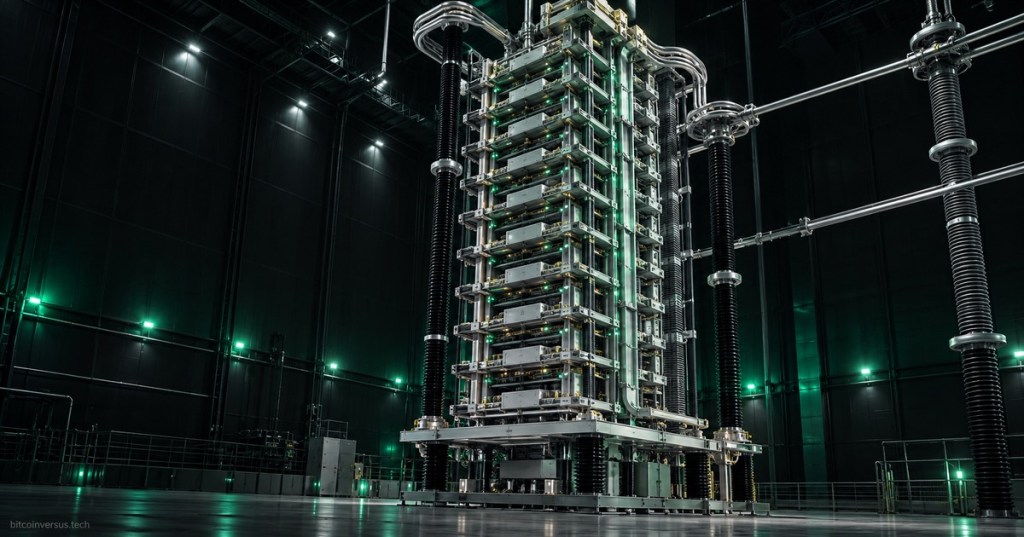
GE Vernova has pushed its voltage-sourced-converter HVDC platform past the 3-gigawatt mark with a new high-current valve designed for ±525 kV transmission. Unveiled at CIGRE Paris 2026, the hardware is aimed at the kind of long-distance power corridors that increasingly have to connect offshore wind, remote generation, large load centers and interregional grids.
GE Vernova says the new High Current VSC Valve extends its established VSC-HVDC platform to more than 3 GW at ±525 kV. The company says the design can be configured for both bipole and symmetrical-monopole schemes and used with overhead lines as well as underground and subsea cables.
What a VSC-HVDC valve actually does
Most transmission grids operate in alternating current, but moving very large blocks of electricity across long distances can favor high-voltage direct current. At each end of an HVDC link, converter stations translate between AC and DC. The converter valve is the power-electronics core that performs that switching under tightly controlled electrical and thermal conditions.
GE Vernova uses voltage-sourced-converter technology for applications where controllability, compact converter stations and operation with weaker AC systems can matter. That makes VSC-HVDC especially relevant to offshore wind connections, subsea interconnectors and transmission corridors that need more flexible control than a simple point-to-point bulk-power link.
For readers building up the fundamentals first, BitcoinVersus has a separate guide to transmission versus subtransmission. The GE Vernova launch sits at the extreme high-power end of that infrastructure stack.
Why the 3 GW and ±525 kV numbers matter
Three gigawatts is not a distribution-system number; it is a bulk-transmission number. In an idealized ±525 kV bipole, the pole-to-pole voltage is 1.05 MV. Using the simple relationship P = V × I, 3 GW divided by 1.05 MV is about 2.86 kA before losses and before accounting for the details of a specific project configuration. That rough calculation shows the electrical scale the valve family is being designed to handle.
The important engineering point is that higher transmission capacity does not come from voltage rating alone. Converter designers have to manage semiconductor switching, insulation coordination, heat removal, fault behavior, control, serviceability and the physical layout of a valve hall as one integrated system.
GE Vernova says its valve towers can be configured with as many as six tiers and that the platform is intended to support IEC 62501 type testing. Removable Power Electronics Units are designed so individual submodules can be serviced without treating the complete valve tower as a single maintenance object.
Three-gigawatt DC corridors are becoming real infrastructure
The rating also lines up with a broader transmission trend already visible in operating projects. The Western Electricity Coordinating Council’s 2026 transmission review notes that SunZia entered operation in April 2026 as a 525 kV DC line tied to 3 GW of wind generation. SunZia is a separate project and should not be confused with GE Vernova’s new valve platform, but the comparison shows that 3 GW and the 525 kV class are no longer theoretical scales for new transmission infrastructure.
That helps explain why suppliers are racing to increase transformer, converter and switchgear capacity. BitcoinVersus recently covered Hitachi Energy’s $528 million Mississippi transformer-factory expansion, another response to the same grid-equipment bottleneck from a different part of the electrical system.
HVDC is different from the 800 VDC trend inside AI data centers
The DC acronym can make very different electrical systems sound similar. A ±525 kV HVDC transmission corridor moves bulk power across regions; an 800 VDC data-center architecture distributes power across a campus or facility. Both use DC to reduce conversion steps or move power efficiently, but their voltage classes, equipment, protection challenges and physical scale are radically different.
That distinction is useful alongside BitcoinVersus’ coverage of Huawei’s grid-interactive 800 VDC data-center architecture. The two systems occupy different layers of the power chain: one can help bring gigawatts toward a load region, while the other manages DC distribution much closer to computing equipment.
The engineering story is maintainability at grid scale
GE Vernova is emphasizing modularity as much as headline power. That makes sense for equipment expected to operate as critical infrastructure for decades. A converter valve that can carry more power is valuable, but a design that is easier to isolate, inspect and service can be just as important to the utility that has to keep the link available.
The new high-current valve is manufactured and tested at GE Vernova’s Stafford facility in the United Kingdom. The product is an evolution of an existing VSC platform rather than a completely new converter architecture, which is significant because grid operators generally value proven system behavior alongside higher ratings.
For electrical engineers, the takeaway is straightforward: bulk-power electronics are scaling toward the same multi-gigawatt territory once associated mainly with large conventional generating stations. The grid of the next decade will depend not only on producing more electricity, but on converter stations, transformers, switchgear and transmission corridors capable of moving that electricity where demand actually exists.
BitcoinVersus.Tech
Advertisement
Editor’s Note:
We volunteer daily to ensure the credibility of the information on this platform is Verifiably True. If you would like to support our research initiatives, please donate here: 3C9o19EH5HSiwEPyCTmEKzxhNCbo2X6TTb
BitcoinVersus.tech is not a financial advisor. This media platform reports on financial subjects purely for informational purposes.


Leave a Reply