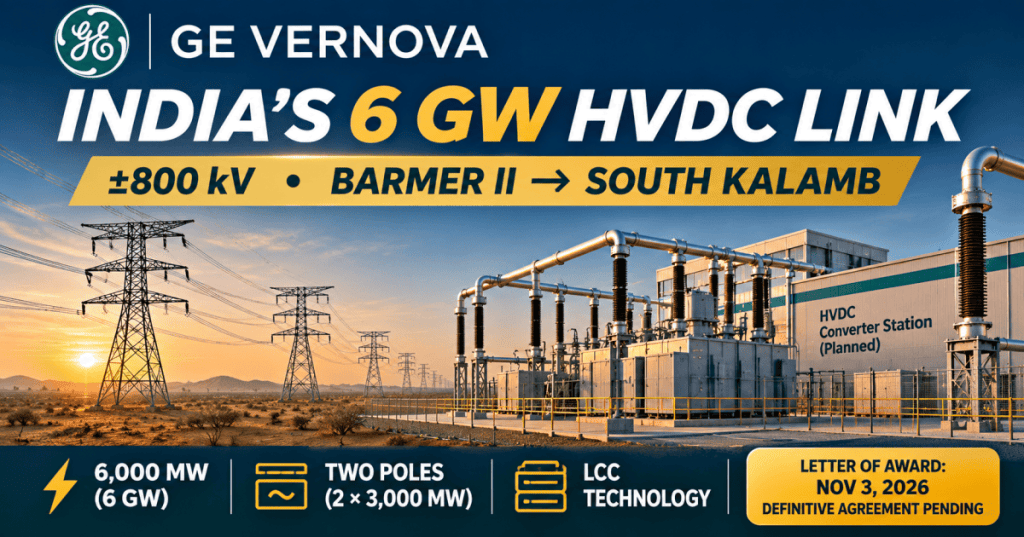
GE Vernova has been selected to supply the converter infrastructure for a 6,000 MW, ±800 kV high-voltage direct-current (HVDC) link planned between Barmer II in Rajasthan and South Kalamb in Maharashtra, India. The company announced the award on November 6, 2026, following a November 3 letter of award from Power Grid Corporation of India Limited (POWERGRID). The system is planned, not energized; a definitive agreement between the Indian subsidiary and POWERGRID remains pending.
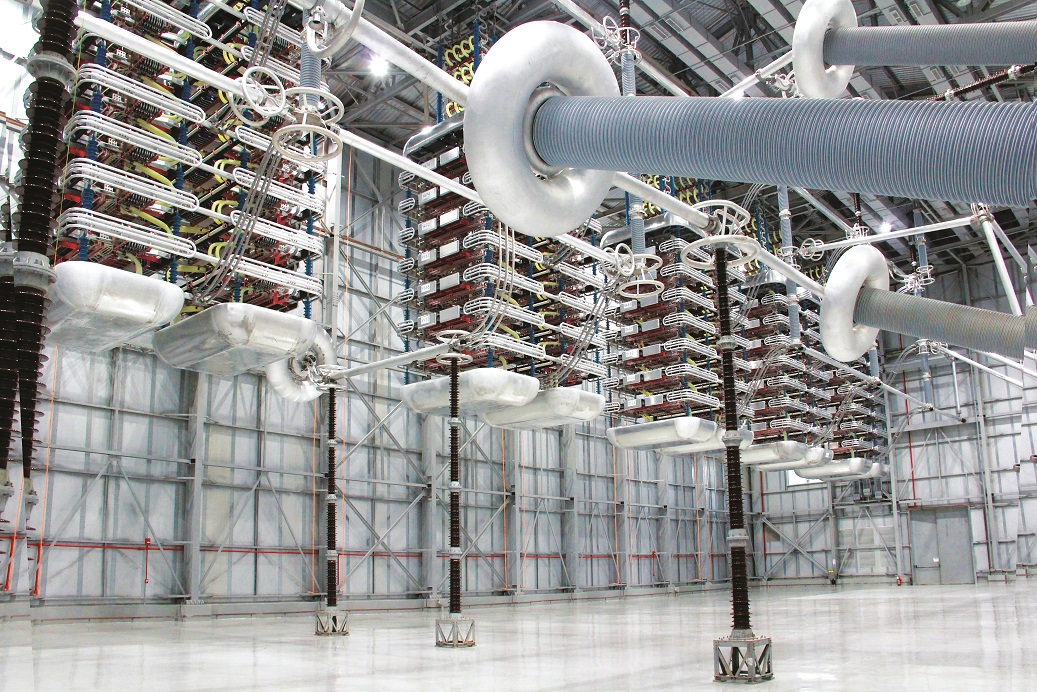
Two 3,000 MW poles form the 6 GW link
The November 4 stock-exchange filing confirms a bipolar configuration rated at 2 × 3,000 MW. A bipolar HVDC system uses positive and negative high-voltage conductors relative to ground. The ±800 kV rating refers to the polarity of each pole, not an 800-kV alternating-current line. Its 6 GW capacity describes maximum planned instantaneous power transfer under rated conditions—not electricity already produced or delivered.
HVDC links use converter stations to transform grid alternating current into direct current at one end and back to alternating current at the other. Long-distance DC transmission can move large amounts of power without requiring the sending and receiving AC systems to operate in synchronism along the entire route. BitcoinVersus.Tech’s primer on power distribution and transmission explains how voltage levels and grid equipment influence delivery.
Rajasthan contains major solar and wind resources, while the receiving end serves a substantial electricity-demand region. POWERGRID’s November 1 financial release listed the Barmer II–South Kalamb scheme among inter-state transmission projects for which it had been selected. The announcement did not establish a commercial operation date, completed route construction or publicly confirmed energy throughput.
Why engineers selected thyristor-based LCC technology
GE Vernova says the stations will use line-commutated converter (LCC) valves manufactured at Pallavaram, India, paired with its eLumina grid-control platform. LCC uses thyristors whose current commutation depends on the AC voltage waveform. The technology is well suited to transferring bulk power between sufficiently strong AC networks; AC filters and reactive-power support are among the engineering considerations.
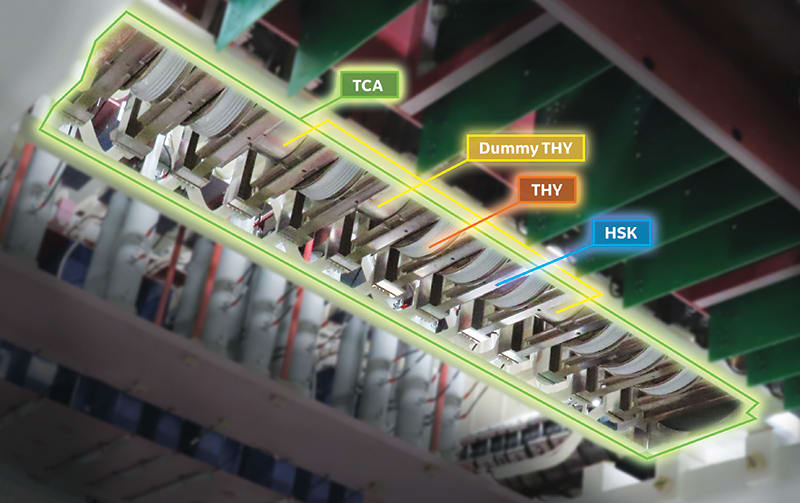
Europe’s transmission-system association ENTSO-E describes the operating trade-offs of LCC links. Compared with a voltage-source converter (VSC), LCC usually needs more support from the connected AC system but is an established approach for very high-capacity, long-distance power. GE Vernova’s separate 3 GW, ±525 kV VSC valve development uses a different converter technology and should not be conflated with the new Indian order.
Local manufacturing and contract scope
The November 6 manufacturer announcement covers converter-station design, supply of major equipment, site erection, testing and commissioning management. Its scope includes locally manufactured valves and eLumina control functions for coordinating the planned power flows. GE Vernova announced a $16 million Indian manufacturing expansion in 2025, including LCC valve production capability at its existing Chennai-area facility.
The listed Indian subsidiary reported L1 bidder status in September and receipt of the formal award letter on November 3. The exchange filing says both parties will execute the definitive agreement later. No final project price or firm service date appears in the primary award documentation. Comparing announced project scale with actual construction progress remains essential.
Transmission capacity is not a completed power plant
At full rating, 6,000 MW would represent 6 gigawatts of instantaneous transfer capability, with actual delivered energy depending on connected generation, dispatch, network conditions, losses and availability. The HVDC corridor does not itself create solar or wind generation. Successful deployment will also require coordinated converter controls, insulation design, protection systems and robust AC interconnections.
India’s investment illustrates the worldwide expansion of high-voltage infrastructure also discussed in BitcoinVersus.Tech reports on AEP’s $37 billion U.S. grid program and GE Vernova’s proposed acquisition of Trench Group. The meaningful next milestones for the Indian link are the definitive contract, construction and equipment deliveries, converter commissioning and evidence of sustained commercial power transfer.
Editor’s Note: Reviewed November 7, 2026. The November 3 award letter, 2 × 3,000 MW capacity, ±800 kV configuration, and agreement-pending status were checked against GE Vernova T&D India’s official NSE filing. Scope, manufacturing location and eLumina controls were checked against GE Vernova’s November 6 press release, while POWERGRID’s November 1 release confirms the broader transmission project selection. Converter-technology distinctions were verified with ENTSO-E and the manufacturer’s control-system documentation. The featured cover is a conceptual editorial illustration, not a photo of a constructed link. Both in-story equipment images are representative historical technical visuals rather than proof of installation. No commissioning date, completed capacity or project value is invented.

To donate 5,000 sats, open the article on a separate display and scan the original QR code with a compatible Bitcoin wallet. On mobile, use another screen or your wallet’s supported image-scanning feature. Verify the destination 3C9o19EH5HSiwEPyCTmEKzxhNCbo2X6TTb before sending.
We volunteer daily to ensure the information on this platform is Verifiably True. If you would like to support the research, please scan QR code.
BitcoinVersus.tech is not a financial advisor. Engineering and company developments are reported for informational purposes, and construction schedules may change.


Leave a Reply