
REDWOOD CITY, Calif. — The key product behind Reach Power’s recent 10-hour drone demonstration is not the quadcopter itself. It is a wireless-power-at-a-distance system built around electronically controlled radio-frequency transmitters, receiving antennas and power-management software. Reach’s October 28, 2026 flight announcement highlights what this hardware can achieve, but the system’s engineering is the bigger story.
A Reach transmitter converts electrical input into directed RF energy. Its adaptive antenna array steers power electronically, while a microcontroller and communications system coordinate with authorized receivers. On the aircraft, the receiver captures RF energy, converts it into usable electrical power and manages battery charging.
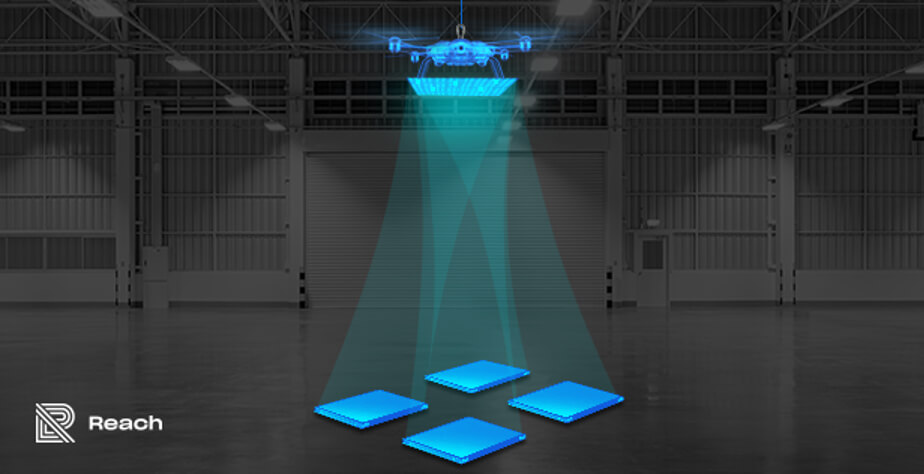
Reach’s own illustration of its four-transmitter drone charging arrangement, published with the May 2024 test; not a photograph of the 2026 flight.
Two Radio Links, One Power System
A 2026 Naval Postgraduate School project sheet identifies a 24 GHz energy link and 2.4 GHz control communications for a Reach demonstration configuration. Reach’s broader FAQ also describes 5.8 GHz and 24 GHz RF operation. These are published system configurations, not proof every transmitter uses an identical frequency.
The software dashboard authorizes endpoints, monitors charging and coordinates allocation. Reach says its current software can support more than 30 devices concurrently, but that claim does not establish that 30 drones can each receive high charging power at once.
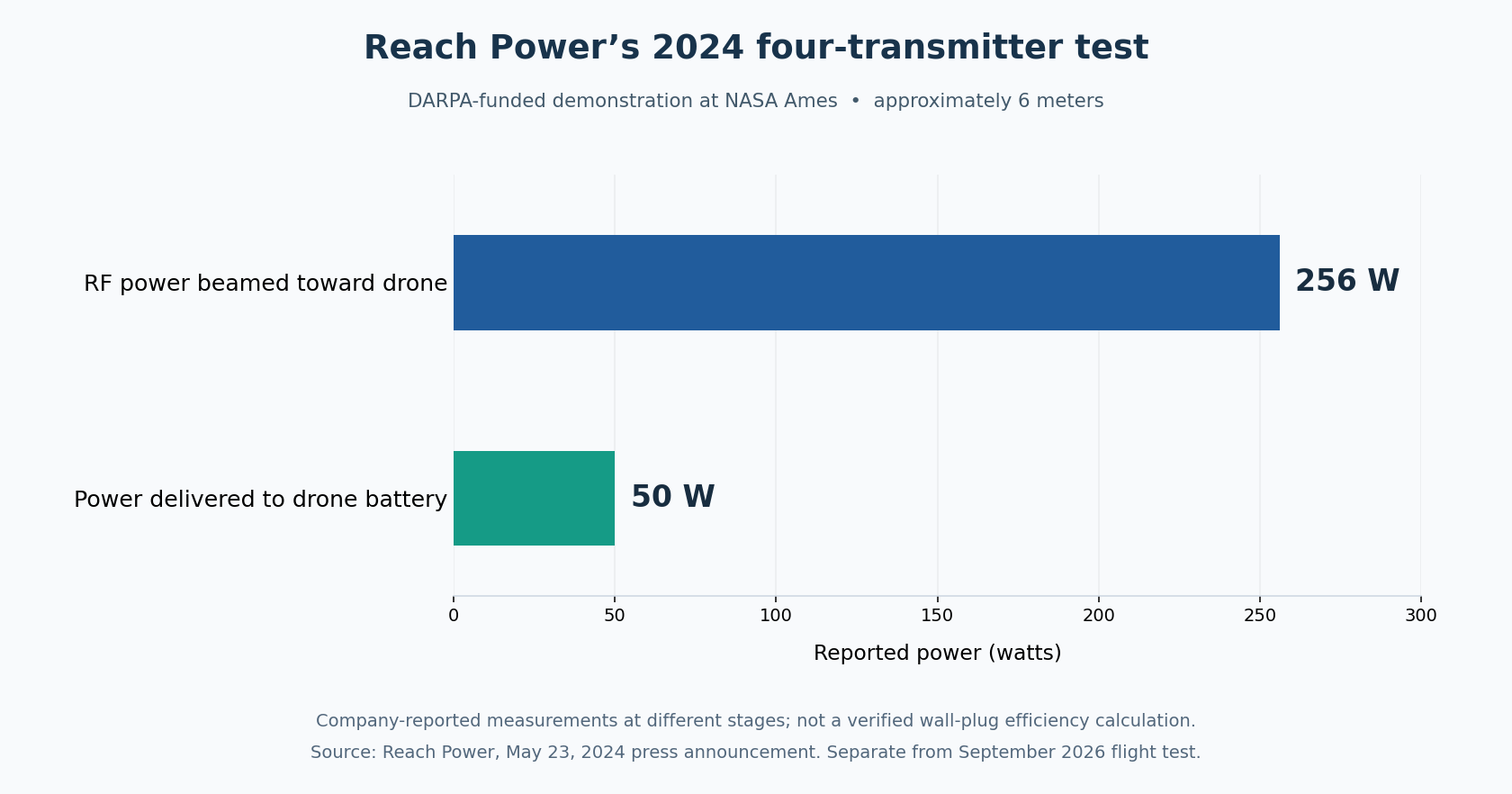
Reach’s May 2024 demonstration: 256 W beamed toward a drone, 50 W delivered at roughly six meters using four transmitters. These figures do not establish wall-plug efficiency.
From a Laboratory Array to Field Hardware
At NASA Ames in 2024, four transmitters worked together to deliver power to one airborne receiver, demonstrating coordinated operation and failover. Reach’s 2026 test added autonomous charging requests and beam reacquisition; however, the company has not disclosed that test’s delivered wattage, transmitter distance or end-to-end efficiency.
Unlike near-field road charging or wired Power over Ethernet, Reach relies on directed far-field radio waves. Unlike laser power-beaming experiments, its system uses RF antenna arrays. Practical deployments must still demonstrate safe exposure limits, reliable tracking and efficient charging in real environments.
Reach’s company-linked 2026 demonstration video shows the transmitter-and-receiver system supporting an autonomous drone; the aircraft is the test load, not the product being examined.
The next milestone is a transparent product specification: rated transmitter input, delivered receiver power, beam range, efficiency, safety certification and availability. Without those figures, Reach has demonstrated promising hardware—not an unrestricted wireless electricity network.
Support BitcoinVersus.Tech
We volunteer daily to ensure the credibility of the information on this platform is Verifiably True. Please scan the original QR code below to donate 5,000 sats if you would like to support our independent reporting. For best results, open this page on a laptop or larger screen.

On mobile, display the QR code on another screen to scan it with a Bitcoin wallet; alternatively, use a wallet’s saved-image QR-scanning feature if available. Bitcoin donation address: 3C9o19EH5HSiwEPyCTmEKzxhNCbo2X6TTb.
BitcoinVersus.tech is not a financial advisor. This media platform reports on financial subjects purely for informational purposes.


Leave a Reply