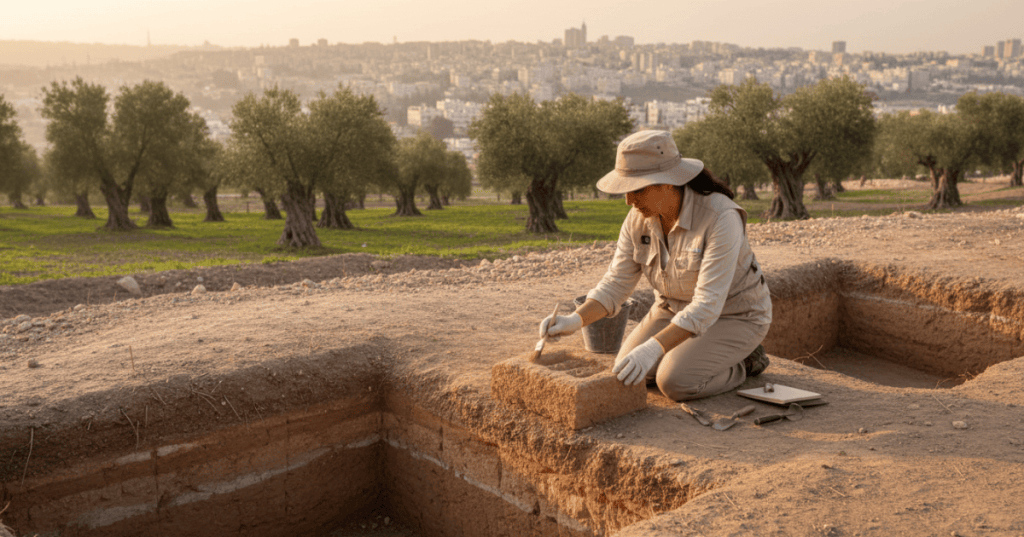
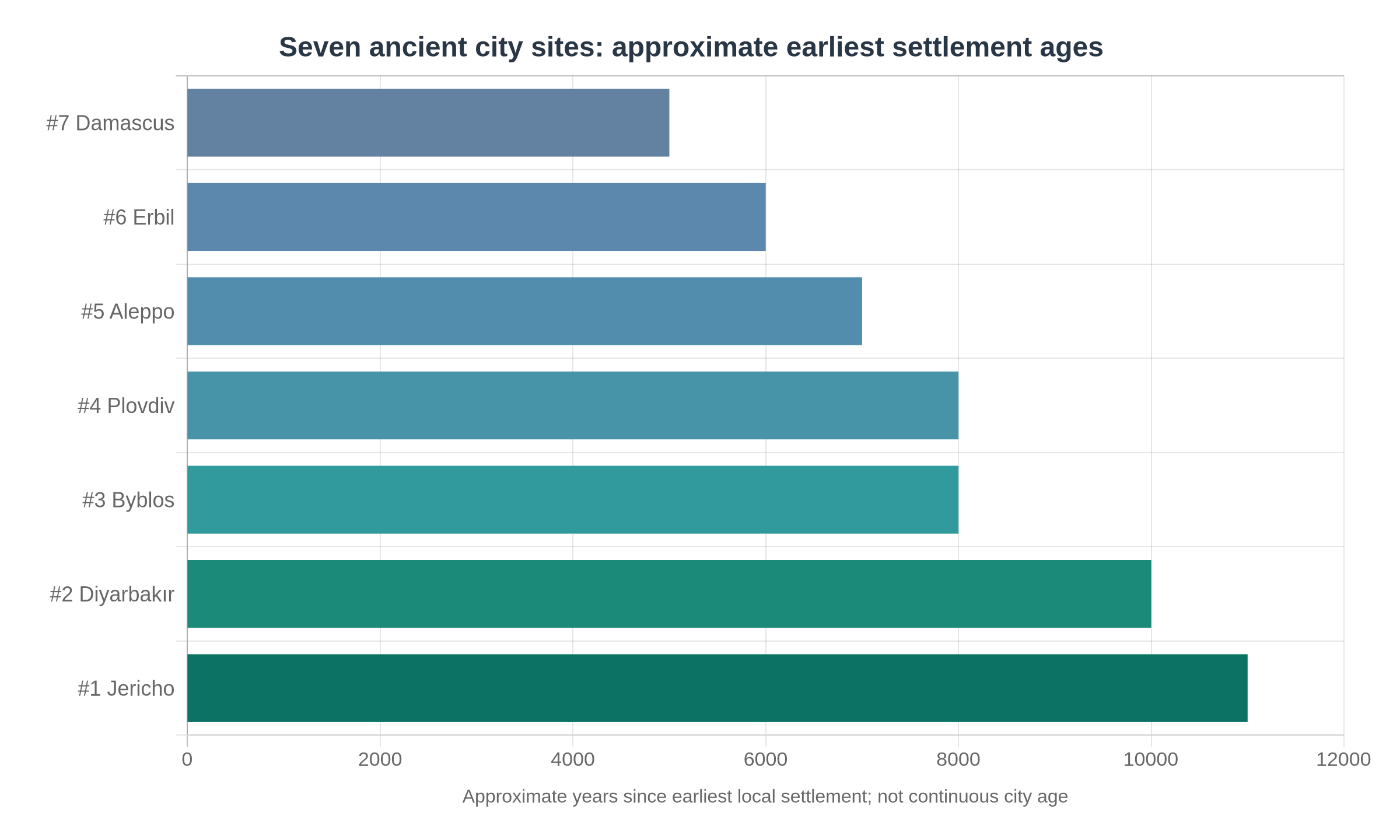
How old are the cities where people still live? This countdown presents seven ancient city sites ranked by approximate evidence of early settlement. These are not proven dates of uninterrupted city government: villages, archaeological mounds, later cities and neighboring sites must be distinguished. Our oldest schools ranking encountered similar continuity questions.
#7 Damascus, Syria — city by the 3rd millennium BCE
UNESCO dates Damascus as an urban center to the third millennium BCE. Much older finds at Tell Ramad, outside the city, do not establish the age of Damascus’s core. The living old city preserves ancient street patterns and the Umayyad Mosque.
UNESCO/NHK English-language heritage documentary about Damascus’s old city.
#6 Erbil, Iraq — occupied for at least 6,000 years
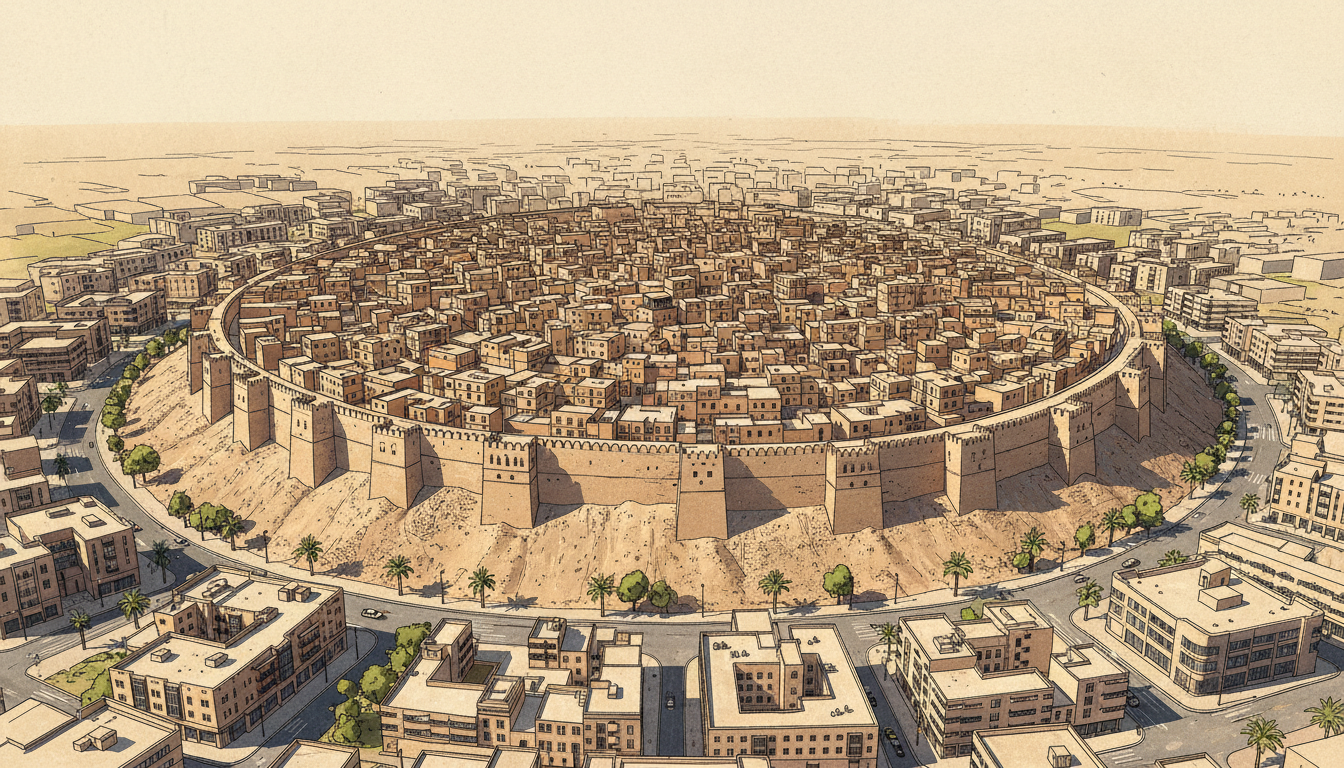
World Monuments Fund traces occupation of Erbil’s citadel mound back more than six millennia. Rebuilding accumulated into a massive elevated tell. UNESCO cautions that the citadel’s social continuity suffered interruptions. Erbil’s history intersects with Mesopotamian urban economies.
#5 Aleppo, Syria — possibly inhabited since the 6th millennium BCE
A UNESCO assessment says Aleppo may have been inhabited since the sixth millennium BCE. Its citadel and trading crossroads testify to successive civilizations, although conflict damaged the old city. Archaeological dating is less certain than its documented medieval fabric.
UNESCO/NHK English-language documentary of Aleppo’s ancient architectural heritage.
#4 Plovdiv, Bulgaria — settlement in the 6th millennium BCE
Plovdiv’s municipality dates settlement on Nebet Tepe to the sixth millennium BCE but says an identifiable town emerged much later. Bulgaria’s living city retains its Roman theatre and old quarter. Its earliest date overlaps that of Byblos.
Keith & Dev’s 2026 Plovdiv travel film, including the Roman theatre and Nebet Tepe.
#3 Byblos, Lebanon — settled around 8,000 years ago
UNESCO traces Byblos to a fishing community about eight millennia ago. Its port later became a Phoenician trading center associated with alphabetic writing. This is evidence of an ancient settlement sequence, not proof that every phase was urban.
wocomoTRAVEL’s English-language documentary on Byblos and its Phoenician past.
#2 Diyarbakır, Türkiye — Amida Mound around 8000 BCE
Recent excavations at Amida Höyük indicate Neolithic habitation around 8000 BCE. Its modern city surrounds a UNESCO-listed fortress. Claims of uninterrupted 10,000-year urban life require caution while archaeology continues. See how early engineering evolved.
360° visual tour of Diyarbakır Fortress and Hevsel Gardens; not proof of Neolithic urban status.
#1 Jericho, Palestine — permanent settlement by 9000–8000 BCE
At Tell es-Sultan, northwest of modern Jericho, UNESCO documents a sizeable Neolithic settlement by the ninth to eighth millennium BCE, including walls and a tower. Earlier human activity is known, but the prehistoric community was not always a city.
Associated Press footage of Tell es-Sultan from 2023, before UNESCO inscription; some interviews are in Arabic.
This is a selected archaeological countdown, not a definitive world record. Earliest settlement, continuous habitation and the birth of a true city are different measurements. Water, trade and construction supported early communities; recordkeeping transformed those communities much later.
BitcoinVersus.Tech
BitcoinVersus.Tech Editor’s Note: We volunteer daily to ensure the credibility of the information on this platform is Verifiably True. If you would like to support our work and help further secure the integrity of our research initiatives, please scan the QR code below to donate 5,000 sats. For best results, scan the QR code from a laptop or larger screen.

Bitcoin address: 3C9o19EH5HSiwEPyCTmEKzxhNCbo2X6TTb. On a phone, open the QR image on another screen or copy and verify the address in your wallet before sending.
BitcoinVersus.tech is not a financial advisor. This media platform reports on financial subjects purely for informational purposes.


Leave a Reply