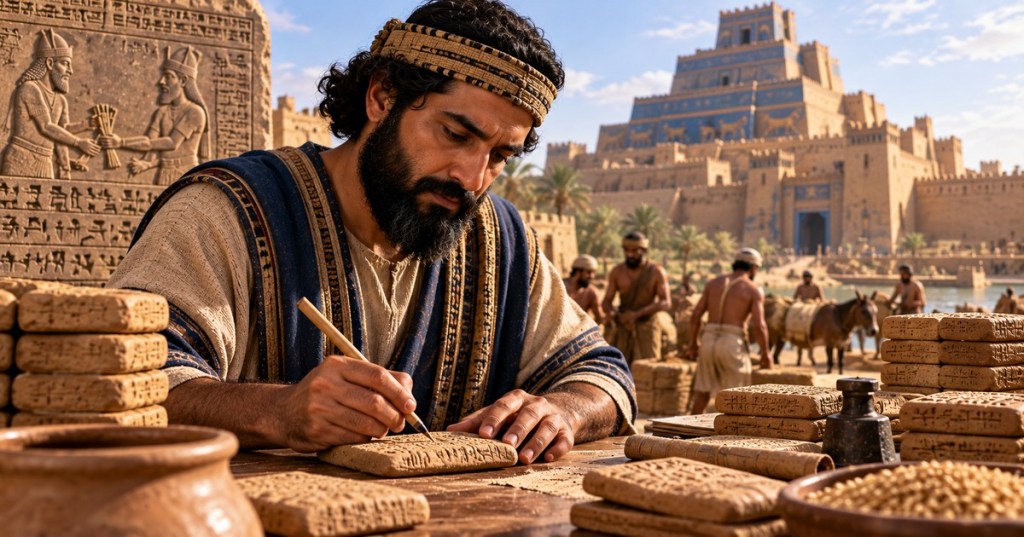
Economic crises did not begin with modern banks or stock markets. In ancient Mesopotamia, agricultural obligations, interest-bearing loans, and debt bondage created pressures serious enough that rulers sometimes ordered debt releases. The surviving evidence reveals a sophisticated system of accounts and credit, but it does not prove that the entire Mesopotamian economy repeatedly collapsed in the modern sense.
This is the first installment of the History of Money economic-crisis sequence, following OSHistory.009: Inflation, Money Supply, and Purchasing Power. It begins with the earliest well-documented debt problems and distinguishes evidence from reconstruction.
Learning objectives
- Describe barley and silver as measures of value and means of settlement.
- Explain the role of cuneiform records, loans, and obligations.
- Identify how debt distress could affect households, landholding, and labor.
- Understand royal debt-release proclamations and their limits.
- Distinguish debt crises, debt cancellation, and civilization-wide collapse.
The earliest written economies
By the late fourth millennium BCE, southern Mesopotamian cities used administrative records to track grain, livestock, labor, and goods. Clay tablets preserved obligations and transactions in durable form. Economic activity involved temples, palaces, merchants, farmers, and households; the balance between these institutions varied by city and period.
Barley was both a major crop and an accounting or payment medium. Silver by weight was widely used as a unit of value, particularly in commercial transactions. These systems existed long before modern banknotes and coinage.
How debt accumulated
Farmers could borrow grain or silver to bridge seasonal needs, pay obligations, or recover from shortages. When harvests failed or households faced extraordinary demands, repayments could become difficult. Interest and arrears could compound pressure. Some debtors pledged labor or property, and debt servitude existed under documented legal arrangements.
The burden was not uniform across society. Long-distance merchant credit differed from agrarian subsistence debt. A royal decree directed at distress obligations did not necessarily cancel all commercial debts.
A documentary overview of the Sumerian economy, barley accounting, silver, and early debt records. Video playback must be confirmed on the live page.
Debt release before Hammurabi
Evidence of rulers presenting themselves as restorers of justice reaches back to third-millennium BCE Sumer. Enmetena of Lagash, often dated to the mid-third millennium BCE, is associated with an early proclamation of release. Scholars distinguish these early texts from the better-documented later Old Babylonian debt-remission edicts.
Old Babylonian rulers issued decrees often discussed under the Akkadian terms mīšarum and andurārum. Depending on the decree, provisions could address certain personal debts, debt bondage, and property lost under distress. The exact scope and enforcement varied; the phrase “all debts were erased” is too broad.
Why rulers intervened
Debt concentration could weaken free households, shrink the labor and tax base, and create social conflict. Debt release could also strengthen a ruler’s legitimacy and political authority. It is therefore useful to analyze both economic stabilization and political incentives rather than assuming a single charitable or purely fiscal motive.
Historian Amanda H. Podany discusses this evidence in the Financial Times’ The Story of Money: How ancient Mesopotamians solved runaway debt. The discussion emphasizes surviving cuneiform records, differences among debts, and the long chronology of debt releases.
A historical discussion of Hammurabi-era kingship and debt forgiveness. Reader discussions are contextual, not primary documentary evidence.
What the surviving records actually prove
The Metropolitan Museum of Art preserves an Old Assyrian cuneiform tablet recording the discharge of a copper debt. Such artifacts show that merchants documented obligations and repayment in legally meaningful ways. See the museum’s cuneiform loan quittance. This particular artifact is not evidence of a royal general debt cancellation; it illustrates the accounting infrastructure within which credit operated.
Was this an economic collapse?
A debt crisis is not necessarily a collapse of an entire economy. Mesopotamian records show distress, debt bondage, royal interventions, and periods of political upheaval. But we do not have comprehensive ancient national accounts, GDP series, unemployment statistics, or price indexes comparable to modern data. Historians cannot responsibly calculate a universal percentage decline for these episodes.
This course will use precise categories: household debt distress, credit crisis, state fiscal stress, currency disruption, regional trade contraction, and political-economic collapse. We will identify which category the evidence supports in each case.
The Hammurabi comparison
Hammurabi ruled Babylon in the eighteenth century BCE. His laws include provisions relating to loans, debt servitude, and agricultural hardship. These rules should not be confused with a universal modern bankruptcy system. Their application depended on social status, the nature of the obligation, and the legal and political setting.
Discussion of debt bondage and the legal treatment of debt in ancient Mesopotamia and related traditions.
What lessons can and cannot be drawn
The historical record supports a modest conclusion: credit arrangements and debt distress are ancient, and some governments intervened to prevent debt obligations from destabilizing households and political institutions. It does not establish that ancient debt releases would automatically solve modern sovereign-debt crises or that modern monetary systems operate identically to those of Sumer and Babylon.
Research exercise
Compare three kinds of evidence: an individual loan receipt, a royal debt-release decree, and a later historian’s interpretation. Identify who issued each record, what debt category it addresses, and whether it documents actual enforcement. Explain why a claim of “the first economic collapse in history” would require more evidence than a surviving debt-release proclamation.
Knowledge check and answers
- What was recorded on clay tablets? Goods, labor, loans, payments, and other administrative and commercial obligations.
- Did ancient Mesopotamia use only barter? No. It used accounting units, commodity payments, and credit obligations.
- Were all debts automatically canceled? No. The scope of releases differed and often distinguished distress debts from commercial obligations.
- Does debt forgiveness prove total economic collapse? No. It demonstrates a response to specific pressures, not a quantified economy-wide breakdown.
- Why is archaeological context important? A loan receipt and a royal decree are different kinds of evidence and cannot be treated as interchangeable.
Primary sources and further reading
Study the Metropolitan Museum of Art’s Old Assyrian loan receipt, the Morgan Library’s explanation of cuneiform, and the Financial Times interview with Amanda H. Podany. The next crisis lesson will examine later ancient and classical-world monetary disruptions with the same source-critical approach.
Previous related lessons
- OSHistory.009: Inflation and Purchasing Power
- OSHistory.008: The Nixon Shock
- OSHistory.002: Commodity Money
- OSHistory.001: The Coincidence of Wants
BitcoinVersus.Tech Editor’s Note:
We volunteer daily to ensure the credibility of the information on this platform is Verifiably True. If you would like to support to help further secure the integrity of our research initiatives, please donate using the QR code provided
For best QR-code scanning results, please scan this donation code from a desktop or larger screen. Mobile screens may prevent camera recognition.



Leave a Reply