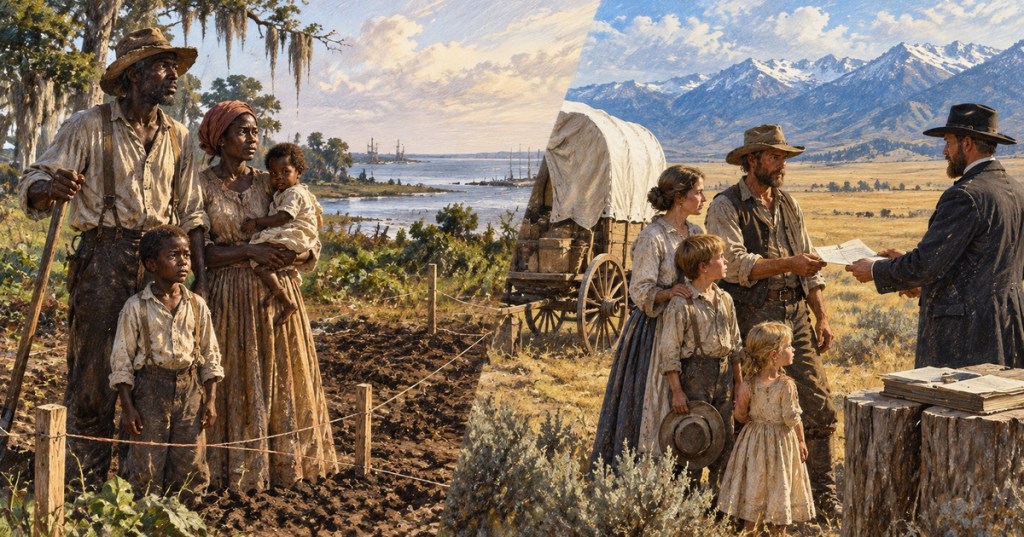
Opinion. How long should a country look backward before an apology—or some form of material repair—becomes unreasonable?
I do not think there is a clean expiration date.
Governments and institutions still return cultural property that is hundreds or even thousands of years old. That does not mean every object was stolen thousands of years ago; sometimes the artifact is ancient and the theft is recent. But the underlying principle matters: the passage of time does not automatically erase a documented ownership claim or a government’s ability to acknowledge a past wrong.
The Polymarket post that prompted this opinion.
The 40-acre order was real
One correction matters before making the argument. The famous coastal land order was not General Order No. 21. It was Special Field Orders No. 15, issued by Maj. Gen. William T. Sherman in January 1865. The order reserved the islands south of Charleston, abandoned rice fields along the rivers and land bordering Florida’s St. Johns River for settlement by people newly freed from slavery.
Families could receive plots of no more than 40 acres of tillable land. The order described the title as possessory rather than a permanent congressional land grant, which is an important legal distinction. Still, this was not a myth invented generations later. It was an actual United States military order establishing a concrete land policy for freed families.
C-SPAN examines Sherman’s Special Field Orders No. 15 and the origin of “40 acres.”
The policy did not last. President Andrew Johnson’s administration restored most of the affected land to former owners. BitcoinVersus.Tech argued for reparations in an earlier 2023 opinion; this is also a correction to that older headline’s reference to “General Order No. 21.” The document relevant to the 40-acre policy is Special Field Orders No. 15.
America was already distributing land
The comparison with the Homestead Act is powerful, but the dates and acreage should also be precise. President Abraham Lincoln signed the Homestead Act on May 20, 1862—nearly three years before Sherman’s order. The law generally offered eligible claimants up to 160 acres of surveyed public land after five years of residence and improvement, not 400 acres after seven years.
The program ultimately distributed roughly 270 million acres. And it was not exclusively a white program: Black Americans later filed homestead claims too. That nuance matters.
But so does the contrast. The United States proved that land could be used as a massive economic-development tool, helping families convert labor and settlement into property. Land was capital. It could be farmed, borrowed against, inherited and transferred. We explored that basic economic idea in The History of Money: The Acre.
At almost the same historical moment, another land policy was aimed specifically at families emerging from generations of forced labor. That policy was largely undone.
Legality is not the whole argument
One response to reparations is that slavery was legal at the time in jurisdictions that protected it. That is historically true. It is not, by itself, a moral answer.
Governments routinely reconsider acts that were legal under earlier systems. Law tells us what a government permitted at a particular moment. It does not permanently settle what later generations may conclude was unjust, nor does it prohibit a later government from creating compensation, restitution or other forms of redress.
The United States has already accepted that principle in other circumstances. The Civil Liberties Act of 1988 formally apologized for the wartime incarceration of Japanese Americans and created restitution payments for eligible survivors. That precedent does not automatically answer the far larger and more complicated slavery question. It does establish that “it happened decades ago” is not an absolute barrier to public redress.
PBS Origins reviews the history of reparations arguments in the United States and abroad.
Personal responsibility and public responsibility can coexist
I am not arguing that my immediate responsibilities are somebody else’s. My bills, my work, my decisions and what I do with my life are mine. That is a separate question.
I am arguing something narrower: governments create economic rules, distribute assets, recognize claims and sometimes reverse promises. When the historical record shows that one policy converted labor into land and durable property while another targeted land program for newly freed people was withdrawn, it is reasonable to ask what obligation remains.
That obligation does not have to take only one form. Reparations could mean direct payments. They could include land or homeownership programs, education benefits, retirement benefits, tax treatment, descendant trusts or long-term community investment. The exact design, eligibility rules and cost deserve serious debate.
So do the objections: Who qualifies? Who pays? How should a benefit be calculated? What about Americans whose families arrived long after slavery? Those are real policy questions, not questions that should be waved away.
But implementation difficulty is different from saying there is nothing to recognize.
Human societies have wrestled with obligations, canceled debts and attempted economic resets for thousands of years; our history lesson on ancient debt forgiveness shows how old that debate really is.
For me, that is the core issue. No living American needs to inherit personal guilt for something an ancestor did. But the United States is still the same continuing government that issued land laws, military orders and property rules. Governments inherit assets, treaties, debts and legal obligations across generations. It is therefore legitimate to ask whether they can also inherit responsibility for documented decisions that denied other Americans the chance to build property from their labor.
The question is not whether history can be undone. It cannot.
The question is whether recognition should stop at an apology—or whether, after examining the evidence, the country believes something material is still owed.
BitcoinVersus.Tech Editor’s Note:
We volunteer daily to ensure the credibility of the information on this platform is Verifiably True. If you would like to support to help further secure the integrity of our research initiatives, please donate using the QR code provided

For best QR-code scanning results, please scan this donation code from a desktop or larger screen. Mobile screens may prevent camera recognition.


Leave a Reply