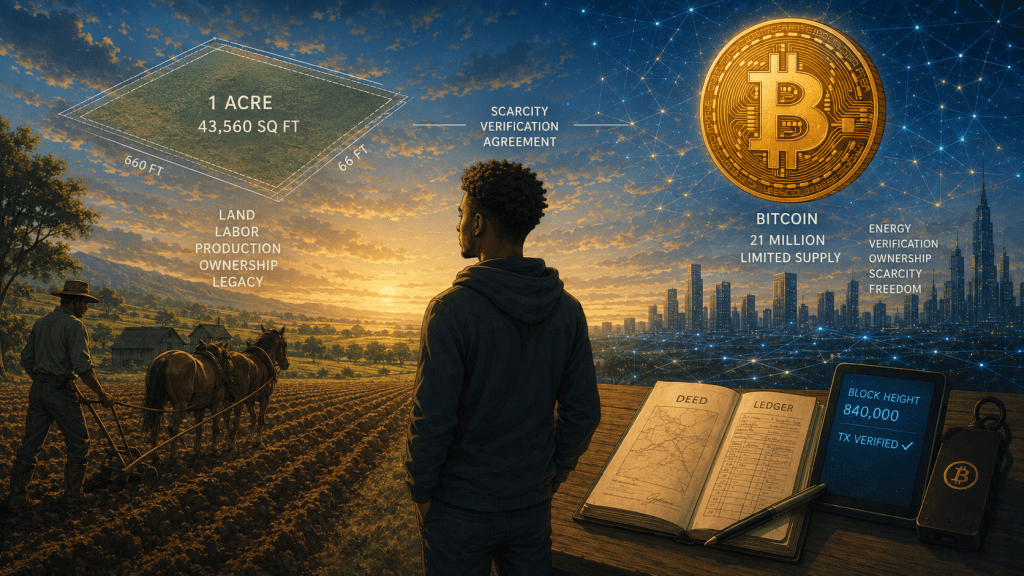
The acre looks ordinary now.
A number on a deed. A property line. A backyard. A farm. A piece of land somebody inherited, bought, divided, defended, or lost.
But fundamentally, the acre was never just land.
It was a unit of scarcity.
A way to take something finite, difficult to produce, and impossible to duplicate, then assign it a measurable place inside an economy.
An acre could not be copied. It had to be cleared, worked, surveyed, recorded, and protected. Its value came from more than the soil itself. It came from the labor invested in it, the production expected from it, and the shared belief that the boundary meant something.
That should sound familiar.
Bitcoin does not grow food. An acre does not move through a digital network. But both become valuable through the same deeper machinery: scarcity, work, verification, ownership, and consensus.
The acre turned land into an account.
Bitcoin turns energy into an account.
One measured productive territory. The other measures verified digital scarcity.
And in both cases, the number only works because people agree not to ignore it.
A survey line is just a line until a court, a government, a buyer, and a neighbor recognize it.
A bitcoin is just data until a network of machines verifies it, records it, and refuses to let the same unit be spent twice.
That is where value begins.
Not in the object alone.
In the system surrounding it.
The acre gave people a way to say: this portion is scarce, this portion is mine, this portion has been measured, and this portion can be exchanged.
Bitcoin says almost the same thing.
This amount is scarce. This amount is mine. This amount has been verified. This amount can move.
The acre became wealth because it could store labor across time. A person could work the land, improve it, pass it down, borrow against it, or trade it for something else.
Bitcoin attempts the same basic function without the field.
It stores economic effort in a form that can be held, transferred, divided, and verified without requiring the owner to stand on the property.
That is the real connection.
Both are systems for turning effort into ownership.
Both depend on limits.
Both require records.
Both become more powerful when the rules are trusted.
The difference is that the acre tied wealth to geography.
Bitcoin tries to separate wealth from geography entirely.
One gave civilization a ledger written across the earth.
The other gives it a ledger written across machines.
But underneath both systems is the same ancient question:
How do we measure what is scarce, prove who controls it, and carry its value into the future?
For centuries, the answer was land.
Now, for some people, the answer is Bitcoin.
BitcoinVersus.Tech Editor’s Note:
We volunteer daily to ensure the credibility of the information on this platform is Verifiably True. If you would like to support to help further secure the integrity of our research initiatives, please donate here: 3C9o19EH5HSiwEPyCTmEKzxhNCbo2X6TTb
BitcoinVersus.tech is not a financial advisor. This media platform reports on financial subjects purely for informational purposes.


Leave a Reply