Elementary Overview
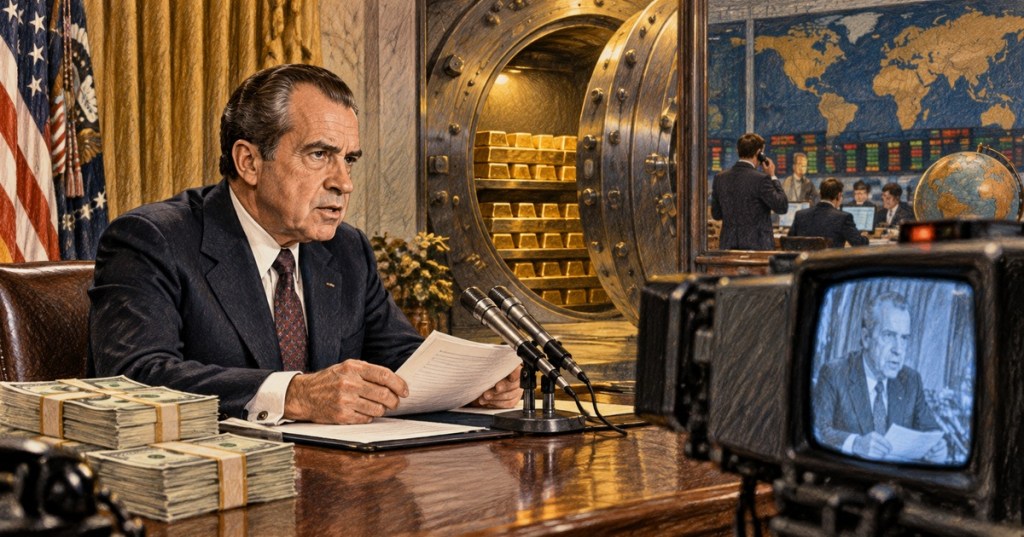
On August 15, 1971, President Richard Nixon announced that the United States would suspend the convertibility of U.S. dollars into gold for foreign official holders. The announcement became known as the Nixon Shock.
This lesson follows OSHistory.007: Bretton Woods. That system tied major currencies to the U.S. dollar while the United States promised foreign monetary authorities that dollars could be converted into gold at $35 per troy ounce. By 1971, maintaining that promise had become increasingly difficult.
The Nixon Shock did not instantly create today’s monetary system in one night. It began the final breakdown of Bretton Woods. An attempted repair followed through the Smithsonian Agreement, and the transition toward generalized floating exchange rates continued into 1973.
What Dollar-Gold Convertibility Actually Meant
It is important to be precise about who could redeem dollars for gold under Bretton Woods. Ordinary Americans were not walking into banks in 1970 and routinely converting Federal Reserve notes into Treasury gold at $35 per ounce. The critical Bretton Woods promise was an international official convertibility mechanism: foreign central banks and monetary authorities holding dollars could present them to the United States for gold.
That distinction connects this lesson to OSHistory.006: The Gold Standard. Monetary systems can use gold in very different ways. A domestic gold-coin standard, an international gold-exchange standard, and Bretton Woods are not interchangeable systems.
The Core Problem: More Dollars, Limited Gold
Federal Reserve History explains that the United States entered the 1960s with a strong reserve position, but the supply of dollars held abroad grew as U.S. balance-of-payments deficits accumulated. Meanwhile, the U.S. gold stock did not grow fast enough to maintain full confidence that every official dollar claim could be redeemed at the fixed price.
This is closely related to the Triffin dilemma. A reserve-currency country must supply the world with enough reserve assets to support international trade and finance. But continuously supplying those reserve assets can eventually make foreign holders question whether the issuer can honor the promise supporting them.
The problem was not simply “the United States printed too much money” in isolation. It was a structural conflict involving global dollar demand, U.S. deficits, inflation, gold reserves, exchange-rate commitments, military and foreign spending, private capital flows, and confidence in the fixed parity.
Pressure Built Through The 1960s
The United States and its partners repeatedly tried to preserve Bretton Woods. The Federal Reserve established international currency-swap lines. Central banks cooperated on gold-market arrangements. Governments imposed capital controls and other measures designed to slow pressure on the dollar.
These interventions bought time, but they did not remove the underlying mismatch between growing foreign dollar claims and the United States’ commitment to redeem official dollars at the fixed gold price.
The U.S. State Department’s historical account notes that earlier administrations had already tried restrictions on foreign lending, measures to discourage foreign investment, international monetary reform, and other actions to support the dollar.
Camp David, August 13–15, 1971
From August 13 through August 15, Nixon met with senior economic advisers at Camp David. Participants included Treasury Secretary John Connally, Federal Reserve Chairman Arthur Burns, Office of Management and Budget Director George Shultz, and Treasury official Paul Volcker.
The surviving records show that the decision was debated. Burns warned about the risks of closing the gold window. Others argued that the United States could no longer remain exposed to a run on its gold reserves.
The Richard Nixon Presidential Library’s August 15 archive preserves recordings, notes, and broadcast records from the day of the announcement. These primary materials are useful because they show that the policy emerged from a broader package addressing inflation, employment, trade, exchange rates, and confidence in the dollar.
Richard Nixon Foundation — Nixon’s August 15, 1971 address announcing the New Economic Policy and suspension of dollar-gold convertibility.
The New Economic Policy Was Bigger Than Gold
Nixon’s announcement contained several major measures. The gold decision is the one most remembered today, but the package also included a 90-day wage and price freeze, tax proposals, spending measures, and a temporary 10% surcharge on many imports.
The administration presented these actions as a coordinated attempt to address inflation, unemployment, the trade balance, and pressure on the dollar. The import surcharge also increased pressure on trading partners to negotiate new exchange rates.
This connects to Why Do Interest Rates Exist? because modern monetary policy operates through a much broader set of institutions and incentives than the simple image of paper money replacing gold.
The Gold Window Was “Temporarily” Closed
Nixon described the suspension as temporary. In practice, the United States never restored the old Bretton Woods promise of official dollar redemption at $35 per ounce.
The immediate purpose was to stop the drain on U.S. gold reserves and force a renegotiation of the international monetary system. The dollar could then move against other currencies rather than being defended indefinitely through the old gold-convertibility commitment.
The Smithsonian Agreement Tried To Save Fixed Exchange Rates
The world did not move directly from August 15 to today’s floating-rate system. In December 1971, major countries negotiated the Smithsonian Agreement.
Under that agreement, the official dollar price of gold was changed from $35 to $38 per ounce, while other countries adjusted their exchange rates against the dollar. The allowed exchange-rate bands were also widened.
The agreement was an attempt to rebuild Bretton Woods around new parities. It did not restore the old gold-convertibility mechanism, and it did not solve the system’s deeper confidence problem.
By 1973, Major Currencies Were Floating
The Smithsonian arrangement did not last. Renewed currency pressure returned, and by 1973 the major industrial currencies were generally allowed to float against one another.
A floating exchange rate means the market price of one currency in terms of another can change rather than remaining permanently fixed at a government-declared parity. Central banks can still intervene, and some countries continue to peg or manage their currencies, but the post-1973 system no longer depended on the Bretton Woods chain of fixed dollar exchange rates anchored to official gold convertibility.
Professor Jonathan Barth — monetary-history lecture on the 1971 Nixon Shock, the gold window, and the breakdown of Bretton Woods.
What Makes Modern Fiat Money Different?
After the breakdown of Bretton Woods, the dollar was no longer redeemable by foreign monetary authorities into gold at a fixed official price. Its value instead rested on a combination of legal institutions, taxation, monetary policy, government credit, banking, economic output, and demand for dollars in domestic and international commerce.
This is commonly described as a fiat monetary system. Fiat money is not “money backed by nothing” in the literal sense that it has no supporting institutions or assets anywhere in the economy. The more precise statement is that the currency is not contractually redeemable into a fixed quantity of a commodity such as gold.
The Federal Reserve’s 2026 history of its balance sheet notes that after official convertibility ended, Treasury securities became the dominant assets on the Fed’s balance sheet while gold became a much smaller share relative to the size of the economy.
Gold Did Not Disappear
Ending convertibility did not make U.S. gold reserves vanish. The United States continued to own substantial gold, and gold continued to trade in private markets. The crucial change was the end of the obligation to redeem foreign official dollar balances for a fixed amount of gold.
Gold also remained a reserve asset held by central banks. The monetary role of gold changed, but its financial and reserve role did not disappear.
1971 Did Not Single-Handedly Cause Every Later Price Increase
Discussions of 1971 often become overly simple. The end of dollar-gold convertibility changed the monetary framework, but later inflation and purchasing-power changes also reflected oil shocks, fiscal policy, monetary policy, productivity, wages, demographics, credit growth, regulation, globalization, wars, taxes, technology, and many other forces.
The Federal Reserve’s history of the Great Inflation places the inflationary period from 1965 to 1982 in a broader policy context that began before the Nixon Shock and continued long after it.
Modern monetary debates frequently use long-run purchasing-power charts to discuss the post-gold era. The social post below links to Federal Reserve economic data, but it should be treated as commentary rather than proof that one 1971 decision alone explains every subsequent movement in the dollar’s purchasing power.
Digital Asset News — modern commentary using Federal Reserve economic data to discuss the long-run purchasing power of the dollar. The chart is context, not evidence of a single-cause relationship with 1971.
Why The Nixon Shock Matters For Bitcoin History
Bitcoin arrived decades later, but debates surrounding it frequently return to the monetary transition of 1971. Bitcoin’s fixed issuance schedule, proof-of-work consensus, and absence of commodity convertibility create a monetary design very different from both a classical gold standard and a central-bank fiat system.
Understanding 1971 helps prevent a common mistake: describing Bitcoin simply as “digital gold” and then assuming its mechanics are the same as historical gold-backed currency. Gold standards relied on institutions promising redemption. Bitcoin instead verifies ownership and issuance through a distributed network and protocol rules.
The earlier lesson OSHistory.003: Standardized Coinage showed how trust migrated from metal weight toward mints and sovereign guarantees. OSHistory.004: Early Banking and Ledger Money showed how money became increasingly represented by claims and ledgers. The 1971 transition is another step in that long history of separating monetary value from direct commodity redemption.
Timeline: From Bretton Woods To Floating Rates
- 1944: Bretton Woods agreements establish the postwar monetary framework.
- 1958: Major European currencies become externally convertible, making Bretton Woods fully operational in practice.
- 1960s: Foreign dollar holdings grow while pressure on U.S. gold reserves increases.
- August 13–15, 1971: Nixon and advisers meet at Camp David.
- August 15, 1971: Nixon suspends dollar-gold convertibility and announces the New Economic Policy.
- December 1971: Smithsonian Agreement establishes new exchange-rate parities and moves the official gold price to $38 per ounce.
- 1972–1973: Currency pressure returns.
- 1973: Major currencies increasingly move to floating exchange rates.
Historical Pattern Recognition
- Reserve currency dilemma: supplying the world with reserve assets can eventually weaken confidence in the promise supporting those assets.
- Fixed-price stress: a government-declared parity becomes harder to defend when market conditions move far from the official price.
- Temporary policies can become permanent: the 1971 suspension of convertibility was announced as temporary but the old system was never restored.
- Monetary systems change in stages: Bretton Woods did not end in one single legal instant; 1971 began a transition that continued through failed repair attempts and the 1973 move toward floating rates.
- Money depends on institutions: gold standards, banknotes, ledger money, and fiat currencies all rely on different combinations of law, accounting, redemption rules, settlement systems, and public confidence.
Exercises
- Explain why the Bretton Woods gold promise applied primarily to foreign official holders rather than ordinary U.S. citizens.
- Describe the Triffin dilemma in your own words.
- List the major components of Nixon’s August 15, 1971 New Economic Policy besides suspension of gold convertibility.
- Explain why the Smithsonian Agreement should be understood as an attempted repair of Bretton Woods rather than the beginning of a completely free-floating system.
- Compare a gold-convertible currency with fiat money and Bitcoin without treating any two of them as identical.
- Explain why long-run purchasing-power decline cannot automatically be attributed to one historical event.
- Create a short timeline from Bretton Woods in 1944 to generalized floating exchange rates in 1973.
Knowledge Check + Answers
- When did Nixon announce suspension of dollar-gold convertibility? August 15, 1971.
- What was the Bretton Woods official gold price before the Nixon Shock? $35 per troy ounce.
- Who could use the core Bretton Woods dollar-gold convertibility mechanism? Foreign official monetary authorities, especially central banks, rather than ordinary retail dollar holders.
- What was the Smithsonian Agreement? A December 1971 attempt to preserve fixed exchange rates through new currency parities and a higher official dollar price of gold.
- Did the Smithsonian Agreement permanently restore Bretton Woods? No. Renewed pressure led major currencies toward floating exchange rates by 1973.
- What is fiat money? Currency that is not redeemable by contract into a fixed quantity of a commodity such as gold and whose value operates through monetary, legal, fiscal, banking, and market institutions.
- Did U.S. gold reserves disappear after 1971? No. Gold remained an official reserve asset; the key change was the end of fixed official dollar redemption into gold.
- Did 1971 alone cause all later inflation? No. The postwar inflation experience had multiple causes and policy drivers before and after 1971.
Prior Lessons And Primary References
- OSHistory.007 — Bretton Woods
- OSHistory.006 — The Gold Standard
- OSHistory.005 — Bank Runs and the Rise of Central Banking
- OSHistory.004 — Early Banking and Ledger Money
- Richard Nixon Presidential Library — August 15, 1971
- Federal Reserve History — Gold Convertibility Ends
- Federal Reserve History — Smithsonian Agreement
- U.S. Department of State, Office of the Historian — Nixon and the End of Bretton Woods
- Federal Reserve History — The Great Inflation
- Federal Reserve Board — A Brief Illustrated History of the Federal Reserve’s Balance Sheet
Elementary Conclusion
The Nixon Shock changed the operating rules of the international monetary system. The United States stopped promising foreign official holders that dollars could be exchanged for gold at $35 per ounce, then tried to rebuild fixed exchange rates through the Smithsonian Agreement. That repair failed, and by 1973 the major currencies were moving toward floating exchange rates. The result was not the instant creation of modern finance but a decisive transition away from Bretton Woods and toward a monetary system in which currency value depends on central-bank policy, fiscal institutions, markets, law, credit, and confidence rather than fixed commodity redemption.
BitcoinVersus.Tech
BitcoinVersus.Tech publishes open technical and monetary-history education across Bitcoin, finance, computing, energy, networking, data centers, semiconductors, robotics, and firmware.
Editor’s Note
Historical monetary systems are often simplified into slogans. This lesson distinguishes official foreign dollar-gold convertibility, domestic gold ownership, exchange-rate parities, inflation, and later fiat-money institutions because those concepts are related but not identical.
BitcoinVersus.tech is not a financial advisor. Content is provided for informational purposes.


Leave a Reply