Elementary Overview
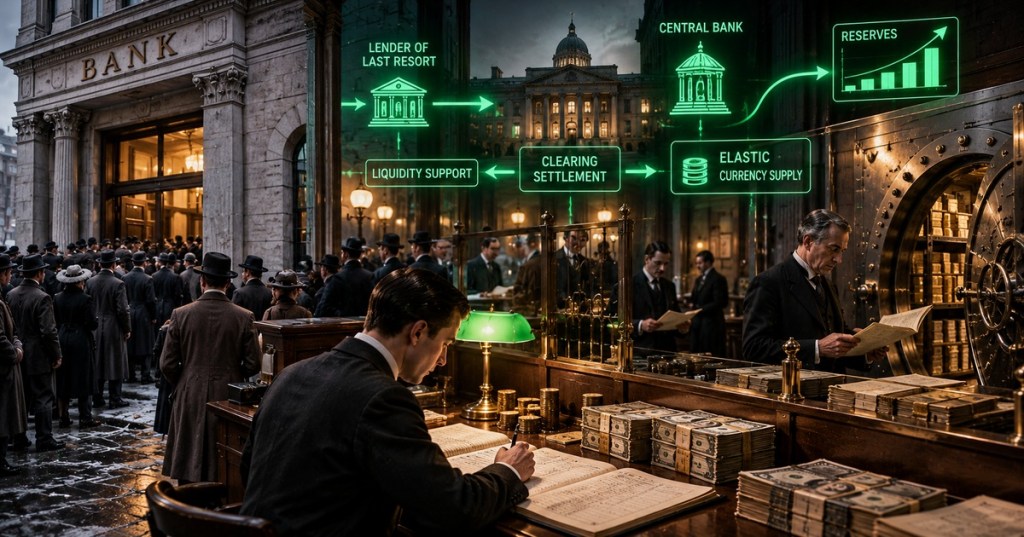
A bank deposit is a promise that a bank will give customers their money or settle payments when asked. The problem is that banks do not keep every deposited unit sitting unused in a vault; much of their balance sheet may be loans and other assets that cannot instantly become cash. If many depositors become frightened and demand cash at the same time, even a bank with valuable assets can face a bank run. Repeated banking panics pushed financial systems toward clearinghouses and eventually central banks that could supply emergency liquidity when ordinary reserves were not enough.
Why a Bank Run Can Become Self-Reinforcing
A bank can be solvent—its assets are worth more than its liabilities—yet still be illiquid because those assets cannot be sold or collected quickly enough to meet immediate withdrawals. If depositors believe other customers will withdraw first, each person has an incentive to get cash early. That behavior can force the bank to sell assets rapidly, sometimes at depressed prices, which can turn a liquidity problem into actual insolvency. The reserve and settlement concepts introduced in OSHistory.004 therefore created a new historical problem: once money existed as bank liabilities on ledgers, confidence in the institution keeping the ledger became economically important.
Clearinghouses Became Early Crisis Backstops
Before a permanent U.S. central bank existed, private clearinghouses sometimes pooled reserves and issued clearinghouse loan certificates so member banks could settle obligations during panics. The New York Clearing House performed this kind of emergency support during nineteenth-century crises, temporarily behaving like a central liquidity institution. The Panic of 1907 exposed the limits of relying on private coordination alone because important trust companies sat outside the strongest clearinghouse protections. The crisis became a major political and economic argument for creating a permanent institution able to respond when liquidity demand surged across the banking system.
The Lender of Last Resort Supplies Liquidity During a Panic
A central bank acting as lender of last resort can lend against acceptable collateral when otherwise solvent institutions cannot obtain enough cash from normal markets. The classic nineteenth-century idea associated with Walter Bagehot was broadly to lend freely during a panic, against good security, and at a penalty rate so emergency support did not simply replace ordinary market funding. Historical Bank of England crises helped shape this role, and later central banks formalized similar emergency-liquidity functions. The important distinction is that liquidity support can give a sound institution time to meet withdrawals; it does not magically make bad assets valuable or erase genuine insolvency.
Elastic Currency Meant the Supply of Settlement Money Could Expand in a Crisis
One complaint about the pre-Federal Reserve U.S. system was that currency was too inelastic: the supply of notes could not expand quickly when the public suddenly demanded more cash. Reformers wanted a mechanism that could convert eligible bank assets into central-bank money during stress. The Federal Reserve Act of 1913 created regional Reserve Banks and a discount window through which member banks could obtain additional reserve balances or currency against collateral. This did not eliminate panics, but it created a standing institution designed to make the monetary system more responsive than the earlier arrangement. Modern BitcoinVersus coverage of the Federal Reserve shows how much broader the institution’s regulatory and monetary role later became.
Central Banking Reduced One Risk but Created New Policy Tradeoffs
A lender of last resort can reduce the chance that a short-lived panic destroys otherwise viable banks, but emergency support also creates questions about incentives. If banks expect rescue regardless of their behavior, they may take more risk; economists call this moral hazard. Central banks therefore developed collateral rules, supervisory systems, capital and liquidity requirements, and other limits intended to separate temporary liquidity assistance from permanent support for insolvent institutions. History also shows that having a central bank does not guarantee good crisis management: the Federal Reserve’s limited response to the banking panics of the early 1930s remains a major case study in how central-bank decisions can either contain or amplify financial stress.
Why This History Matters to Bitcoin and Modern Payment Rails
The rise of central banking shows how monetary systems repeatedly changed their trust architecture when new payment technologies created new failure modes. Coins required trust in weight and minting; bank ledgers required trust in institutions and reserves; central banking added a higher-level institution that could provide system-wide settlement liquidity. Modern bank rails and stablecoin systems still interact with this institutional structure. Bitcoin takes a different path: instead of adding a lender of last resort above the ledger, it uses a distributed ledger, fixed protocol rules, and market-priced liquidity without a central institution that can create additional Bitcoin during a panic.
Prior Lessons
- OSHistory.001: The Coincidence of Wants
- OSHistory.002: Commodity Money — Why Some Goods Work Better as Money
- OSHistory.003: Standardized Coinage — Weights, Mints, Seigniorage, and Trust
- OSHistory.004: Early Banking and Ledger Money — Deposits, Banknotes, Checks, and Reserves
Exercises
- Explain the difference between a solvent bank and a liquid bank using a simple example.
- Describe how a rumor can become self-fulfilling during a bank run.
- Explain how a clearinghouse loan certificate could reduce settlement pressure among member banks.
- Describe the lender-of-last-resort function without using the phrase “bailout.”
- Explain what economists meant by an “elastic” currency in the early Federal Reserve debate.
- Give one benefit and one moral-hazard risk created by emergency central-bank lending.
- Compare the central-bank solution to a liquidity panic with Bitcoin’s fixed-supply monetary design.
Knowledge Check + Answers
- What is a bank run? A rapid wave of withdrawals caused by depositors trying to obtain cash or settlement before other depositors do.
- Can a solvent bank be illiquid? Yes. Its assets can exceed liabilities while still being unavailable quickly enough to meet immediate withdrawals.
- What did clearinghouses sometimes do during panics? They pooled reserves, coordinated settlement, and issued temporary clearinghouse loan certificates to support member banks.
- What is a lender of last resort? An institution—normally a central bank—that provides emergency liquidity when solvent financial institutions cannot obtain enough funding through normal markets.
- What did “elastic currency” mean historically? A monetary supply able to expand when demand for cash and reserves rose sharply and contract again when the emergency passed.
- Why was 1907 important in U.S. monetary history? The Panic of 1907 demonstrated the limits of private crisis management and accelerated political support for a permanent central-bank system.
- Does central-bank lending eliminate insolvency? No. Liquidity assistance can bridge temporary cash shortages but cannot make fundamentally bad assets or an insolvent balance sheet healthy.
Elementary Conclusion
A simple way to picture central banking is to imagine many neighborhood banks that each keep only part of their resources as ready cash. Most days that works because customers do not all ask for cash at once. During a panic, however, everyone may rush to the door together. A central bank was designed to become a larger emergency source of money and reserves so a temporary rush does not automatically break the entire system. That does not mean every troubled bank should survive; it means society created a higher-level institution to separate a shortage of immediate cash from a bank that is truly insolvent. Later lessons will show how this central-bank structure interacted with gold standards, government money, electronic payments, and eventually Bitcoin.
BitcoinVersus.Tech
Advertisement
Editor’s Note:
We volunteer daily to ensure the credibility of the information on this platform is Verifiably True. If you would like to support our research initiatives, please donate here: 3C9o19EH5HSiwEPyCTmEKzxhNCbo2X6TTb
BitcoinVersus.tech is not a financial advisor. This media platform reports on financial subjects purely for informational purposes.


Leave a Reply