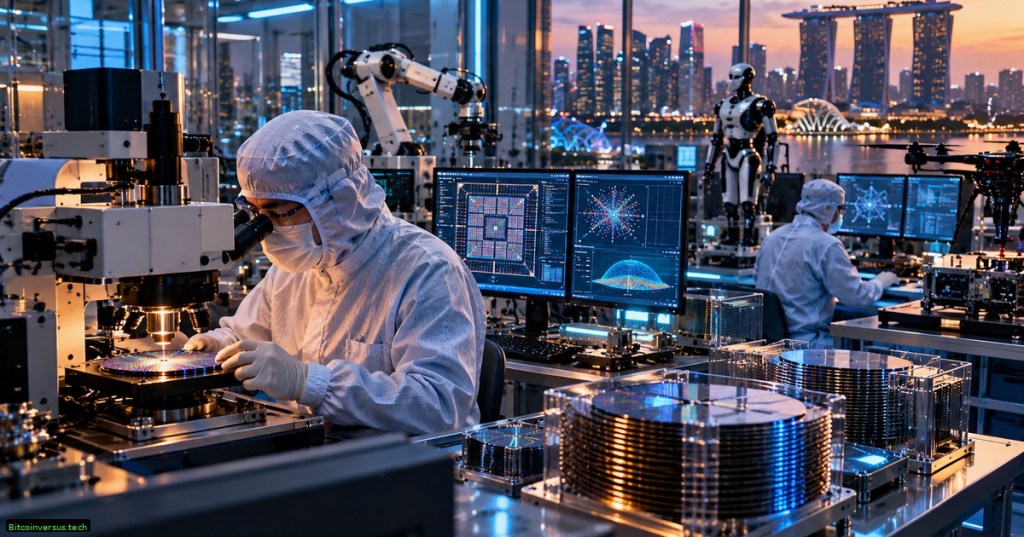
Singapore is pushing deeper into edge AI with a new four-year research lab built around one of artificial intelligence hardware’s hardest problems: moving data between compute and memory without wasting power.
STMicroelectronics and the National University of Singapore launched the ST–NUS HELIX Corporate Lab on August 24, 2026. NUS says HELIX stands for Hardware for Embodied Low-power Intelligent Xcceleration and will target generative and embodied AI that can run directly on compact, power-constrained hardware.
18nm FD-SOI Is the Hardware Base
ST is providing NUS with a dedicated design chassis built on its proprietary P18 18nm fully depleted silicon-on-insulator technology. FD-SOI supports ultra-low-power operation and adaptive body-biasing, letting engineers tune the tradeoff between performance and energy use.
The lab will span AI models, system architecture, heterogeneous accelerators, memory hierarchies, circuit design, chip integration and silicon implementation. That fits Singapore’s broader effort to deepen its semiconductor innovation ecosystem beyond manufacturing alone.
Phase-Change Memory Targets the Data-Movement Problem
HELIX will combine embedded phase-change memory with on-chip SRAM and study memory-centric architectures and in-memory computing. The goal is to reduce off-chip data movement, which can dominate energy consumption in memory-bound AI workloads.
That matters for embodied AI, where robots, humanoids and drones have to sense, decide and act in real time. BitcoinVersus has already covered humanoid systems that depend on fast local perception and control; HELIX is aimed at making that class of intelligence more efficient at the hardware level.
Singapore Is Building More of the AI Hardware Stack
Singapore is also expanding its role in high-end AI-chip substrates and advanced packaging and heterogeneous integration. HELIX adds architecture, memory and low-power silicon research to that stack.
In its official launch announcement, ST said the program is intended to move promising research toward scalable semiconductor solutions while building Singapore’s pipeline of engineers in AI systems and chip design.
The Bigger Point
The next generation of robots, drones and intelligent devices needs more AI capability without becoming too hot, too power-hungry or too dependent on the cloud. HELIX is Singapore’s attempt to solve that problem from the memory system outward.
BitcoinVersus.Tech
Advertisement
Editor’s Note
No project funding figure was disclosed in the two primary launch announcements reviewed for this story.
We volunteer daily to ensure the credibility of the information on this platform is Verifiably True. If you would like to support to help further secure the integrity of our research initiatives, please donate here: 3C9o19EH5HSiwEPyCTmEKzxhNCbo2X6TTb
BitcoinVersus.tech is not a financial advisor. This media platform reports on financial subjects purely for informational purposes.


Leave a Reply