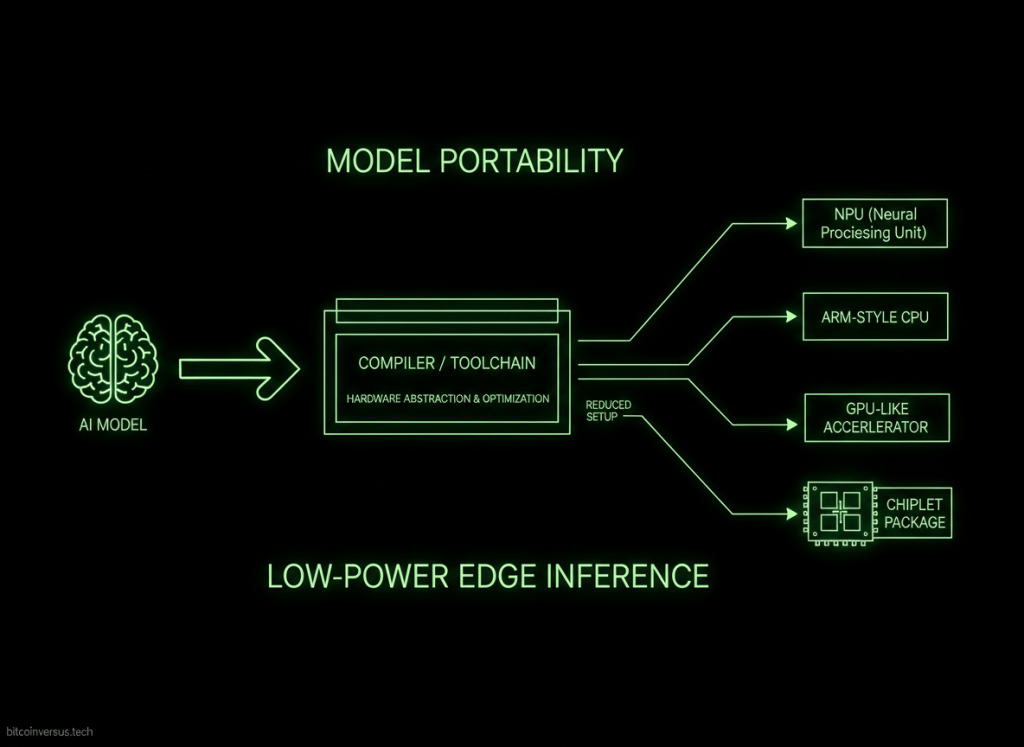
The hardest part of putting an AI model onto a new chip is often not buying the silicon. It is getting the model to run correctly on it.
Lola Vision Systems is building its business around that translation problem. The Washington, D.C.-based startup says engineers can spend roughly 200 hours getting an AI model configured for unfamiliar hardware before meaningful testing even begins. Its answer is a compiler toolchain designed to automate more of that work while the company develops its own edge-AI processor.
The bottleneck sits between the model and the chip
TechCrunch reported on October 5 that Lola Vision’s core software takes a customer’s code and AI model and translates them into instructions that a specific processor can execute. Founder and CEO Tayo Adesanya described the manual setup process as a major bottleneck, especially for teams trying to move models from development systems onto power-constrained edge hardware.
That problem is easy to underestimate. An AI model that runs well on one GPU, NPU, CPU, or accelerator does not automatically run efficiently on another. Operators still have to deal with memory layouts, supported operators, quantization, runtime libraries, preprocessing, kernels, power limits, and hardware-specific execution paths.
For mission-critical systems, simply getting a model to launch is not enough. Latency has to be deterministic, power draw has to fit the platform, and the output has to remain reliable enough for a vehicle, aircraft, drone, sensor, or defense system to trust it.
Lola is selling software before its own silicon arrives
The company does not have to wait for first silicon to generate revenue. Lola says its edge software stack can run on existing commercial hardware, allowing customers to license the toolchain before migrating to the company’s own processor later.
That sequencing matters for a semiconductor startup. Designing custom silicon requires substantial capital and long development cycles. A software layer can get Lola into customer workflows earlier, produce real deployment data, and potentially reduce the risk that its eventual chip arrives without a mature developer ecosystem.
TechCrunch says Lola has raised just over ₿11.68 ($1 million) to date, has one signed customer, and has received letters expressing interest from roughly a dozen companies that could buy its chips once available.
LVS-250 is a five-chiplet edge processor
On its current product roadmap, Lola describes the LVS-250 as a five-chiplet processor using UCIe 2.0 to connect neural compute, security, RF, beamforming, and MRAM functions inside one package.
The company lists approximately 230 TOPS of INT8 AI performance, less than 25 watts of power draw, a 35 mm package, GlobalFoundries 12LP+ manufacturing, integrated post-quantum security, and volume production targeted for 2027.
Those are company specifications for a product still on the roadmap, not independent production benchmarks. The more important near-term proof point is whether Lola’s software can deliver meaningful deployment gains on existing hardware before customers are asked to migrate to custom silicon.
The compiler can become the moat
Semiconductor startups often focus attention on TOPS, process nodes, memory bandwidth, or watts. Lola’s strategy highlights another competitive layer: the software that makes those specifications usable.
If a customer can move the same AI workload among NVIDIA, Qualcomm, ARM, RISC-V, or future Lola silicon without rebuilding the application each time, the compiler and runtime become a portability layer between models and hardware.
That can matter more as edge systems become heterogeneous. A drone might combine an NPU for vision, a CPU for control logic, a radio subsystem, secure memory, and specialized acceleration. The software stack has to decide where work executes and how data moves among those components.
Chiplets make that software problem even more important
Lola’s hardware roadmap fits a broader industry move toward modular silicon. BitcoinVersus.Tech recently covered SEMIFIVE and Mobilint building a robotics AI chip around LPDDR6 and UCIe-S, EdgeCortix unveiling its RAIDEN AI chiplet, and onsemi using the Synaptics acquisition to move deeper into edge AI.
As those systems become more modular, software has to abstract more hardware differences rather than fewer. UCIe can standardize how chiplets communicate electrically, but it does not automatically make an AI model portable across every compute block.
Edge AI is a deployment problem before it becomes a benchmark contest
The edge-AI market is crowded with impressive hardware claims. The practical winner may be the platform that lets engineering teams move a model from training to a reliable field deployment with the least friction.
If Lola Vision can materially compress a setup process measured in hundreds of engineering hours, the compiler may become the product that earns customer trust before the semiconductor does.
That is a useful inversion of the normal semiconductor story: instead of asking whether a startup can build a faster chip first, ask whether it can make many different chips easier to use — and then give customers a reason to choose its own silicon when it arrives.
BitcoinVersus.Tech
Advertisement
Editor’s Note
We volunteer daily to ensure the credibility of the information on this platform is Verifiably True. If you would like to support to help further secure the integrity of our research initiatives, please donate here: 3C9o19EH5HSiwEPyCTmEKzxhNCbo2X6TTb
BitcoinVersus.tech is not a financial advisor. This media platform reports on financial subjects purely for informational purposes.


Leave a Reply