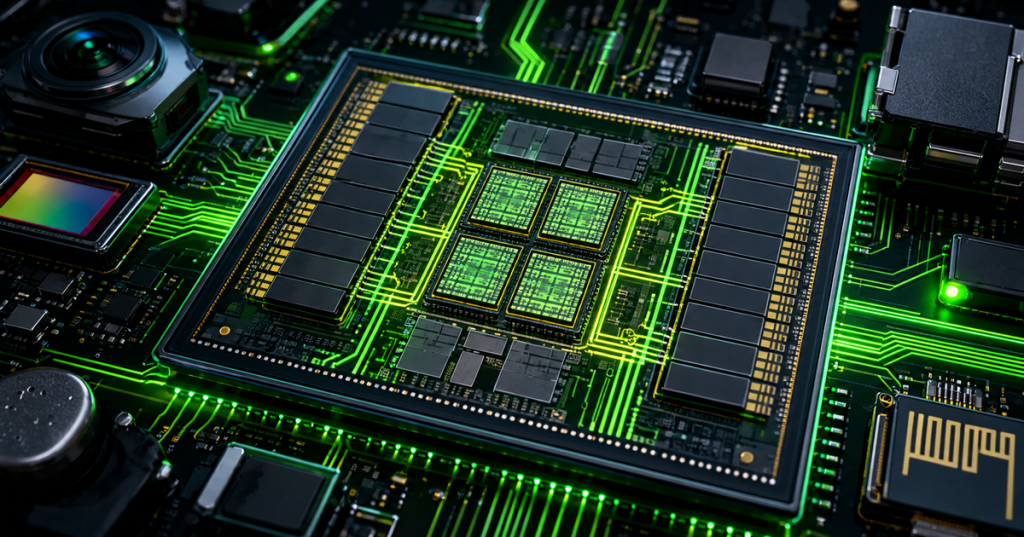
INTERA has launched EAGLE Cognit, a near-memory AI accelerator IP designed for low-power inference inside edge devices, sensors and next-generation system-on-chip designs.
The new accelerator is built around a simple idea: reduce the energy and latency wasted moving data back and forth between memory and compute. INTERA’s October 15 launch announcement says EAGLE Cognit supports configurable matrix-vector processing, numerical precision from 2 to 32 bits, and implementations with 4 or 16 processing elements, with architectural testing extending to 32 banks per processing element.
EAGLE also supports sparse computation and Spiking Neural Networks, alongside conventional CNNs and multilayer perceptrons. That makes the IP relevant to wake-word detection, event-driven sensing, wearables, predictive maintenance, radar perception and other always-on workloads where cloud inference can add latency, bandwidth cost or privacy concerns. SEMICON Europa’s official exhibitor listing independently describes the architecture as ultra-low-power, near-memory AI IP for TinyML and edge applications. The event listing also confirms the 4-to-16 processing-element range and 2-to-32-bit precision support.
The design fits a broader shift BitcoinVersus.Tech has been tracking toward smaller, more specialized AI hardware: Renesas is compressing models for industrial edge hardware, Singapore’s HELIX lab is combining FD-SOI with phase-change memory, and Lola Vision is attacking the software porting bottleneck.
The important point is that EAGLE Cognit is licensable semiconductor IP, not a finished consumer chip. Its value will depend on how efficiently customers integrate the block into real SoCs, how well the software toolchain performs, and whether near-memory execution delivers measurable power savings in deployed products.
BitcoinVersus.Tech Editor’s Note:
We volunteer daily to ensure the credibility of the information on this platform is Verifiably True. If you would like to support to help further secure the integrity of our research initiatives, please donate using the QR code provided

For best QR-code scanning results, please scan this donation code from a desktop or larger screen. Mobile screens may prevent camera recognition.


Leave a Reply