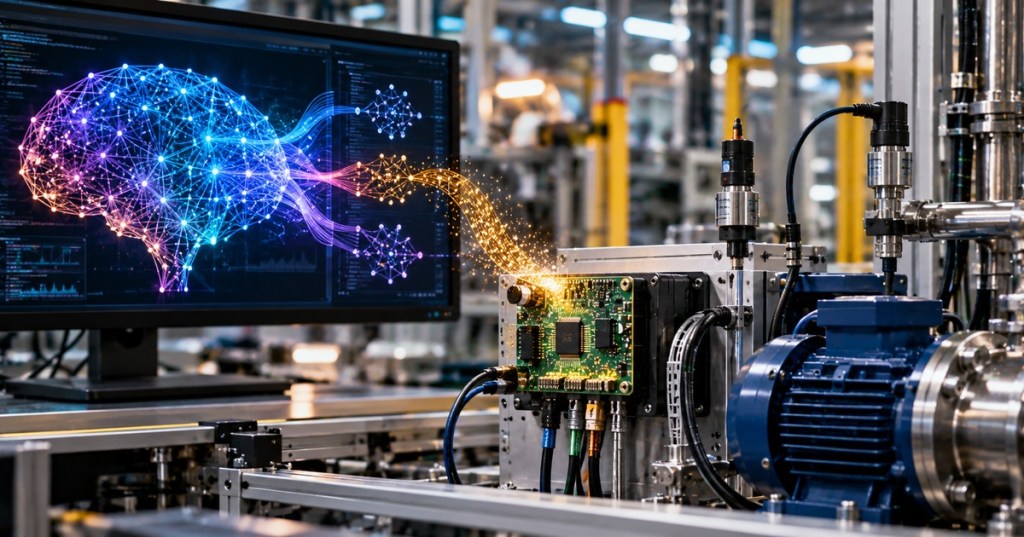
Renesas is pushing a familiar machine-learning technique into a much more constrained environment: industrial sensors, motor controllers and mixed-signal endpoints that may not have the memory, power budget or compute resources to run a large AI model locally. In an October 14 technical post, the company described how knowledge distillation can move useful behavior learned by a high-compute “teacher” model into compact “student” logic that executes directly beside the sensor.
The idea is simple in principle but important in practice. A large model can be trained during development on temperature, vibration, pressure, current, calibration history, known failures and other operating data. Engineers then reduce the useful decision behavior into a smaller form that the deployed device can actually execute. Renesas says that student behavior may become calibrated thresholds, gain or offset corrections, lookup tables, linearization curves, timers, counters, voting logic, state-machine transitions or local control rules.
This is not the same thing as forcing a miniature neural network onto every sensor. In the Renesas implementation model, the large model does the expensive learning work during development. The endpoint receives the distilled result: the smallest deterministic behavior needed to recognize a useful condition and react quickly.
Renesas demonstrates Reality AI predictive maintenance at the industrial edge, showing how machine-learning behavior can be deployed close to equipment rather than requiring continuous cloud analysis.
The teacher does the heavy learning
Knowledge distillation has been studied for years as a way to transfer useful behavior from a larger model or ensemble into a smaller model. The foundational 2015 work by Geoffrey Hinton, Oriol Vinyals and Jeff Dean described how knowledge from a cumbersome ensemble could be compressed into a single model that was much easier to deploy. The original distillation research focused on neural-network compression; Renesas is applying the broader teacher-student concept to a different systems problem: industrial endpoints where the final implementation may be a compact rule set rather than a conventional neural network.
That distinction matters because industrial control hardware often has to make bounded-time decisions. A pressure sensor may need to flag an overpressure condition. A motor controller may need to detect abnormal current behavior. A pump-monitoring circuit may need to qualify vibration or temperature changes before they become a fault. Those events cannot always wait for a high-level operating system, a cloud connection or a large inference pipeline.
At the device level, this is closely related to the concepts covered in BitcoinVersus.Tech’s microcontroller architecture lesson. Registers, interrupts and local peripherals exist precisely because embedded systems need direct, predictable interaction with hardware. Distilled AI behavior can become another source of local decision logic inside that architecture.
Why industrial edge AI cannot always look like cloud AI
Cloud AI can assume large memory pools, fast accelerators, high-bandwidth networking and enough electrical power to keep those systems running. A sensor endpoint may have none of those advantages. Its design priorities may instead be milliwatts, microseconds, electrical isolation, analog accuracy, long service life and predictable behavior.
Moving every raw measurement upstream also creates a data-movement problem. Continuous vibration, acoustic, current or pressure data can generate a large stream even when almost nothing interesting is happening. If the endpoint can determine locally that conditions remain normal, the system can send a compact status update instead of every sample. When a real anomaly occurs, it can interrupt the host, change a control output or begin higher-resolution logging.
This Renesas demonstration uses TinyML and Reality AI for sensorless predictive maintenance in an electric-motor system, an example of inference moving into firmware close to the physical equipment.
Renesas wants part of the decision loop in mixed-signal hardware
Renesas’ October 14 article goes beyond the usual MCU-only deployment model. The company argues that some distilled behavior can be implemented in configurable mixed-signal hardware positioned directly in the sensor signal path. Its AnalogPAK concept combines functions such as analog acquisition, programmable gain, analog-to-digital conversion, comparators, references, lookup tables, arithmetic resources, counters, timers, digital logic and serial interfaces.
That means a student device could acquire a signal, correct it, compare it against an adaptive threshold, require the condition to persist for a defined time window and then generate a hardware output or interrupt. The host MCU can remain responsible for communications, diagnostics and broader system policy while the endpoint performs the fast local qualification.
This partitioning can also reduce software burden. Firmware timing can vary because of interrupt latency, task scheduling and competing workloads. Designers already manage those interactions in real-time systems; BitcoinVersus.Tech’s RTOS synchronization and concurrency lesson explains why shared resources and timing behavior become harder as embedded software grows. Moving selected fault qualification into deterministic hardware can shrink the amount of software that must participate in the critical path.
An embedded-systems discussion focused specifically on deploying knowledge-distilled models to microcontrollers highlights the same practical constraints Renesas is targeting: memory, compute budget, vendor toolchains and the need to fit inference to the endpoint.
A motor-monitoring example shows the architecture
Renesas gives a motor-drive endpoint as a concrete example. During development, a teacher model could analyze winding temperature, phase-current behavior, load, ambient temperature, duty cycle and known fault cases. The development system identifies patterns that correlate with abnormal operation.
The deployed student does not need to preserve the entire teacher. Instead, it might apply a temperature-dependent gain correction, use a lookup table to compensate a sensor, compare the corrected measurement against load-dependent thresholds and require a suspicious condition to remain present for a defined number of samples. Only after that qualification would it assert a fault output or interrupt the MCU.
That is where “AI at the edge” becomes less about a marketing label and more about architecture. The original learning process can be computationally expensive. The deployed behavior can be intentionally small. Engineers still need to validate the distilled rules against real operating conditions, because compressing behavior is useful only when the smaller implementation preserves the decisions that matter.
The trade-off is flexibility versus determinism
A full neural model remains more flexible than a set of thresholds, tables and state rules. It can potentially represent richer nonlinear behavior and respond to combinations of inputs that were difficult to express manually. But that flexibility comes with compute, memory, software and validation cost. A distilled hardware implementation gives up some generality in exchange for a much smaller and more predictable execution path.
That trade-off is familiar throughout embedded engineering. A general-purpose processor can run many algorithms, while dedicated hardware does fewer things with tighter timing and lower overhead. Likewise, the instruction path described in BitcoinVersus.Tech’s Armv8-M architecture explainer ultimately reduces high-level software into operations the processor can execute. Knowledge distillation performs a conceptually similar reduction at the model-behavior level: retain the useful decisions while removing deployment complexity that the endpoint cannot afford.
Renesas’ AI Model Deployer demonstrates the other end of the edge-AI workflow: taking a trained model and preparing it for local object-detection and classification workloads on embedded hardware.
What is actually new here
Knowledge distillation itself is not new, and Renesas is not claiming to have invented it. The new engineering emphasis is where the student behavior can live. Instead of assuming that “edge AI” always means an NPU executing a compressed neural network, Renesas is describing a continuum that reaches farther toward the analog front end: the teacher can learn from rich data, while the student may become compact mixed-signal behavior directly adjacent to the sensor.
That could be useful in condition monitoring, industrial protection, battery systems, pumps, motors, actuators and other endpoints where most measurements are normal most of the time and the important job is to detect a meaningful change quickly and reliably. It may also reduce bandwidth and processor utilization because the endpoint can perform more interpretation before involving the host.
The limits need to stay clear. Renesas does not publish a universal accuracy improvement, latency reduction or power-saving percentage for this architecture. Those outcomes depend on the teacher model, sensor quality, distilled rules, endpoint implementation and specific industrial process. A compact student can also fail if operating conditions move outside the data used during development. Industrial deployment therefore still requires validation, fault testing, calibration and clear fallback behavior.
The larger edge-AI shift
The larger trend is that AI is spreading across several layers of a control system rather than living in one processor. Large models can help engineers discover patterns. Smaller models can perform local inference. Deterministic firmware can manage supervisory control. Mixed-signal hardware can qualify time-critical sensor conditions. The best partition depends on what must be learned, what must be flexible and what must happen within a guaranteed response window.
Renesas’ October 14 proposal is therefore less about shrinking a chatbot and more about turning learned behavior into industrial electronics. If the approach proves useful across real deployments, the most common form of edge AI may sometimes be almost invisible: a sensor interface or controller quietly applying rules that were learned elsewhere, making a decision locally, and sending the host only the information that matters.
BitcoinVersus.Tech Editor’s Note:
We volunteer daily to ensure the credibility of the information on this platform is Verifiably True. If you would like to support to help further secure the integrity of our research initiatives, please donate using the QR code provided

For best QR-code scanning results, please scan this donation code from a desktop or larger screen. Mobile screens may prevent camera recognition.


Leave a Reply