Elementary Overview
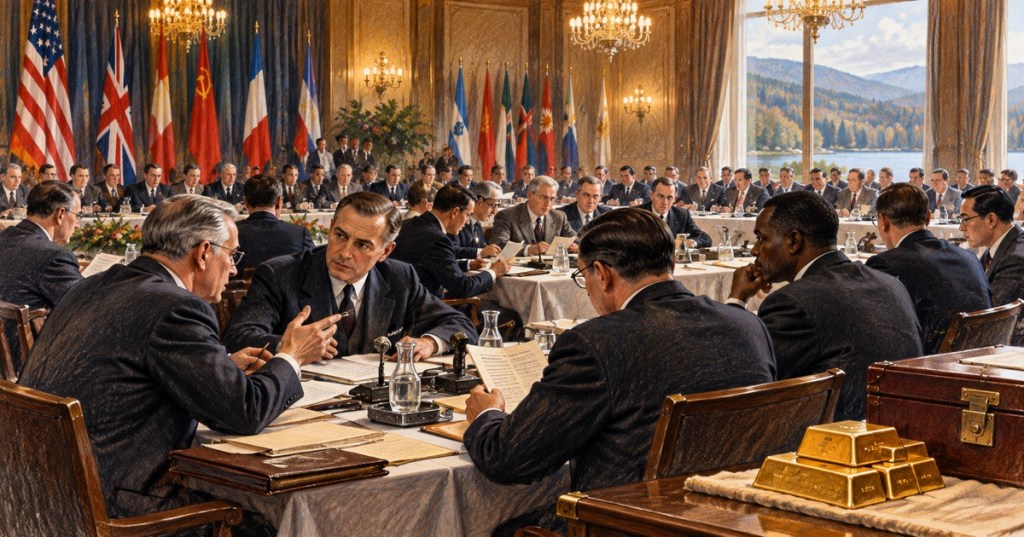
Bretton Woods was the post-World War II monetary system that placed the U.S. dollar at the center of international exchange while keeping the dollar tied to gold for official foreign holders. Delegates from 44 Allied countries met in Bretton Woods, New Hampshire, in July 1944 to design a system intended to reduce destructive currency competition, support reconstruction, and make international trade easier to finance. The agreement also created the institutional foundations for the International Monetary Fund and the World Bank.
This lesson follows OSHistory.006: The Gold Standard. Earlier lessons covered bank runs and the rise of central banking, ledger money and banknotes, standardized coinage, and commodity money.
What Bretton Woods Was Trying to Fix
The designers of Bretton Woods were reacting to the instability of the interwar period. The Great Depression, exchange controls, competitive devaluations, trade barriers, banking failures, and the collapse of earlier monetary arrangements convinced many policymakers that the postwar economy needed a more structured international framework.
The goal was not to restore the old gold standard exactly as it had existed before World War I. Policymakers wanted exchange-rate stability without forcing countries to respond to every balance-of-payments problem with severe domestic deflation. The resulting compromise became a system of fixed but adjustable exchange rates.
How the Dollar-Gold System Worked
Participating countries declared exchange-rate parities against the U.S. dollar. The dollar, in turn, was tied to gold at an official price of $35 per troy ounce. This did not mean every person holding a dollar could demand gold. The international convertibility commitment applied mainly to official foreign monetary authorities.
Member currencies were generally expected to remain close to their declared dollar parities, with adjustments possible when a country faced what the system called a fundamental disequilibrium. A central bank could buy or sell foreign exchange to keep its currency near the agreed rate instead of allowing the market price to float freely every day.
The system therefore created a chain: national currencies were linked to the dollar, and the dollar was linked to gold. Gold remained important, but the dollar became the practical settlement and reserve asset at the center of the network.

The IMF and the World Bank
The International Monetary Fund was created to support monetary cooperation, monitor the exchange-rate system, and provide temporary financial assistance to countries facing balance-of-payments problems. IMF resources could give a country time to adjust rather than forcing an immediate exhaustion of reserves.
The International Bank for Reconstruction and Development, which became the core of the World Bank Group, was created for reconstruction and long-term development finance. The institutions had different roles: the IMF focused more directly on monetary stability and short-term external financing, while the World Bank focused on reconstruction and development projects.
The IMF formally came into existence in 1945 and began operations in 1947. The exchange-rate system itself did not become fully functional overnight. Postwar controls and shortages remained important, and broad current-account currency convertibility among major European countries was not restored until 1958.
Why the Dollar Became So Important
The United States emerged from World War II with enormous productive capacity and a very large share of the world’s official gold reserves. War-damaged economies needed dollars to buy food, fuel, machinery, and other imports. That made the dollar unusually useful as an international settlement asset.
As trade expanded, foreign central banks accumulated dollar reserves. Those dollars could be used for international payments, held as reserves, or in principle presented by eligible official holders for U.S. gold at the official price. This arrangement helped make the dollar the central reserve currency of the Bretton Woods era.
The Built-In Tension
The system contained a difficult contradiction. The rest of the world needed a growing supply of dollars to finance expanding trade and build reserves. Supplying those dollars often required the United States to run international deficits. But the more dollar claims accumulated abroad, the more difficult it became to maintain confidence that official dollar holders could convert their holdings into gold at $35 per ounce.
This problem is commonly associated with economist Robert Triffin and is often called the Triffin dilemma. International liquidity depended on a reserve currency whose issuer could undermine confidence in that same currency by creating too many external claims relative to its gold stock.
Federal Reserve historical accounts note that by the early 1960s outstanding foreign dollar claims had grown large relative to U.S. gold reserves. The system could continue only as long as foreign governments remained confident enough to hold dollars rather than demand gold in large quantities.
Pressure Builds in the 1960s
During the 1960s, the United States continued to experience balance-of-payments pressure while inflation increased. Europe and Japan had rebuilt productive capacity and became stronger exporters. More dollars circulated outside the United States, while confidence in the official gold price became harder to preserve.
Governments tried several temporary solutions. The London Gold Pool attempted to support the official gold price. The United States adopted measures intended to slow capital outflows. The IMF created Special Drawing Rights as a new international reserve asset. These measures bought time, but they did not remove the underlying conflict between growing dollar liquidity and finite U.S. gold reserves.
The Gold Window Closes
On August 15, 1971, President Richard Nixon suspended the dollar’s convertibility into gold for foreign monetary authorities. The announcement is often called the Nixon Shock. It removed the central gold-convertibility promise that had anchored the Bretton Woods exchange-rate system.
The change did not instantly produce today’s monetary system. Governments attempted to preserve fixed exchange rates through the Smithsonian Agreement, which realigned major currency values and widened permitted trading bands. The arrangement soon came under renewed pressure, and by 1973 most major currencies had moved toward floating exchange rates.
The IMF later formally recognized a world in which members could choose different exchange-rate arrangements. Gold’s official monetary role diminished, while the dollar remained the dominant international reserve and settlement currency even without a fixed gold-conversion promise.
What Changed After Bretton Woods
- Major exchange rates increasingly floated according to market supply and demand rather than fixed dollar parities.
- Gold no longer served as the formal convertibility anchor of the dollar.
- Central banks gained more room to pursue domestic monetary policy, although exchange-rate and inflation tradeoffs remained.
- The IMF shifted from supervising a fixed-parity system toward broader surveillance, crisis lending, and international monetary cooperation.
- The U.S. dollar retained a central global role despite the end of official gold convertibility.
Practical Exercise
- Explain why Bretton Woods was not simply a return to the classical gold standard.
- Draw a simple chain showing a national currency linked to the U.S. dollar and the dollar linked to gold.
- Explain why the world needed more dollars as international trade expanded.
- Explain why issuing more dollars could weaken confidence in dollar-gold convertibility.
- Compare the roles of the IMF and the World Bank in the original framework.
- Describe what changed when the United States closed the gold window in 1971.
Knowledge Check + Answers
- What was fixed to gold? The U.S. dollar was officially convertible for eligible foreign monetary authorities at $35 per troy ounce of gold.
- Were all national currencies directly redeemable for gold? No. Participating currencies were generally pegged to the dollar, while the dollar provided the gold link.
- What did the IMF do? It supported international monetary cooperation and provided temporary assistance to countries facing balance-of-payments problems.
- What did the World Bank originally emphasize? Postwar reconstruction and long-term development finance.
- What was the Triffin dilemma? The world needed dollar liquidity, but accumulating too many dollar claims could undermine confidence in the United States’ ability to maintain gold convertibility.
- What happened in August 1971? President Nixon suspended the dollar’s official convertibility into gold, removing the system’s key anchor.
- Did the dollar stop being important afterward? No. The dollar remained the leading reserve and settlement currency even after gold convertibility ended.
Primary References
- International Monetary Fund — The IMF in History
- Federal Reserve History — Creation of the Bretton Woods System
- Federal Reserve History — Launch of the Bretton Woods System
- Federal Reserve History — Nixon Ends Convertibility of U.S. Dollars to Gold
- International Monetary Fund — Rethinking the International Monetary System
Elementary Conclusion
Bretton Woods replaced the idea of every major currency standing directly on gold with a layered system centered on the U.S. dollar. It gave the postwar economy more exchange-rate stability, created institutions that still shape international finance, and made the dollar the key reserve asset. But the system also depended on confidence that the United States could supply enough dollars for the world while still preserving the dollar’s gold promise. That tension eventually became impossible to manage, and the closure of the gold window in 1971 opened the path toward today’s mostly fiat, mostly floating international monetary system.
Editor’s Note
This lesson uses original artwork created specifically for OSHistory.007. The featured image is not reused in the body. Historical claims are grounded primarily in IMF and Federal Reserve historical records; interpretations of Bretton Woods remain debated among economic historians.
We volunteer daily to ensure the credibility of the information on this platform is Verifiably True. If you would like to support our research initiatives, please donate here: 3C9o19EH5HSiwEPyCTmEKzxhNCbo2X6TTb
BitcoinVersus.Tech content is provided for informational and educational purposes.


Leave a Reply