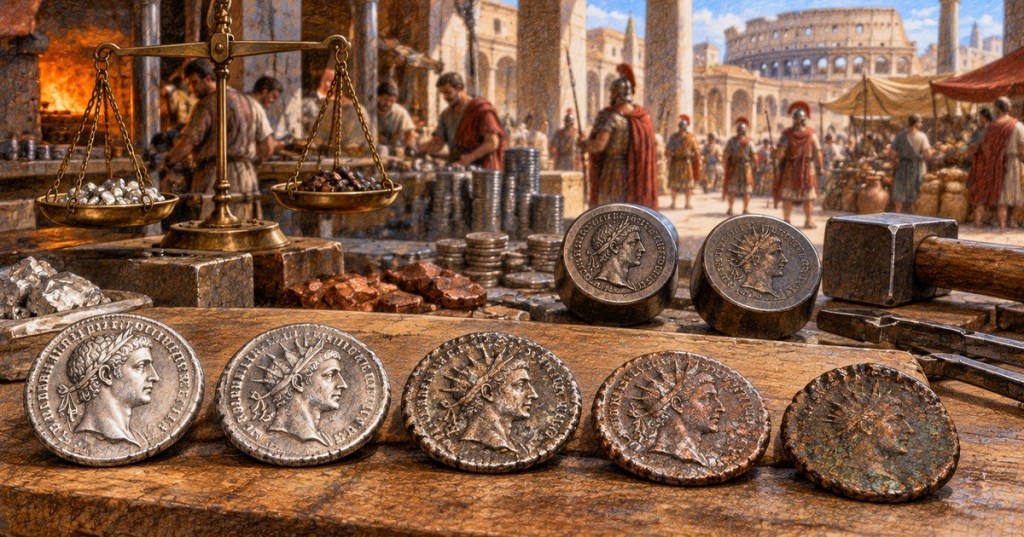
Rome’s third-century monetary crisis was not caused by one bad coin or one emperor. It emerged from a long interaction among military spending, political instability, declining silver content, rising mint output, disrupted confidence, regional fragmentation, and changing prices. The surviving coins make that process unusually visible because the money itself changed physically over time.
This lesson follows OSHistory.010: Mesopotamian Debt Crises and Debt Forgiveness. The earlier lesson examined ancient credit stress. OSHistory.011 moves into a different kind of monetary disruption: a state repeatedly changing the metal content and structure of its coinage during fiscal and political crisis.
Classical Numismatics introduces the Roman imperial denomination system and the relationship among gold, silver, and bronze coinage.
Elementary Overview
A metal coin can have two kinds of value at once. It can be worth something because the government says it is money, and it can also contain valuable metal. Roman emperors sometimes reduced the amount of silver in coins while continuing to issue them at the same or higher face value. That let the state stretch its silver farther, but repeated reductions became part of a much larger monetary problem when war, taxation, political instability, and rising prices were already putting pressure on the empire.
Learning Objectives
- Explain the difference between coin weight, metal fineness, and face value.
- Describe the denarius and the later antoninianus.
- Explain why debasement could increase the number of coins minted from a fixed quantity of silver.
- Distinguish debasement from inflation rather than treating them as identical.
- Connect military and political instability to monetary pressure during the third century.
- Explain why archaeological coins are evidence, but not a complete price index.
- Describe the reform efforts of Aurelian and Diocletian.
- Avoid the oversimplified claim that debasement alone “destroyed Rome.”
The Denarius Before the Crisis
The silver denarius became one of Rome’s most important monetary units. Its weight and fineness changed across centuries, but for long periods it served as a widely recognized silver denomination across the empire. Roman money also included gold and base-metal denominations, so the monetary system was never simply “one silver coin.” Exchange relationships among denominations, taxes, army pay, market prices, and regional practices all mattered.
Classical Numismatics traces the denarius from its earlier history through its decline as a major silver denomination.
What Debasement Means
Debasement means reducing the precious-metal content of a coin relative to an earlier standard. This can happen by lowering the coin’s weight, reducing its silver or gold fineness, or both. If one kilogram of silver previously produced 300 coins, a lower-silver standard might allow the mint to produce more nominal units from the same metal supply. That can increase state revenue from minting, especially when the government must meet large immediate expenditures.
Debasement does not automatically produce an equal percentage increase in prices. Prices depend on monetary supply, demand for money, taxation, production, trade, confidence, war, regional conditions, and how quickly people change the value they assign to the coins. This distinction matters because Roman debasement began long before the most dramatic third-century price instability.
The Antoninianus Changed the System
Emperor Caracalla introduced the antoninianus in the early third century. It was tariffed above the denarius, but its precious-metal content did not rise proportionally with its face value. As the century progressed, the antoninianus itself was repeatedly reduced in silver content. By the middle of the third century, researchers find increasingly base-metal coins with a silver-rich surface layer rather than a solid high-silver alloy.
Materials research published through Cambridge describes severe third-century debasement and notes that by around AD 250 the production of complex copper-alloy coins with a silvered surface had become common. That physical evidence matters because it shows that the deterioration in intrinsic metal content was not merely a later literary claim; it survives in the metallurgy of the coins themselves.
Why the Third Century Was Different
The empire’s monetary system came under unusual pressure during the third century. Emperors faced repeated civil wars, frontier threats, rapid changes of ruler, large military payrolls, and fragmentation of political authority. Cambridge historian Constantina Katsari describes a system in which repeated silver debasements and the overvalued antoninianus helped increase mint output while political instability undermined the stability of the monetary economy.
Historian Garrett Ryan explains the relationship among Roman fiscal pressure, debasement, inflation, and third-century political instability.
Coins Show the Change Physically
The British Museum preserves third-century radiates that illustrate the transition. One Valerian II radiate dated roughly AD 255–258 is catalogued as silver, while a Gallienus radiate dated AD 260–268 is catalogued as copper alloy. Individual museum objects do not by themselves define the entire empire’s standard, but collections allow researchers to compare weight, composition, mint, ruler, chronology, and regional circulation.
An AskHistorians discussion raises the important distinction between metal content, nominal value, monetary expansion, and the actual economic mechanism connecting debasement to price changes.
Inflation Evidence Must Be Read Carefully
Roman price evidence is uneven. The Bank of England has cited the late Roman episode as one of the earliest documented inflationary periods and noted a very large increase in wheat prices between the second and third centuries. That does not mean every Roman price rose at the same rate or that one empire-wide consumer-price index can be reconstructed. Surviving papyri, inscriptions, coin finds, military pay records, tax records, and legal texts cover different regions and periods.
The safest conclusion is that substantial monetary instability and rising prices occurred, particularly during the third-century crisis, while the exact timing and causal weight of debasement differed across regions and commodities. Debasement was part of the crisis, but plague, war, political fragmentation, taxation, production shocks, military demand, and trade disruption also mattered.
Aurelian and Diocletian Tried to Restore Order
Emperor Aurelian attempted monetary reform in the 270s after reuniting much of the fractured empire. Diocletian later introduced a broader coinage reform beginning in the 290s. These reforms changed denominations and standards in an effort to rebuild a more usable monetary system. Reform itself could be disruptive because old coins, new tariffs, taxes, and expectations had to be reconciled.
This long-form monetary history places third-century debasement and inflation within the wider evolution of the imperial Roman economy.
Diocletian’s Maximum-Price Edict
In AD 301, Diocletian and his co-rulers issued the Edict on Maximum Prices. Surviving fragments list maximum prices and wages across a large number of goods, services, and occupations. The edict’s preamble blamed excessive prices on greed and profiteering. Modern historians use the document as evidence for severe price pressure and state intervention, while also debating its intent, enforcement, geographic reach, and effectiveness.
The edict is especially useful as a warning against simple historical narratives. A government can observe high prices without correctly identifying every cause, and a price-control law can tell historians that officials perceived a problem without providing a complete explanation of the monetary system that produced it.
Did Debasement “Destroy Rome”?
No single-variable explanation is strong enough. The western Roman Empire did not disappear in the third century, and monetary reforms continued for centuries. The Crisis of the Third Century was followed by political reunification, administrative reform, new coinage, and later monetary systems built around different denominations. Debasement contributed to monetary instability, but it should be studied alongside military expenditure, political succession, taxation, disease, frontier pressure, regional fragmentation, and changes in production and trade.
The more defensible historical lesson is narrower: when a state repeatedly changes the precious-metal content and supply of its money during a period of fiscal and political stress, nominal prices and public confidence can become harder to interpret. Coins then become not just money, but physical records of the pressures facing the state that issued them.
Research Exercise
Choose three Roman coins from different points in the second and third centuries. Record ruler, date, denomination, weight, metal classification, mint, and museum catalogue source. Then compare those objects with one surviving price or wage source from the same broad period. Explain which conclusions can be supported directly and which would require broader evidence.
Next, write a short causal diagram linking fiscal pressure, military spending, mint output, debasement, confidence, prices, taxation, and political instability. Mark every arrow as either directly documented, strongly inferred, or uncertain. The purpose is to practice historical causation without turning correlation into proof.
Knowledge Check
- What does coin debasement mean?
- Why could debasement let a government mint more nominal currency from the same amount of silver?
- Why are debasement and inflation not identical?
- What was the antoninianus?
- What physical evidence shows severe third-century debasement?
- Why was third-century political instability important to the monetary crisis?
- What did Aurelian and Diocletian attempt to do?
- What was Diocletian’s Edict on Maximum Prices?
- Why can no single surviving coin prove an empire-wide inflation rate?
- Why is “debasement destroyed Rome” too simple?
Answers
- Reducing a coin’s precious-metal content relative to an earlier standard by lowering fineness, weight, or both.
- Less precious metal per coin allows a fixed metal stock to be divided into more coins.
- Inflation is a change in the general price level; debasement is a change in coin composition. One can influence the other without being mechanically identical.
- A Roman denomination introduced under Caracalla and later heavily debased during the third century.
- Metallurgical analysis and surviving coins show increasingly base-metal compositions with silvered surfaces.
- Repeated civil war, frontier pressure, rapid changes of emperor, military payrolls, and fragmented authority increased fiscal and monetary pressure.
- They introduced monetary reforms intended to restore a more stable and usable coinage system.
- An AD 301 law setting maximum prices and wages for a large range of goods and services.
- One object documents one minting event; economy-wide claims require large samples plus price, wage, tax, and circulation evidence.
- Rome’s crisis involved military, political, epidemiological, fiscal, production, trade, and monetary forces, and the empire continued after the third century.
Elementary Conclusion
The simple version is: Rome kept changing what its silver money was made of while the empire was under enormous pressure. The coins became less silver-rich, prices became less stable, and governments tried several reforms. But the coins did not act alone. They are one of the clearest physical clues showing how military, political, and monetary problems became connected during the third-century crisis.
Previous Related Lessons
- OSHistory.010: Mesopotamian Debt Crises and Debt Forgiveness
- OSHistory.009: Inflation, Money Supply, and Purchasing Power
- OSHistory.003: Standardized Coinage
- OSHistory.002: Commodity Money
Primary and Scholarly References
- British Museum — Valerian II radiate, AD 255–258
- British Museum — Gallienus radiate, AD 260–268
- Cambridge — Experimental Investigation of Silvering in Late Roman Coinage
- Cambridge — The Roman Monetary System: Third-Century Economics
- Fordham Internet History Sourcebooks — Diocletian’s Price Edict, AD 301
- Bank of England — Inflation Theories Through the Ages
BitcoinVersus.Tech Editor’s Note:
We volunteer daily to ensure the credibility of the information on this platform is Verifiably True. If you would like to support to help further secure the integrity of our research initiatives, please donate using the QR code provided

For best QR-code scanning results, please scan this donation code from a desktop or larger screen. Mobile screens may prevent camera recognition.
BitcoinVersus.Tech provides technical education and analysis for informational purposes only.


Leave a Reply