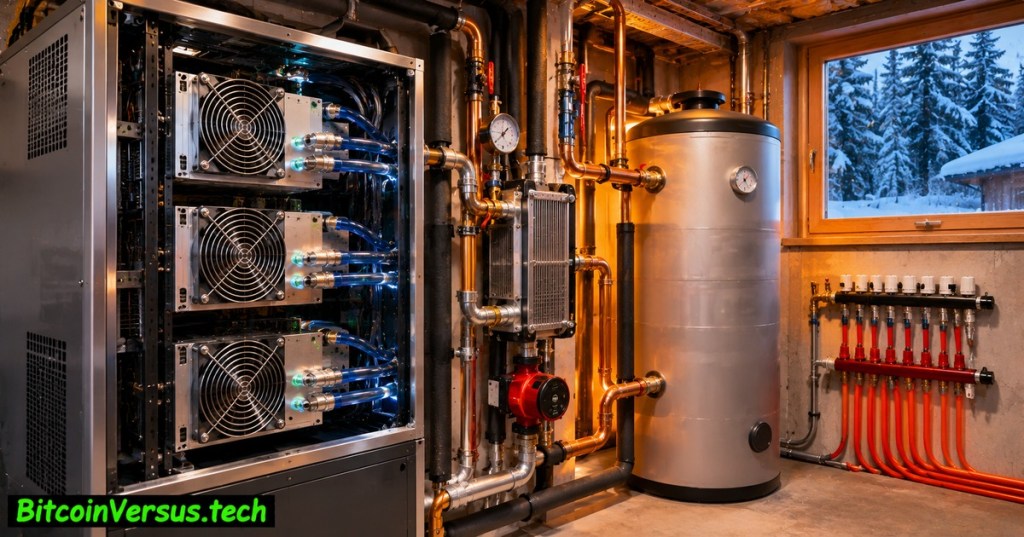
Thirty buildings now use Finnish startup SunBit’s Bitcoin mining heat systems, according to founder Elmeri Suomi’s November 8, 2026 interview with CoinDesk. One 180-square-meter home in Nokia disconnected from district heating entirely, replacing it with a liquid-cooled Bitcoin Boiler and separate hot-water tank. The installations offer an appealing engineering proposition: mine Bitcoin while recovering heat that conventional ASIC operations would normally reject outdoors.
A more difficult question is whether the economics survive Bitcoin’s next block-subsidy halving, expected in 2028. Even when the heat is useful, running mining hardware consumes electricity, and mining income fluctuates with Bitcoin’s price, network difficulty and fees. SunBit’s 30-system figure is a company-reported deployment count, not an independently audited census.
Independent February 2026 documentary by Joe Nakamoto showing mining heat recovery in Finland. Archival footage illustrates district-heating systems, not all 30 SunBit installations. Watch the original video.
How a Bitcoin boiler turns electricity into hot water
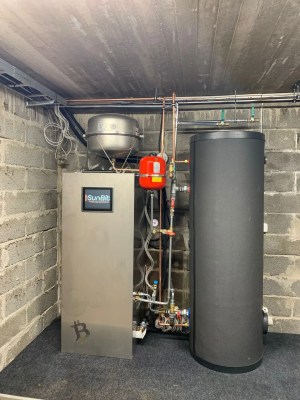
According to SunBit’s technical explanation, one liquid-cooled mining unit consumes approximately 5.3 kilowatts. A boiler holds two units, providing up to 10.6 kW of heat. Its water loop can reach 60°C, connecting to hydronic radiators, floor heating or domestic hot-water storage. Remote controls adjust mining activity to electricity prices and equipment conditions.
At a constant 5.3 kW, a single unit would consume about 46,428 kWh annually (5.3 × 8,760 hours). Nearly all electricity eventually becomes heat, but not all heat necessarily enters the building. Excess output can be expelled through an outdoor dry cooler. A conventional heat pump can deliver approximately 2.5–3 kWh of heat per kWh of electricity, so the mining boiler competes through cryptocurrency revenue rather than superior thermal efficiency.
A 180 m² house, an industrial hall and the limits of free heat
The manufacturer’s case studies show different deployment models. In Kotka, a 200 m² home retained its oil boiler as backup. In Vimpeli, a 3,000 m² industrial hall combines mining heat, an oil system and an air-to-water heat pump, while a 30 kW solar array can supply surplus electricity. The company also describes an installation in the Netherlands.
CoinDesk reported a modeled annual electricity expense near $5,200 for one 5.3 kW unit, against approximately $6,100 in annual Bitcoin receipts after SunBit’s service charge under the company’s assumptions. The roughly $900 difference comes before equipment depreciation, maintenance and financing. A quoted installed system starts around $20,000, while SunBit advertises three to six years of payback under favorable conditions.
Finnish-language video interview featuring SunBit founder Elmeri Suomi, covering Bitcoin mining waste-heat technology. Archival discussion, not a measured audit of the November installation count. Watch the original video.
The 2028 halving changes the projected heating bill
Bitcoin’s current subsidy of 3.125 BTC per block is scheduled to fall to 1.5625 BTC at the next halving. At unchanged network hashrate, transaction fees, hardware output and market conditions, a miner would receive substantially fewer new coins. CoinDesk’s sensitivity analysis estimated that SunBit’s modeled electricity-offset economics would require Bitcoin above roughly $131,000 following the halving. The threshold is a conditional scenario, not a price forecast or universal break-even point.
SunBit’s publicly available calculator does not incorporate the 2028 event into its standard payback estimate. Bitcoin’s market price might rise, but competitors can also add more efficient ASICs, reducing each machine’s share of rewards. Our earlier Finland mining-heat coverage and 2026 heat-reuse roundup documented the broader opportunity.
Can heating become part of the mining business model?
Heat reuse offers a useful outlet for some energy that would otherwise be wasted, particularly where buildings already have hydronic plumbing and substantial winter demand. Competing concepts include Heatbit’s household water heater and BITMAIN’s larger hydro-mining racks. Heating requirements, local electricity tariffs, coolant maintenance and summer heat rejection all affect viability.
For homeowners, the appropriate comparison is total lifetime heating expense, including mining income, electricity, installation, repairs and alternative equipment. The boilers keep producing warmth even when Bitcoin mining becomes unprofitable. Whether that warmth is affordable remains a separate, measurable question.
Primary sources and method
Sources: SunBit product specifications and installation case studies; CoinDesk, November 8, 2026. The deployment count and payback figures are company claims cited by the reporting, while the 2028 Bitcoin threshold is a scenario based on fixed assumptions.
Reporting Note: The photorealistic featured cover is an original conceptual illustration, not an actual SunBit utility room. The in-story installation photograph comes from SunBit’s official case study. The videos are historical technical context and should not be read as verification of current customer economics. Bitcoin mining and heating economics are subject to substantial uncertainty.
Editor’s Note: We volunteer daily to ensure the credibility of information on our platform is Verifiably True. Support our research by scanning the QR code below to donate 5,000 sats.

For mobile scanning, open the article on another display and scan the QR code with a Bitcoin wallet. Verify receiving address 3C9o19EH5HSiwEPyCTmEKzxhNCbo2X6TTb before sending.
BitcoinVersus.tech provides technical and financial journalism for informational purposes only and does not provide investment, legal or cybersecurity assurance.


Leave a Reply