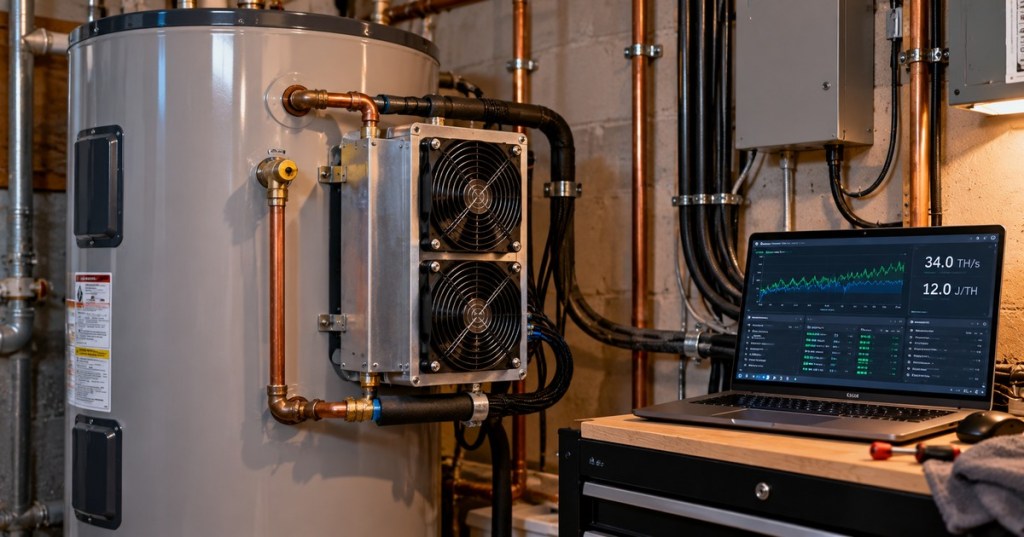
October 22, 2026. Heatbit has introduced Bitwater, a retrofit heating element designed to mine Bitcoin while warming water in an existing residential electric tank. The company opened preorders today and targets first deliveries in the first quarter of 2027. The idea is to put specialized SHA-256 computation in place of some conventional resistive heating, then use the resulting thermal energy for a household task.
What Heatbit Announced
Heatbit advertises up to 34 terahashes per second (TH/s) at 12 joules per terahash (J/TH). Multiplying those values yields approximately 408 watts of ASIC electrical demand at the stated operating point. The company says Bitwater can heat water without increasing the electricity required for comparable heating. These are manufacturer specifications and claims; independent measurements of real installations, total system power, heating recovery rate and uptime have not yet been established.
Polymarket’s October 22 post about the newly announced Bitcoin-mining water heater. The post is the social discovery lead; technical claims are checked separately.
How Can a Miner Heat Water?
Nearly all the electricity consumed by a mining ASIC ultimately becomes heat. In a conventional mining facility, cooling infrastructure moves that heat away from the chips. A heat-reuse system instead transfers it into water. Unlike a conventional resistance element, the ASIC performs Bitcoin proof-of-work computations while consuming the electricity that becomes heat. The useful heat is not free energy; the potential additional value comes from mining rewards earned during heating.
The key operational question is how long the device actually runs. A water heater controlled by a thermostat may stop drawing power once its setpoint is reached. If Bitwater runs only during heating demand, its average daily hashrate and mining income will be lower than continuous 34 TH/s operation. Recovery speed, compatibility, installation cost, tank safety, and any auxiliary heaters also matter.
Why 12 J/TH Matters
At 12 J/TH, Bitwater’s announced ASIC efficiency is competitive with many dedicated miners, although the specification is not an independent benchmark. This adds another example to BitcoinVersus.Tech’s continuing research on ASIC power efficiency and the path toward 1 J/TH. A water heater does not change the fundamental J/TH of its chips; it changes the economic usefulness of their heat.
Not the First Bitcoin Water Heater
The category predates Bitwater. Superheat demonstrated its H1 mining water heater at CES 2026 and later offered H1C preorders. Its approach integrates mining hardware with a water-heating appliance rather than replacing an element in an existing tank. That distinction could affect installation requirements and retrofit costs.
Vortex Bitcoin’s January 2026 demonstration of the competing Superheat H1, not Heatbit Bitwater. Included as a visual explanation of the mining-to-water heat-reuse concept.
Community discussion of Heatbit’s announcement includes questions about tank recovery times, payback and whether mining operates continuously.
The Economics Still Need Testing
Heatbit’s promise is not that Bitcoin mining eliminates electricity costs. A resistive electric heater and an ASIC heater both convert electrical energy into thermal energy, but Bitcoin rewards may offset part of the cost of energy already needed for hot water. Profitability depends on the product’s upfront price, network difficulty, BTC price, pool fees, maintenance, and daily heating runtime. It also depends on the baseline: heat pumps can produce more delivered heat per kilowatt-hour than resistance heating, making direct comparisons especially important.
Key Takeaways
- Heatbit announced Bitwater on October 22, 2026, with preorders open and Q1 2027 deliveries targeted.
- Advertised performance is 34 TH/s at 12 J/TH, implying approximately 408 W at that operating point.
- Bitcoin rewards could offset some water-heating expense, but the company has not demonstrated guaranteed household savings.
- Bitwater joins a growing market for mining-powered home heating, including Superheat’s earlier products.
Sources
Heatbit — official explanation of mining-based heating · Bitwater launch report and specifications · Superheat’s earlier water-heater announcement
BitcoinVersus.Tech Editor’s Note: We volunteer daily to ensure the credibility of the information on this platform is Verifiably True. If you would like to support to help further secure the integrity of our research initiatives, please donate using the QR code provided

For best QR-code scanning results, please scan this donation code from a desktop or larger screen. Mobile screens may prevent camera recognition.


Leave a Reply